BlogPoll Ballot Week 11, Mo Money, Mo Texas and Return of the WAC

Some thoughts as we head into the weekend:

(1) Mr. Numb Existence – Somehow, I ended up with the Mr. Numb Existence Award this week in the BlogPoll that’s given to the pollster with the individual ballot closest to the overall result.  This occurred even though I deviated from the overall poll almost immediately by putting TCU at #2 instead of Auburn.  Regardless, and I say this as someone that has long been skeptical about the top-to-bottom quality of the non-AQ conferences, but TCU can and will pretty much kick the crap out of everyone this season.

(2) Mo Money, Mo Texas – Shortly after posting this generally blase post about the initially underwhelming projected financial figures for the Longhorn Sports Network, our good friend Chip Brown from Orangebloods.com reported that ESPN came in with a bid to pay Texas $12 million per year, which is a massive game-changing number on its face.  This swung the pendulum in the public eye from “Why did Texas do this?” to “Texas could almost afford to pay Cam Newton if it wanted to”.  The one reservation people should keep in mind is whether this $12 million per year includes radio and other media rights, as well, which this Austin American-Statesman article intimates.  If that’s the case, then the $12 million figure isn’t necessarily that crazy.  Ohio State’s radio and multimedia rights deal with IMG and RadiOhio is worth an average of $11 million per year, which is all on top what the Buckeyes receive from the Big Ten TV contracts.  It’s unclear how the ESPN arrangement will interplay with the Texas deal with IMG, which is the primary multimedia rights holder for the school and is running the search for the Longhorn Network partner.

A question that I’ve been continuously getting is, “Why would ESPN be willing to pay so much for maybe one Texas football game per year and a handful of non-conference basketball games?”  Well, one has to consider that since the Big Ten Network has been formed, ESPN has been overpaying for college sports in large part to prevent other conference networks from coming to fruition.  Those networks represent extra competition to the Mothership itself along with taking away properties from its ESPN Regional syndication arm.  The Worldwide Leader had to pay both the SEC and ACC hundreds of millions of dollars in Godfather offers in order to keep them bolting to competitors and starting their own networks.  In contrast, ESPN has just destroyed the chances of a Big 12 network ever forming by paying a mere $12 million per year to Texas.  When you look at it that way, $12 million is a complete bargain compared to what ESPN had to ward off potential competition from the SEC and ACC.

(3) Return of the WAC – Oh, poor WAC.  This summer, it looked like it might nab BYU for non-football sports and possibly start a chain reaction where the Mountain West would start crumbling and the WAC could pick up the pieces.  Instead, the MWC embarked on its own smack-down raid by grabbing Nevada and Fresno State on top of conference headliner Boise State and BYU ended up taking its non-football programs to the WCC, which left the WAC wondering if it would even have enough members for a football conference in 2011.  It’s been a rough go-around for a non-AQ conference that has sent its champion to BCS bowls 3 out of the last 4 years.

At least the WAC will receive a reprieve with Nevada and Fresno State agreeing to stay until 2012, which is when replacements Texas State and the University of Texas-San Antonio come in for all sports and hockey/skiing power Denver joins as a non-football member.  Rejection was still in the air for the WAC, though, as Montana declined an invite.  (Note that Texas State, UTSA and Montana are all currently FCS schools, so the new WAC members will be moving up to the FBS level.)

Also, as discussed by a number of commenters, Hawaii is possibly the next most likely school to declare independence with a possible home for non-football sports in the Big West.  I vacillate back-and-forth as to whether it’s a good idea for Hawaii to become an independent.  In theory, it ought to be able to fill out its football schedule because of the extra game exemption provided by the NCAA, but we have already seen the Big Ten schools essentially abandon playing  in Honolulu because of a combo of high costs and the desire to play more home games.  As more BCS leagues go to 9-game conference schedules, Hawaii is going to face more challenges scheduling AQ teams than before.   Finally, who knows whether the Big West schools are really going to be willing to shoulder the costs of sending non-football sports to the Honolulu, which means that Hawaii might need to hold onto its relationship with the WAC.  On the other hand, Hawaii is uniquely attractive to a network like ESPN because its home games fit perfectly into late-night time slots on the mainland.  Thus, it’s possible for Hawaii to get a BYU-type TV deal in place, which would make it more than worth it financially to become independent.

It appears that the conference realignment game will see the most action at the non-AQ level for the next few years besides an addition or two by the Big East… unless it decides to follow one of my “modest proposals” for the league that I’ll present next week.  Until then, have a great weekend with Illini-Gopher football, Illini-Saluki basketball, Derrick Rose vs. John Wall and hopefully Julius Peppers decapitating Brett Favre.

BYU Independence Day and How It Helps the BCS Conferences

While the realignment action at the BCS conference level has come to a standstill, BYU is aiming to be a next-tier combination of Notre Dame and Texas and possibly causing a massive upheaval at the non-AQ level with its reported proposal to become a football independent and become a member of the WAC for all other sports.  (The Salt Lake Tribune is calling this a “done deal”.)  If BYU pulls the trigger on going independent, I believe that it would be a brilliant move for the school and, interestingly enough, a great opportunity for the BCS conferences.

BYU has long been one of the most interesting potential players in the college conference realignment story.  From a pure financial and fan base perspective, BYU should’ve been invited to a BCS conference many years ago.  The Cougars sell out every home game, travel en masse to bowl games, and garner a national TV audience with LDS members.  Political factors, though, have killed BYU’s chances of getting into the Pac-10 (as the California-based schools have a myriad of issues where it has clashed with LDS positions) and its no-playing-on-Sunday rule has been a nagging problem for other conferences.  With its in-state rival of Utah heading down the yellow brick road to BCS AQ status in 2011 and the Big IIX unlikely to expand for several years, BYU has been at risk of getting left behind.

Count me in as someone that believes that BCS AQ status is far from a sure thing for the Mountain West Conference.  If there is a way for the other BCS conferences to avoid inviting in the MWC, it will absolutely exploit it – they have ZERO desire to give up $18 million per year and an at-large BCS bowl slot.   If BYU’s leadership has been evaluating everything realistically, they have realized that this is the case and came to the conclusion that if it wants any reasonable chance of becoming one of the insiders to the BCS, it would need to become independent.

Is BYU on the level of Notre Dame in terms of casual fan popularity?  Of course not.  However, BYU has an asset that no other school in the entire country has (and what Texas has banked its entire future upon creating): its own television network.  This isn’t some type of fly-by-night operation.  BYU-TV has a state-of-art studio, the most advanced HD live event production truck in the entire Western half of the United States, 60 million U.S. subscribers (including every single DirecTV household) and 40 million subscribers outside of the U.S. While I have never actually watched BYU-TV and presume that its programming lineup currently consists of telecasts of church services, stories of mission trips, a reality TV show featuring Jim McMahon visiting and reviewing every single bar in Chicago, and the Steve Young edition of “The Bachelor”, the key point is that BYU already has a ready-made and widely distributed cable TV platform to take its sports properties in-house.  My understanding is that BYU makes approximately $1.5 million per year from the current MWC TV deals.  That is a fairly low threshold to cross if the school turns BYU-TV into a revenue generator for sports events (currently, the network relies on donations and subscriptions similar to PBS) since it has 100 million international households already in the fold.  This isn’t even counting the fact that ESPN or another network would likely be willing to pay a premium for BYU’s top games.  If Army and Navy can strike deals on their own with national networks, there’s no reason that BYU wouldn’t be able to do it even better.

That’s all fluff compared to the big picture, though.  Maybe it’s because I have spent my entire life (other than my college years in Champaign) living and/or working in Cook County, but when Slant reader loki_the_bubba posted the initial rumors about this BYU story last night, my immediate thought was this: “Political payoff.” As we all know, this is perfectly legal under Federal law.

There seems to be this growing assumption that an independent BYU won’t be able to receive the same type of preferential treatment from the BCS system as Notre Dame does today.  However, I vehemently disagree with this notion, and it has little to do with college football games themselves and everything to do with Capitol Hill.  Which politician has spent more time bashing the BCS system, calling for hearings on the issue and demanding regulation more than any other?  Senator Orrin Hatch (R-Utah).  What school did Sen. Hatch attend?  Brigham Young University.  Let’s list out the potential scenarios:

SCENARIO A: BYU stays in the MWC.  In 2 years, the MWC meets the BCS AQ numerical criteria and the BCS conferences decide to let the conference into the party.  This means that the BCS conferences have to give up at least $18 million per year and an at-large bowl slot.

SCENARIO B: BYU stays in the MWC.  In 2 years, the MWC meets the BCS AQ numerical criteria, but the BCS conferences decide to keep the MWC on the outside because it makes zero financial sense to invite them in.  Sen. Hatch raises a political and legal shitstorm unlike anything seen before and puts the entire BCS system in jeopardy.

SCENARIO C: BYU becomes a football independent, but the BCS conferences don’t give the school a Notre Dame-type deal.  Sen. Hatch raises a political and legal shitstorm unlike anything seen before and puts the entire BCS system in jeopardy.

SCENARIO D: BYU becomes a football independent and the BCS conferences extend the school a Notre Dame-type deal.  With both Utah and BYU now within the BCS system, Sen. Hatch suddenly has a new-found love for the BCS bowls and Washington leaves college football alone entirely.  Meanwhile, it cuts the legs out from under the MWC and any other viable non-AQ upgrade possibility.

I don’t know about you, but it looks like paying BYU a couple of million bucks per year as an independent under Scenario D in order to preserve a cartel of hundreds of millions of dollars, extinguish its most prominent opponent in Washington AND destroy the MWC’s chances of ever moving up to AQ status makes a whole lot of business and political sense if you’re running the BCS.  Plus, it’s going to be fairly rare that BYU will garner a top 8 final BCS ranking (which is where Notre Dame needs to rank in order to receive an automatic BCS bid), so it virtually preserves an at-large BCS slot for the current AQ conferences.  It’s a win-win-win for BYU, Sen. Hatch and the BCS system overall.  Unfortunately, the MWC will find a new definition of pain and suffering, as it is slowly digested over a thousand years in the Sarlacc pit of the non-AQ world.

In summary, BYU has an international TV network, a widespread built-in following with the LDS, and political clout of the highest order that can be leveraged into BCS access on par with Notre Dame.  From where I’m standing, it almost makes too much sense for BYU to declare its independence.

(Follow Frank the Tank’s Slant on Twitter @frankthetank111)

(Image from Deseret News)

Choose Your Own Adventure For Big East Expansion: It’s Not Easy Being Green (or Purple)

I attended Illinois for undergrad, so my heart will always be with the Fighting Illini first and foremost, but as a DePaul Law graduate, I also keep close tabs on the state of the Big East.  The fan base of the Big East is by far the most skittish of any conference regarding expansion issues because it was obviously the main victim of the last major conference realignment in 2003 (when the ACC poached Miami, Virginia Tech and Boston College).  This resulted in the Big East scrambling to protect its automatic bid to the BCS by inviting Louisville, Cincinnati and South Florida for all sports (including football) along with DePaul and Marquette as non-football members.  In that round of expansion, Louisville was already an obvious BCS-ready school that was within striking distance of the Big Ten footprint, which made it a logical choice for a replacement member, while Cincinnati and USF were in the midst of building up their own programs.  USF ended up putting together some great seasons in the all-important Florida market while Cincinnati came within a couple of seconds massaged by a Jerry World time clock operator of making it to the national championship game this past season.  The problem today for the Big East is that if it loses any member to the Big Ten (which, if you’ve read my previous blog posts regarding the Big Ten Expansion Index, isn’t necessarily as likely as the general public believes since I believe that the Big Ten is looking toward Texas and the Big XII), there isn’t any Louisville-type school located east of the Mississippi River that’s a logical “no-brainer” replacement.  There are some schools comparable to USF and Cincinnati circa 2003, but the conference enters dangerous territory by adding more “project” schools in terms of keeping the top-to-bottom strength of schools high enough to justify inclusion in the BCS.

Before anyone can even get to talking about additional Big East schools, though, the overarching question is “WTF does the Big East want to be?”  Should the football members (hereinafter defined as “Big East Football”) split off to form a separate all-sports conference?  Are the Catholic basketball members (hereinafter defined as the “Big East Catholics”) too valuable for the football members to leave?  Is it worth it to risk breaking up arguably the nation’s best basketball conference under the current hybrid structure in order to have a maybe good/maybe not that good football conference?  The purpose of this post is to provide a more high-level examination of the choices between Big East Football splitting off or keeping the Big East Catholics in the fold.  I’ll name some expansion candidates in hypothetical scenarios that I’d personally favor if I were in charge of the Big East, but it’s not worth it as of now to provide an in-depth examination of each of those candidates in the same manner of the Big Ten Expansion Index since it’s largely pointless without knowing out what the Big East wants to do structurally.  In fact, I’ll state upfront that I’m sincerely 50/50 about whether the Big East ought to split whether or not it even loses anyone from Big East Football (with the caveat that the way that my split proposal is far more aggressive than what I see typically proposed).  Thus, I’m giving everyone two options that I would examine if I were Big East Commissioner along with the pluses and minuses of each.  Then, you can decide which one you like better – think of it as a “Choose Your Own Adventure” for Big East expansion.

I’m using the following assumptions:

(1) The Big Ten does NOT take a Big East member – I’m going to examine this from the perspective of the Big East as presently constituted because I don’t believe the high-level analysis really changes that much even if a school like Syracuse or Rutgers leaves.  The issue of whether the Big East should split exists as of today and will be applicable regardless of the actions of the Big Ten.

(2) The Big East won’t kick out Notre Dame – About every 3 or 4 hours on any Big East message board, you’ll see a brand new thread stating, “WE MUST GIVE ND AN ULTIMATUM!!!!!! JOIN US 4 FB OR GTFO!!!!!”  It’s about as predictable as Amy Winehouse ignoring all 12 steps of all of her rehab programs on a random Friday night.  Let’s put aside the fact that such a suggestion usually entails “threatening” probably the most famous and powerful athletic department in the nation in order to invite a school like Memphis or East Carolina.  First off, if Notre Dame refuses to join the Big Ten for football where the school would maintain its rivalries against Michigan, Michigan State and Purdue and actually make more money in the process, then I can’t really see the Irish taking a pay cut to play USF and Cincinnati annually.  I’ll let Domers like Sully comment further on this, but that’s just my gut feeling.  Then, as a practical matter, let’s simply count the votes in the Big East to gauge the interest of kicking out ND.  The other Big East Catholics absolutely fall all over themselves to be associated with the nation’s preeminent Catholic sports program, so that’s 7 votes against kicking out ND right there.  Pitt has a longstanding relationship with Notre Dame for football which it isn’t going to mess with – I would imagine that ND would easily go back to playing Penn State annually and drop its games with Pitt if the Panthers ever supported kicking ND out.  Syracuse and Rutgers are also holding out hope for Big Ten invites.  Since any kicking out of Notre Dame could possibly nudge the Irish into the Big Ten and close off that 12th conference spot forever, SU and RU aren’t going to want to do anything to ND, either.  Those are 10 schools right there that will automatically support Notre Dame, which means that ND will be in the BE as long as there is the current hybrid structure.

(3) The Mountain West Conference will NOT receive an auto-bid to the BCS – There’s a dangerous assumption percolating out there that the Mountain West becoming an automatic-qualifying (AQ) conference with respect to the BCS is a foregone conclusion.  This is based on the MWC reaching certain numerical criteria that the BCS previously set out to evaluate conferences.  There’s kind of big hitch that too many people are forgetting, though: the current BCS conferences have the final say and they don’t really have any incentive to let the MWC into their club at all.  It’s the equivalent of me trying to obtain membership into Augusta National Golf Club.  If I’m a scratch golfer that can afford to pay the initiation fee (not that either one of those things are true, but bear with me here), that’s still not enough to get an invitation – the people at Augusta have to REALLY REALLY REALLY like me on top of all of that.  In another real life example, think of it as achieving a really high SAT score.  Even though that score might indicate that you could get into Harvard on paper, the fact of the matter is that Harvard’s admissions committee evaluates bunch of other byzantine factors, such as whether you’re a native female Alaskan who moved to Kenya that can play the oboe at a professional orchestral level.  In the case of the MWC, the BCS conferences might have set the criteria, but that doesn’t mean that they’re going to follow it.

Here’s the bottom line for the MWC: the Pac-10 and Big XII aren’t going to approve AQ-status for the MWC because they don’t want to empower direct competition in their home markets and that conference is a prime target for their own expansion and/or replacement plans.  The Big Ten and the SEC are virtually guaranteed 2 BCS bids every year under the current system, so they don’t have an incentive to potentially give up one of those spots to the MWC.  The Big East is the most vulnerable of the current BCS conferences, so it doesn’t want to give any opportunity to let the other BCS members remove AQ-status for the Big East while bringing the MWC in as a 7th member.  I guess the ACC doesn’t have quite as much of a dog in this fight, but as you can, the other 5 BCS conferences have direct incentives to say “No” to the MWC regardless of how well the conference performs.  That’s not really fair (and my feeling is that they’re more bothered by letting the likes of Wyoming and San Diego State into the fold than harboring any grudges against Utah and BYU), yet it goes back to the cynical version of the Golden Rule (“He who has the gold makes the rules”) as applied to the chasm between the AQ and non-AQ conferences.  You’ll see pretty clearly in a moment why the MWC’s continued non-AQ status is very important to the Big East’s options.

So, let’s review the two divergent roads that the Big East can take Robert Frost-style.

OPTION A – KEEP THE HYBRID STRUCTURE

Here’s the reality for the Big East:  Penn State isn’t walking through that door.  Boston College isn’t walking through that door.  Maryland isn’t walking through that door.  While the presumption is that college conference choices revolve almost entirely around football (as indicated by how I gave Football Brand Value three times the weight of Basketball Brand Value in the Big Ten Expansion Index), if there aren’t major pigskin programs that are willing to join the Big East, it may very well be in the best interest of the conference to continue to focus on what it’s exceptional at: basketball.  If the Big East were to split, the usual suspects of candidates from Conference USA wouldn’t really add that much financial value to the football side of the ledger while it could destroy much of the greatness of the basketball side.

At the same time, the value of the Big East Catholics is as a collective instead of individual schools.  You’ll see plenty of comments from bloggers and message board posters out there that they don’t understand what schools like newer member DePaul and original member Providence bring to the Big East.  The point is not what DePaul and Providence bring as individual programs, but rather the 8 Big East Catholics happen to deliver the New York, Chicago, Philadelphia, Washington, DC, and Boston/Providence markets, which are all top 10 TV markets.  For all of the ragging that Big East Football schools might have on the Big East Catholics, you can be guaranteed that the number of top 10 markets that are in the conference as a result of the Big East Catholics are on PowerPoint slide #1 in any Big East presentation to ESPN or other TV networks.  That staggering large market PowerPoint slide goes away if Big East Football separates themselves from the Big East Catholics.

In fact, it could be argued that if Big East Football loses a member to the Big Ten or another conference (i.e. collateral damage if the Big Ten takes a school from the ACC, who in turn will look to the Big East for a replacement), the Big East Catholics would be more valuable than ever.  Any reasonable replacement that could be out there may not bring as much as value on the football side as keeping the basketball side as elite as possible.  While football is going to rule the day for the other BCS conferences in terms of revenue and expansion, the Big East simply “is what it is” – a great (if not the nation’s best) basketball conference that happens to play some football.  As long as the Big East maintains its BCS AQ status, maintain the current hybrid structure could be making the best of a situation where the perfect scenario isn’t a viable option.

OPTION B – SPLIT (BUT DO IT IN A BIG WAY)

The Big East split advocates often argue that as long as the Big East stays in its current hybrid form, it can never hope to achieve the stability of the Big Ten or SEC.  Of course, the Big XII, an all-sports conference which has Texas, Nebraska and Oklahoma in the fold, is unstable, too, with members openly talking about moving to the Big Ten or Pac-10.  So, a split for the sake of “stability” is an unreasonable goal – other than the Big Ten and SEC, no conference will be completely safe in this next round of realignment discussions.  However, that doesn’t mean that there aren’t split scenarios that could add value to the Big East immediately.

The problem with most of the Big East split advocates is that they are making the classic sports fan mistake of thinking in purely geographic terms.  This leads them to only considering some “meh” schools from C-USA located east of the Mississippi River such as Memphis, East Carolina and Central Florida or maybe even MAC schools like Buffalo and former Big East football member Temple.  Those are all schools that bring in various positives to the table, but none of them are anywhere close to slam dunks where it would be worth it to split away from the Big East Catholics for those “usual suspects” alone.  So, if the Big East is finding only ho-hum choices of schools east of the Mississippi, why isn’t the conference looking west?  Specifically, the Big East needs to be taking a hard look at Texas Christian University.

I know what a lot of you are thinking – here’s a d-bag Chicago lawyer that has argued that the Big Ten ought to invite Texas for several weeks and now is saying that the Big East should add TCU.  WTF is going through that crack-induced head of his with him adding Texas-based schools to Eastern/Midwestern conferences?!  Doesn’t he know that the schools, politicians and fans in the Lone Star State just want to beat up on each other (because the old SWC worked so well) instead of dealing with a bunch of Yankees?!  Well, as you can tell from my blog posts, I’m not hung up on geography when it comes to conferences.  I know that will simply be a fundamental issue for a lot of people, but we live in a world where Penn State is in the Big Ten, Boston College is in the ACC, DePaul, Marquette and South Florida are in the Big East, Louisiana Tech is in the WAC… and TCU is aligned with a bunch of Rocky Mountain schools in the Mountain West.  It appears to me that the long distance conference cherry was popped long ago.

Regardless, TCU going to the Big East isn’t a novel idea.  Jake, a regular commenter on this blog who has a fear that TCU could get screwed in this realignment process (and I’ll explain why that’s a legitimate fear in a moment), has mentioned the possibility.  ESPN’s Big East blogger Brian Bennett addressed his thoughts on the prospect of TCU in the Big East (who, as you’ll see, I disagree with).  Finally, the very knowledgeable denizens of BigEastBBS have discussed TCU a number of times.

There are a couple of items that impress me about TCU.  First, its revenue in 2007-08, which was a “normal” season where it didn’t receive a jackpot of funds from participation in a BCS bowl like this past season, was $43.4 million, which was by far the highest figure of any non-BCS school.  This was greater than in-state Big XII competitor Texas Tech, in the same range as schools like Syracuse and Miami, more than 3 Big East schools (Pitt, USF and Cincinnati) and greater than the next highest non-BCS school (BYU) by nearly $7 million.  Second, guess which school has had the most NFL draft picks in history out of any non-BCS program?  TCU, who is ahead of an entire slew of BCS programs on that measurement.  Those two factors show that TCU isn’t just a fly-by-night program that got hot this past season.  Its long-term revenue levels and history of churning out quality players mean that TCU is a legitimate BCS-level program as of today that also happens to be in the major market of Dallas-Fort Worth (even if it doesn’t deliver that market in the manner of Texas or Texas A&M).

The opportunity for the the Big East is that TCU probably can’t get into the Big XII (whereas too many people assume the opposite, including Mr. Bennett from ESPN.com).  As I explained in point #4 in this post, TCU’s chances to get into the Big XII are almost a carbon copy of Pitt’s chances of getting into the Big Ten: they’re too much of a geographic fit (where they’re already within the conference footprint) in a world where expanding the conference footprint into new markets is more important for TV purposes.  If you’ve followed my posts examining the prospect of Texas joining the Big Ten, you know that the #1 reason why the Big XII has issues is that it has TV revenues due to the lack of markets outside of the state of Texas.  Thus, if the Big XII were to lose one or more members, adding TCU as a replacement doesn’t address that conference’s main problem that has caused such instability in the first place.  As I’ve stated before, the only legitimate shot that TCU has to get into the Big XII is if both Texas and Texas A&M leave that conference.

Thus, TCU looks a lot like Louisville circa-2003: a BCS-ready program whose immediately geographically-close BCS conferences (in Louisville’s case at the time, the SEC and ACC) will probably never invite it.  Even worse, the thoughts of the MWC becoming an AQ conference diminish dramatically if the Big XII and/or Pac-10 start picking off schools like Utah and BYU.  Meanwhile, an expanded Big East that includes TCU looks a whole lot better than being limited solely to its standard C-USA options.  Take a look at this hypothetical 12-school conference with North and South divisions:

NORTH
Syracuse
Rutgers
UConn
Pitt
West Virginia
Temple

SOUTH
Cincinnati
Louisville
Memphis
USF
Houston
TCU

In my opinion, that’s a pretty solid football AND basketball conference from top-to-bottom that covers a multitude of major markets.  For the people that still care about geography, this league actually bears little difference to the old C-USA when Army was still a football member, where the league stretched from Texas to New York.  Still, please don’t get hung up on the non-TCU schools that I inserted since they are really gut-level choices.  I chose Temple (despite its horrid experience as a football-only member of the Big East where it was kicked out even when the conference was in search of warm bodies in the wake of the 2003 ACC raid) simply because if the Big East is going to split, I feel that the conference is going to need a presence in the Philadelphia market (even if it’s more for the basketball side of the equation).  Memphis is sort of a natural extension for the Big East after having added Louisville and Cincinnati.  The Tigers from Memphis with respect to the Big East feel a lot like the Tigers from Missouri with respect to the Big Ten – the geography works and there are some pre-existing rivalries, but it’s not exactly an exciting game-changing move.  Houston provides a large market and travel partner for TCU.  Regardless, you can exchange ECU and/or UCF for any of those choices I’ve mentioned above if you’re so inclined.  The overarching point is that a Big East split looks a whole lot better with TCU involved than without.  If the Big East were to lose a member to the Big Ten or another conference, then including TCU is even more vital for the conference in terms of maintaining its BCS AQ status.  Maybe it would behoove the Big East to make the first move here by inviting TCU immediately so that it doesn’t even give an opening to the Big XII to potentially grab them in the event that both Texas and Texas A&M go to the Big Ten or Pac-10.

What would happen to the Big East Catholics?  I’d envision a 10-school all-Catholic league league that would consist of the legacy Big East members plus Xavier and St. Louis University.  That would be a legitimate major basketball conference in great TV markets with a side benefit of DePaul possibly winning multiple conference games in a season.  (Actually, the Blue Demons still wouldn’t with that lineup.)  If Notre Dame were to take a Big Ten invite, you could plug in Dayton (who might very well have the best college basketball fan base in the nation that no one seems to know about) and continue to have a fantastic 10-school conference.  That’s not a bad ending for the Big East Catholics in a split situation.

I don’t know if the Big East Football schools are bold enough to go forward with Option B, but it’s at least a colorable argument for a split if TCU is included.  If TCU can’t be brought in, though, then I don’t think a split would be wise.

With all of that in mind, which scenario would you choose if you were running the Big East?

(Follow Frank the Tank’s Slant on Twitter @frankthetank111)

(Image from Wikipedia)

Big Ten Expansion Follow-Up Post #3 – More on the Financial Gap Between the Big Ten and Big 12, Notre Dame’s Independence in Question, East Coast Family, and Fallout in Other Conferences

I never intended this blog to be exclusively devoted to Big Ten expansion issues (and one of these days, I’ll get back to my regularly-scheduled moaning about the respective states of the Illini, Bears and White Sox as well as analyzing the inevitable Bulls trade deadline rumors that make “Texas to the Big Ten” seem like a lock by comparison), yet a number of recent comments from all of the wonderful readers out there and news events necessitate another follow-up post. If you haven’t already read them, here are the original Big Ten Expansion Index post and follow-ups #1 and #2.  As a side note, there’s been a bit of speculation that I must be an unemployed stoner or doctoral student (or both) to have the time to write such long posts.  In reality, I’m actually an extremely time-pressed attorney that is raising twin babies at home, which is why I hadn’t written anything prior to the Big Ten Expansion Index post for a period of 6 months.  Thus, these blog posts are the product of halfway-cognizant insomia (and I really wish I was joking about that).  Anyway, let’s go through everything in general categories:

1. Missouri Would Have a $10 Million Financial Boost with Big Ten Membership (and Texas would, too) – The St. Louis Business Journal has presented an analysis that shows that it would make at least $10 million per year more in the Big Ten compared to the Big 12. This is based on the current Mizzou revenue share in the Big 12 of around $8.4 million and the Big Ten’s revenue figures of today (which would assuredly jump with the addition of a conference championship game and additional Big Ten Network subscribers). What’s also noted in the article (but not emphasized since this is written from the Mizzou point of view) is that the Texas revenue share in the Big 12 was around $10.2 million last year (which was the most in that conference), which is even less than what I was basing my financial assumptions on in the original Big Ten Expansion Index post. For all of the squawking from non-Texas Big 12 fans that I’ve seen on virtually every blog and message board that has reviewed my blog posts, the supposed Texas control of revenue in the Big 12 amounts to less than a $2 million per year advantage over Missouri (not chump change, but not exactly dominating, either). Yet, according to the St. Louis Business Journal’s numbers, that $2 million difference would pale in comparison to the minimum $10 million per year boost that either Missouri or Texas (or any other Big 12 school) would receive by going to the Big Ten.

As Deep Throat once said to Bob Woodward in a dingy parking garage, “Follow the money.” Even if you reasonably believe that a school like Texas would ultimately have to reject an invite from the Big Ten due to political factors (which I fully acknowledge is a critical issue), the financial calculations from the St. Louis Business Journal would show why Texas would at least look at Big Ten membership seriously and that this isn’t a proposal that’s going to be ignored from the beginning (as a lot of non-Texas Big 12 fans seem to believe). Let’s put it this way: if some other company proposed to give you a $10 million raise for doing the exact same thing as you’re doing now, chances are that you aren’t just going to completely ignore it and say, “Nope. I’m not even going to listen.” Non-Texas Big 12 fans (as well as fans from a lot of other conferences) want or hope that’s what Texas is going to respond to an offer of at least $10 million more per year (or to put it in more impactful terms using simple multiplication, a minimum of an extra $100 million over the course of 10 years): “Nope. I’m not even going to listen.”  This isn’t even accounting for the fact that (1) people seem to expect Texas to just let Missouri walk away to double its TV money and concurrently weaken the already poor Big 12 contract (thereby pulling the Longhorns’ TV revenue down even further) and (2) the academic funding from the CIC dwarfs the athletic side of the equation. 

I can completely accept the argument that the Texas state legislature could kill this deal from a political standpoint, but I don’t think anyone can reasonably believe that any school is going to just automatically turn down at least $100 million over the course of 10 years without performing some heavy due diligence and analysis to see whether it’s worth it.  Plus, it’s not as if it’s only the beancounters from Wu-Tang Financial are considering this a real possibility.  For the skeptics out there that the Texas fan base would be completely against this, please look back at the comments from Texas alums to my prior posts along with the links to various Longhorns blogs and message boards and see what they’re saying.  In addition to all of that, here’s yet another fairly positive discussion from the Texas blog Burnt Orange Nation.   Once again, think like a university president as opposed to a sports fan here.  The Big Ten offers Texas and every other school in the Big 12 (and frankly, every other BCS conference) more money for the athletic department via its TV contract and more money for academics via the CIC.  Any university president is at least going to evaluate that type of proposal with some heavy consideration.

2.  Notre Dame Almost Joined the Big Ten in 2003 – Last week, Notre Dame basketball head coach Mike Brey spilled the previously unknown beans about how extremely close the Fighting Irish were to joining the Big Ten when the ACC raided the Big East back in 2003. If you read the initial Big Ten Expansion Index post, you’ll know that every single Big Ten school makes about twice as much TV money as Notre Dame’s NBC contract (and as shown by my first follow-up post, the additional money Notre Dame receives from the Big East basketball TV contract basically amounts to a rounding error to any school in the Big Ten). What’s interesting to me about the Brey story is that Notre Dame was so close to joining the Big Ten even when it wasn’t in its financial interest to do so at that time (since the NBC contract was the gold standard for college sports in 2003). Now that it is arguably very much in Notre Dame’s financial interest to join the Big Ten, maybe the “Notre Dame will never join a conference” line of thinking isn’t as iron-clad as previously thought.

Notre Dame athletic director Jack Swarbrick even acknowledged that the Big Ten makes substantially more TV money than what the Irish receive from NBC in this Chicago Tribune story from last month.  Look at Swarbrick’s quotes closely in that article.  While that story was widely cited by the national media as Notre Dame supposedly preemptively rejecting the Big Ten, as a fellow attorney, I recognize and respect how carefully parsed Swarbrick’s statements were and that he effectively didn’t say anything at all.  If Notre Dame were to join the Big Ten tomorrow, there is absolutely nothing that Swarbrick said that would’ve been a lie.  Still, Notre Dame depends upon alumni support more than any other BCS school and Sully’s comment on my Big Ten Expansion Index post is indicative of what they’re thinking. I’d still wager that Texas has more of chance of being invited and accepted into the Big Ten than Notre Dame at this point in time.

3. The East Coast Family – I’ve seen a fairly large number of suggestions that the Big Ten ought to go to the 14-school route with a full-on Big East raid of Rutgers, Syracuse and UConn.  The argument is that while none of those schools by themselves can deliver the New York City market, putting all of them together could very well do so plus gain traction in New England on top of that.  It’s a plausible scenario, but I still stand by my stance on the only way that it would be worth it to have a 14-school conference: “… using a historical NBA superstar comparison, if the 12th Big Ten member has to be at least at the level of Kobe Bryant, then the 13th and 14th Big Ten members have to be both Michael Jordan and Wilt Chamberlain.”  I’m confident that Texas fans will beat down any cable provider in its home state that doesn’t carry the Big Ten Network on basic cable.  I’d also say the same about a slew of other Big 12 schools, including Nebraska and Missouri.  However, I just don’t have that confidence in any of the Big East schools or even three of them together to deliver their own markets.  The Big Ten would only make a move for sure things and the problem is that the northeastern schools are the least sure moves out there (even if they have the greatest potential number of households).  Once again, the only “plausible” scenario that I see the Big Ten going up to 14 schools is that it absolutely must take Texas A&M in order to get its real target of Texas, in which case a 14th school on top of them is needed to round everything out.  3 additional schools would need to add over $60 million to the conference pot in order to maintain the per school revenue status quo, so it would take 3 blockbuster schools in order to do that.  I believe that the objective of a 14-school Big Ten is to make markets irrelevant – at that point, it’s all about making the Big Ten Network into an ESPN-esque must-have channel in every home in the country.  Otherwise, it’s not worth it to expand to that size.

Others have asked again that I examine some ACC schools, such as Maryland and Boston College.   Those types of schools are definitely enticing from an academic and TV market perspective (and I’d love Miami in particular for a lot of reasons), but I’ll reiterate that I don’t think that the Big Ten is going to be likely to lure anyone from there even with that conference’s own TV issues.   There’s a scene from Wall Street where Bud Fox is livid that Gordon Gekko has decided to break-up Blue Star Airlines (where Fox’s father worked at as a union leader).  Fox asks Gekko, “Why do you need to wreck this company?”  Gekko screams back, “Because it’s WRECKABLE, alright?!”  In terms of college conferences, the Big 12 and Big East are wreckable in a way that the other BCS conferences aren’t at this time, which is why I’ve continued to focus on expansion candidates from those two particular conferences.  The ACC, in contrast, has a collection of academically-minded universities that have similar goals from top to bottom much like the Big Ten and Pac-10.

At one time, I was completely convinced that the Big Ten would look eastward if it ever decided to add a school other than Notre Dame.  However, I’m suspending that thought until the marquee Big 12 schools like Texas are completely off the table.

4.  Nationwide Conference Fallout – Finally, part of the fun of speculating about what the Big Ten would do in expansion is how the other conferences would respond.  How would the Big 12 react if it loses a school?  What about the Big East?  Will the Pac-10 finally go to 12 schools itself?  How would the non-BCS conferences be affected?

If Notre Dame were to move to the Big Ten, it would probably be the biggest news but also have the least impact on other conferences (at least football-wise).  The Big East would have to replace a basketball member, which would likely come in the form of an all-sports school to finally give its football conference 9 teams.  Current Conference USA members Memphis, East Carolina and Central Florida (UCF) are considered to be the main options for the Big East, which is a whole lot of “meh” for a conference really needs a marquee football member that it probably won’t ever obtain (even though the conference has done pretty well overall since the ACC raid in 2003).  Still, Notre Dame going to the Big Ten doesn’t take away anything from Big East football.  Syracuse or Rutgers going to the Big Ten, though, takes a whole lot away from the Big East.  If the Big East ends up having to add one or more of the aforementioned options from C-USA in that scenario, that’s going to be a significant blow to the conference’s national reputation.  I personally think that the Big East’s automatic BCS bid will be safe if it only loses one school since the states that the conference represents are just too politically and publicly powerful through the media to kick out, but you might see a split from the Catholic basketball schools at that point (which would have massive repurcussions in conference alignment for basketball).

In the event that one or more Big 12 schools leave for the Big Ten, I believe that BYU and Utah would be the consensus top candidates (in that order).  I put BYU ahead of Utah for the simple fact that BYU delivers Utah’s market plus a national fan base with its Church of Jesus Christ of Latter-Day Saints (LDS) members (similar to Notre Dame’s hold on Catholics).  BYU’s religious underpinnings wouldn’t concern the Big 12 seeing that it has Baylor as a member and that school only started to allow dancing a few years ago.  (As you’ll see, though, those religious underpinnings will automatically kill BYU’s chances elsewhere.)  A lot of the public seems to think that TCU would get into the Big 12 if there was an open spot, but this is another classic case of people thinking like sports fans as opposed to university presidents.  If there’s one point that I hope everyone that has read my posts understands, it’s that the lack of major TV markets in the Big 12 outside of the state of Texas is specifically what makes that conference vulnerable (and why Missouri and Nebraska would accept a Big Ten invite in a heartbeat and I think Texas and Texas A&M would strongly consider it).  So, TCU provides exactly as much TV value to the Big 12 as Cincinnati and Iowa State would to the Big Ten: none whatsoever.  The Big 12 isn’t going to add yet another Texas school when the conference’s #1 issue is not having enough of a presence outside of Texas.  Thus, the only way that TCU gets into the Big 12 is if BOTH Texas and Texas A&M leave the Big 12 at the same time and the conference decides that it needs TCU to shore up its Texas home base.  Other schools that might be in the mix for the Big 12 are New Mexico (who is very underrated as an expansion candidate in my opinion since it’s a flagship with a good fan base in a growing state) and Boise State (who is very overrated as an expansion candidate since they’re very hot now yet I’m not sure if they bring that much value when they go through an inevitable down period).  In any event, the Mountain West is almost certainly screwed as a conference if the Big 12 loses a school.

The Pac-10 expansion situation is extremely difficult to predict because of this simple fact: any expansion candidate needs unanimous approval from all 10 members in order to receive an invite.  In contrast, the Big Ten needs an 8-3 majority to add a school.  So, the unanimous vote requirement is the key to virtually everything in the Pac-10.  I can’t tell you how many people that I’ve seen suggest that the Pac-10 will eventually invite BYU without understanding why it would neverever happen.  Let’s think about this for a couple of seconds: in order for this to occur, it would require the University of California-Berkeley to vote affirmatively to share money and associate itself with BYU and the LDS.  If that disconnect isn’t obvious to you for some reason, let’s spell it out at a rudimentary level: California liberals have complete disdain for the LDS because of how much money that the church poured into the state to kill all of the gay rights propositions over the past few years.  BYU happens to be the intellectual nerve center of the LDS.  The most liberal institution in the most liberal city in California (if not the entire United States) happens to be the University of California-Berkeley.  You will see riots in Berkeley that would harken back to the 1960s if Cal even considered for a moment to allow BYU to join the Pac-10.  This isn’t even accounting for other ultra-liberal schools in the Pac-10 like UCLA and Oregon.

Utah is a little more palatable, but remember that the Pac-10 couldn’t even agree on inviting Texas back in the 1990s (otherwise, the Longhorns would now be members of that West Coast conference).  If a clearly academically and athletically superior Texas couldn’t get a unanimous vote from the Pac-10, I don’t know if Utah would even stand a chance.  Granted, the Pac-10 would probably like a mulligan on Texas and they’d take Colorado, as well, but with the revenue disparity between the Big Ten and Pac-10 so large today, I doubt that Texas would choose the Pac-10 over the Big Ten at this point if it ever left the Big 12.  Also note that having each school play both USC and UCLA annually is critically important for recruiting, ticket selling and TV purposes.  This year’s Pac-10 football champ of Oregon, for example, had most of its players come from Southern California who were hypnotized by all of the green and yellow hues on the Ducks’ uniforms.  This is also the case for virtually every other Pac-10 school.  Therefore, if the Pac-10 were to propose to go up to 12 schools, anyone that has to give up games against USC and/or UCLA in order to play a Utah-level school will automatically vote against expansion, as well (unless you’re talking about another top TV market like Texas).  Academics are also as important to the Pac-10 as the Big Ten, so any candidate that doesn’t have top academic credentials (i.e. Boise State and UNLV) is going to rejected by the likes of Stanford.  With such a high standard to get expansion approved in the Pac-10 and a lack of any obvious expansion candidate on the West Coast, the Pac-10 is probably going to end up standing pat no matter what happens.

I have a ton more thoughts on how other conferences might react, but I’ll save for those for a later date.  Keep those comments coming and I’ll provide more feedback in the near future.

(Image from Population Statistic)

Reexamining the Plus-One College Football Option

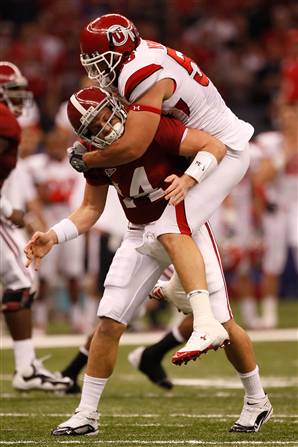
Utah Utes Alabama Crimson Tide Sugar Bowl

On a couple of occasions on this blog, I’ve argued in favor of an 8-team college football playoff system that uses the BCS bowls with their traditional conference tie-ins. While I still believe this would be the most viable solution to determine a national champion, I’m frankly getting completely sick of politicians trying to do anything with college football. Any sports fan that actually supports the federal government to get involved in this issue is completely insane. If there’s one system that’s guaranteed to be worse than the BCS today, it’s whatever convoluted format that Congress would come up with. Congressman Joe Barton needs to find a new issue to focus on, such as the economy, health care, or the multiple wars that our country is engaged in at this time. At the same time, the complaints from the bowl abolitionists such as the Mountain West Conference are getting as tired and worn out as Rachel Nichols’ campouts outside of Brett Favre’s Mississippi compound. The blind drumbeat that Utah was somehow disenfranchised last season has actually made me less sympathetic to the playoff issue since I wrote this post back in November largely supporting President Obama’s views on the matter. If you honestly can tell me that you would feel comfortable wagering your life savings that Utah would’ve beaten Florida, USC, Texas, and/or Oklahoma last season head-to-head, then you can go ahead and claim that the Utes deserved to be national champions. Otherwise, the fact that they went undefeated is irrelevant when compared to 1-loss teams from the much stronger SEC and Big 12. Besides, it’s incredulous to me that the Mountain West Conference and other fans are all of the sudden arguing how unfair the system is today even though the BCS expanded in 2006 to give the non-BCS conferences more opportunities to get into the top-level games and despite the fact those conferences bring very little of their own revenue (and definitely not many viewers as evidenced by the TV ratings) to the table. In the pre-BCS days, teams such as Boise State, Hawaii, and Utah would’ve never gotten a sniff of the Sugar Bowl and Fiesta Bowl, yet there were hardly any calls for a college football playoff prior to 1998 even though all bowls were completely about conference tie-ins and backroom deals.

Regardless, the college football playoff issue keeps coming back up like the Chinese water torture drip of baseball player names coming out from the 2003 steroid testing. The more that I investigate the issue, the more that I become convinced that even an 8-team playoff will never come to fruition (much less the extremely bad idea of a 16-team playoff). When the BCS bowls expanded to add a separate national championship game, thereby having 5 bowls with 10 participants, several things occurred.

First, it gave the non-BCS conferences a lot less incentive to push for a playoff. As stated before, those conferences were now getting access to revenue and bowls that they never did in the pre-BCS days, and that’s why all of those conferences opposed a playoff proposal in front of the BCS last week (except for the Mountain West, who submitted that proposal).  (Apparently, Senator Orrin Hatch didn’t realize that this automatic qualification existed for the non-BCS conferences in the Senate hearing on college football matters on Tuesday and actually openly speculated that this was some type of secret despite being published and written about everywhere.  This happens to be the Senator that called this hearing in the first place.  Once again, I don’t care how much you might hate the BCS – you don’t want these politicians anywhere near college football, particularly when you consider that Senator Hatch is relatively smart and thoughtful compared to the rest of that sorry lot.)  Therefore, those non-BCS conferences now have less incentive to mess with a system that they are now gaining revenue from (which they never would’ve had access to in the pre-BCS days).

Second, it clarified to the TV networks that the college football postseason is not like the NCAA Tournament. While the NCAA Tournament is partially about hyping Cinderellas in the first two rounds, the general public has shown year after year that it wants to sit down to watch the power teams in college football such as Florida, Texas, and Ohio State, even if they claim verbally that they want to see the Utahs and Boise States of the world. This is similar to when a lot of sports fans claimed to rejoice when neither the Red Sox nor Yankees were involved in the World Series last season, yet hardly any of those sports fans bothered to subsequently watch that World Series and drove the event to its worst ratings in history. Ever since the major conference realignments in the ACC and Big East that became effective in 2005, the only BCS bowl games other than the national championship games to have garnered over a 10.0 TV rating have all involved Big Ten schools (see historic data and this past year’s numbers). Meanwhile, the Boise State-Oklahoma 2006 Fiesta Bowl overtime classic that lots of non-BCS school proponents love to point out got trounced in the ratings that season by blowouts in the USC-Michigan Rose Bowl and LSU-Notre Dame Sugar Bowl. When ESPN, Fox, or some other network pays for sports rights, it cares about what people actually “do” as opposed to what they “say”, and what people keep doing is watch power programs in the major bowl games while ignoring the less sexy match-ups.

Third, the BCS expansion has better allowed the various bowls to retain their traditional tie-ins more often than not even if they lose a conference partner to the national championship game. The Rose Bowl has been getting its desired Big Ten-Pac-10 matchup even though Ohio State went to the national championship game 2 seasons in a row, while the Sugar Bowl has been able to always pick an SEC team despite the conference having sent its champ to the BCS title game for the past three seasons. This is an important point, particularly for the Rose Bowl, in terms of retaining the historical matchups that these bowls provide.

Finally, the Big Ten, SEC, and Big 12 have consistently established themselves as conferences that will almost always send 2 teams each to BCS bowls. Those conferences have teams from top-to-bottom with fan bases that both travel en masse to bowl games and bring in TV ratings. As a result, those conferences received even more benefits from the current BCS system since they are consistently receiving second BCS bowl game revenue shares to split among its members. Schools with horrific football histories such as Indiana, Vanderbilt, and Baylor now take in more bowl game revenue on a year-to-year basis than USC and Notre Dame. So, those 3 conferences aren’t ever going to vote for a system that would reduce their chances of sending 2 teams to the BCS.

The upshot is that even though the general perception is that a college football playoff would be a no-brainer money-maker, the fact is that the BCS conferences, TV networks, bowls, and even the non-BCS conferences actually don’t have much incentive to radically change the system that is in place today.  Team Speed Kills put together an excellent economic analysis of why it wouldn’t be financially rational for the BCS conference to alter the system (and this is coming from someone else that is on record as a playoff supporter).  This means that every sports fan out there needs to stop wasting their breath on advocating scrapping the whole system. You’ll see Sammy Sosa in the Baseball Hall of Fame before that happens.

However, we can still improve upon what we have now for everyone involved by implementing a plus-one model. For the uninitiated, the plus-one model consists of the BCS bowls all being played, having the national championship matchup being determined thereafter, and then a separate title game subsequently being played. I know that I have previously criticized the prospect of a plus-one as simply pushing off a #1 vs. #2 decision from December to January, but I’ve come around to it as a reasonable, if imperfect, alternative to today’s system. Here is how I would envision it working taking into account all of the financial and historical realities that are in place (which way too many fans either ignore or dismiss):

  1. The BCS would add the Cotton Bowl as a true 5th bowl game. As previously noted, there needs to be 10 total participants in order to maximize the opportunities for both the non-BCS conferences (to obtain single bids) and the largest power conferences (to obtain multiple bids).
  2. The BCS bowls will always have their traditional conference tie-ins. I know that this is anathema to a lot of fans that want to see straight seeding (or at least the top 4 teams seeded in a de facto 4-team playoff), but whether you agree with it or not, the Big Ten and Pac-10 aren’t going to give up the Rose Bowl. If the Cotton Bowl is added as a 5th BCS game, it would take the Big 12 champ if it’s from the Big 12 South (meaning any of the Texas or Oklahoma schools) while the Fiesta Bowl gets that conference tie-in if a Big 12 North team qualifies. This makes the most sense from both a historical (old Southwestern Conference connection with the Cotton and the Big 12 South schools) and traveling fan base perspective (Midwestern schools in the Big 12 North such as Nebraska and Missouri prefer going to Phoenix over Dallas). After that, the bowl of those two that doesn’t get the Big 12 auto bid gets the first pick of at-large teams using the same BCS ranking qualifications that are in place today (i.e. teams in the top 14 are eligible, top non-BCS conference school on top 12 must be picked by someone, a maximum of 2 teams can be picked from any one conference, etc.). After that, the bowls with open at-large spots will make selections from the BCS eligible pool in reverse order of the BCS rankings of the the teams that are already locked into those bowls. For example, the Orange Bowl had the lowest ranked team automatically committed to its game last year (#19 Virginia Tech as the ACC champ), so it would have been next in line with its selection, and so forth. This would be the mechanism to get as even of a distribution of teams across the bowls as possible (except that the Rose Bowl gets the Big Ten and Pac-10 champs no matter what). So, last year’s bowl matchups would’ve ended up like this (with BCS rankings after the regular season):Rose Bowl: #5 USC (Pac-10 champ) vs. #8 Penn State (Big Ten champ)

    Cotton Bowl: #1 Oklahoma (Big 12 champ) vs. #12 Cincinnati (Big East champ/6th at-large)

    Sugar Bowl: #2 Florida (SEC champ) vs. #6 Utah (non-BCS automatic qualifier/5th at-large)

    Fiesta Bowl: #3 Texas (1st at-large since Cotton got Big 12 champ) vs. #10 Ohio State (3rd at-large)

    Orange Bowl: #19 Virginia Tech (ACC champ) vs. #4 Alabama (2nd at-large)

  3. The day after the last BCS bowl is played, another set of BCS rankings will come out to determine the national championship matchup.  The title game will then be played on an open date thereafter (third Monday in January or one week before the Super Bowl).

Obviously, there’s still the prospect of controversy surrounding those final BCS rankings.  However, at least the outcomes of the BCS bowls provide some important information, such as whether a team such as Utah could handle Florida.  All of the catcalls about Utah last season were with the benefit of 20/20 hindsight after it beat Alabama in the Sugar Bowl.  Up to that point, reasonable college football fans wouldn’t have put Utah in the top 2 teams in the country, so it’s a bit disingenuous to state that they should’ve been in the national championship game based on the information that people had as of the final BCS rankings.  If the Utes were able to beat Florida in a plus-one system, though, then they would have had the marquee win necessary to have legitimately been in the championship discussion before the national title game (as opposed to after it).  Meanwhile, all of the BCS bowls become relevant to the national championship race as opposed to being glorified consolation prizes.  This is a throwback to the pre-BCS days when the first day of the year was one of the best sports days of the year.  The regular season also continues to have much more impact under the plus-one model.  Indeed, this is the biggest advantage of the plus-one system over any form of a playoff and why I’ve warmed up much more to the prospect of the idea.  We lose key historical moments like last year’s SEC championship game, the crazy last day of the 2007 regular season, and the 2006 Ohio State-Michigan game if all of those games become merely seeding exercises for a playoff.

So, the unseeded plus-one system is an option that the BCS conferences actually have a rational economic incentive to put into place.  Whether this could ever be put into place is obviously the continuing dilemma.

(Image from MSNBC.com)

A Defense of Big Ten Football

ohio-state-buckeyes-texas-longhorns-fiesta-bowl

When I wrote this post on the “Conference Pride Paradox” a little over two years ago, Big Ten football was at its zenith with 2 BCS bowl victories during the prior season and its premier rivalry (which, in my opinion, is also the best rivalry in all of sports) of Ohio State vs. Michigan was being hyped for weeks as the Game of the Millennium with a #1 vs. #2 matchup for the first time.  After the Ohio State won that classic game, the national debate was centered around how Michigan deserved another shot at the Buckeyes in the National Championship Game.  Thinking back about those days that really weren’t very long ago at all, it’s amazing how far the national reputation of Big Ten football has fallen.  With Ohio State’s loss last night to Texas (albeit one that could have been prevented had the Buckeyes just kept a safety or two back in the secondary to make a tackle), the Big Ten has now lost 6 straight BCS bowl games (2 in each of the last 3 seasons).

There’s no doubt that the nation has a right to be skeptical about the prospects of the next Big Ten invitee to a National Championship Game (and frankly, no one should be surprised if Ohio State is right back in that mix next year with the players that they have coming back).  However, with Big Ten bashing becoming so fashionable among college football fans, I believe that the performances of the conference over the past 3 seasons need to be into context.  Please note that the following comments aren’t excuses – if you want to be the best, you have to beat the best at anytime anywhere, and the Big Ten teams that have gone to BCS bowls have failed miserably on that front.  It’s just that when one looks at who and where the Big Ten has played in its recent BCS matchups, it becomes apparent that the only ones that have the right to say anything are USC and the top tier of the SEC (as much as I loathe them).  Everyone else that is piling on the Big Ten (i.e. Big East, ACC, and Big 12 fans, Pac-10 schools that aren’t USC, Mountain West Conference bandwagoners riding a hot Utah team, etc.), though, need to STFU since they all likely would be in the exact same position of the power Midwestern conference if they had to play the same games.

Here are the Big Ten’s BCS opponents over the past 3 seasons:

  • USC in the last 3 Rose Bowls in Pasadena
  • Florida in the 2006 National Championship Game in Arizona
  • LSU in the 2007 National Championship Game in New Orleans
  • Texas in the 2008 Fiesta Bowl in Arizona

Look at that list of teams – it’s complete murder’s row of marquee national programs without a single breather.  The Big Ten didn’t get to play the likes of Wake Forest, Louisville, Cincinnati, or Hawaii, who were BCS participants in other bowls during this period.  Unlike the conferences that are participating in Thursday night’s National Championship Game, the Big Ten didn’t lose to non-BCS conference teams in the manner of the Big 12 (the Boise State-Oklahoma gem in the 2006 Fiesta Bowl) or the SEC (last week’s stunning Utah beat-down of Alabama in the Sugar Bowl – there was nothing fluky about the Utes in that game).  Yet, those conferences haven’t been indicted in their entirety even though their marquee teams failed to beat smaller schools whose stadiums have fewer amenities than the average SEC weight room.

The one true horrible loss for the Big Ten was Florida’s thrashing of Ohio State in the 2006 National Championship Game, where the Buckeyes had been ranked #1 nearly the entire season and were strongly favored to win the game.  After that, though, note that two 2nd place Big Ten teams (Michigan in 2006 and my alma mater Illinois in 2007) along with this year’s Penn State team got to play USC in de facto Trojan home games right outside of Los Angeles.  How many champions from any conference, much less 2nd place teams like the Big Ten has sent, are going to beat USC head-to-head in Los Angeles?  Anyone that has even a smidgen of knowledge about college football knows that this is a monster task in a sport where home field advantage is a huge deal and nowhere near the same as playing Wake Forest in the Orange Bowl or Hawaii in the Sugar Bowl.  The Big Ten doesn’t have a Rose Bowl problem or a Pac-10 problem – it has a USC problem.  Of course, every other conference would also be “exposed” as having a USC problem if its champion or 2nd place team had to play the Trojans in LA every year.  (Please note that I wouldn’t trade the Big Ten’s relationship with the Rose Bowl for anything in world since it’s the one BCS bowl outside of the National Championship Game that people actually care about.  My trip to Pasadena following the Illini last year was one of the greatest sports experiences of my life, with the exception of that game thingy.)  If USC didn’t crush its Pac-10 competition every season (outside of the annual obligatory game where they don’t show up against a ridiculously inferior team, which ruins their national championship chances) where some other team from that conference would get to the Rose Bowl, then there likely wouldn’t be a Big Ten drought in that game.

Similar to the USC situation, LSU arguably received an even greater home field advantage with last year’s National Championship Game being played in New Orleans.  Once again, would any team from any other conference have won essentially a road game at LSU in that situation?  SEC fans have earned the right to crow here, but any other conference that throws stones at the Big Ten has to realize that if they had sent a representative to that game, they also would have been crushed.  West Virginia would have received the honors to get thrashed if they had taken care of business against a pathetic Dave Wannstedt-led Pitt team while Missouri would have been the victims if they had beaten Oklahoma in the Big 12 Championship Game on the last weekend of the regular season.  None of that happened, so Ohio State, whose resume by the end of that weekend consisted of doing to the least wrong of any of the BCS conference champions that season, backed that ass up into the right to play in the title game on the road where they were guaranteed to be huge underdogs.

Finally, Texas was heavily favored to crush Ohio State in last night’s Fiesta Bowl but the Longhorns only salvaged a win because of a Buckeye defensive meltdown in the last 2 minutes of the game.  (By the way, it was fascinating to witness Jim Tressel use the reverse-Tebow technique of using Todd Boeckman to spot Terrelle Pryor at quarterback, where the intent was actually to bring in a traditional pocket passer for one or two plays at a time in order to change the pace from having a running quarterback.  The increasing reliance on spread or spread-esque offenses isn’t necessarily the greatest trend for college football overall, particularly for young QBs that want to reach the NFL, but that’s a discussion for another day.)

Once again, I’m not saying that the Big Ten’s performances in BCS bowls have been anywhere near satisfactory.  The Big Ten receives a ton of perks for having teams that draw huge television ratings (the only BCS bowls that have had over a 10.0 rating outside of the National Championship Games since the ACC-spurned conference realignment in 2003 are all of the games that have featured a Big Ten team) and the most national and wealthiest fan base of the BCS, which includes placement in the Rose Bowl (the highest profile bowl) and the other BCS bowls salivating over taking one of the conference’s other teams for an at-large bid.  With that elevated position, the Big Ten is justifiably going to receive more scrutiny when compared to USC or teams from the SEC and the conference’s teams will need to start performing.  I have faith that the Big Ten will bounce back soon enough since conference performance is cyclical, which is often hard to remember in a “What have you done for me lately?” world.  Earlier this decade, the SEC and Big 12 were the conferences being criticized as being weak and without depth.  The Big East was hailed as being back as a power conference two years ago but now is facing calls of not deserving an automatic BCS bid.  The old cliche of “what goes around comes around” is very true in college sports, so the haters out there won’t have the Big Ten to kick around much longer.

(Image from Arizona Republic)

Random Observations on the World of Sports and Frank the Tank’s Football Parlay – New Year’s 2009 Edition

robbie-gould-bears-packers

A few random observations before we get to an expanded edition of this week’s football picks:

  1. The Bears Are Horrible… and the NFC is Even Worse – There was no logical reason for the Bears to have beaten the Packers this past Monday night.  They played as if though they were ready to pack it in for the season as opposed to fighting to keep alive in the playoff race.  Only the Bears have the ability to make me feel like I just drank some paint even while winning football games.  The only saving grace is that the NFC is so horrific (trading the Big 12 South straight up for the NFC West would have made for a much more competitive year) that this mediocre team could still actually host a playoff game if the right things fall into place.
  2. The Illini Basketball Team Actually Has Some Life… and So Does the Rest of the Big Ten – Hope is a dangerous drug.  As I’ve stated in some prior posts, I was more than willing to scrap this current Illinois basketball season as a complete rebuilding project with an aim toward giving Alex Legion ample playing time.  After absolutely crushing Missouri in the Braggin’ Rights Game on Tuesday night, though, the Illini seem to be looking to get back to the NCAA Tournament a year ahead of schedule.  One of these years, Illinois will beat Mizzou in football and then Mizzou will beat Illinois in basketball, upon which I will cardon myself in the basement with a plethora of perishable goods to prepare for the impending destruction of the world.
  3. Bulls Are the Ultimate .500 Team – Has there been a team in recent memory that have hung around the .500 mark with such consistency as this year’s Bulls?  I’m pretty sure they’ve attempted to get to .500 every single time that I’ve watched one of their games this season.  They’re like a baksetball version of an Escher painting.
  4. For the Love of God, Stop Fellating the Celtics – On the complete opposite side of mediocrity, I know that the ESPN criticism in the blogosophere can often be over the top at times, but how many fucking years in a row do they need to put up a fucking daily game-by-game comparison of a hot NBA team’s record versus the 1996 Bulls (and said hot NBA team flames out by the middle of January at the very latest)?  Well, the tizzy around the Celtics’ recent 19-game winning streak has been almost as ridiculous as the inclusion of the 2005 USC Trojans in the infamous “greatest college football team ever” bracket prior to that season’s national championship game (who subsequently lost to Texas).  When an NBA team only has 5 losses at the All-Star Break, then we can start talking about whether a team might beat the Bulls’ single-season record.  If it’s only a month-and-a-half into the season, though, just simmer down and shut the fuck up.  I cannot tell you how much I hate these premature crownings of teams.  Let me move on before I throw my laptop across the room…

On that happy holiday note, let’s get to a super-sized edition of the football picks (home teams in CAPS where applicable):

NFL FOOTBALL PARLAY

  • PHILADELPHIA EAGLES (-1) over Dallas Cowboys – In relatively quiet fashion, the Iggles have been as consistent as anyone in the NFC since Donovan McNabb learned about ties in the NFL.
  • Miami Dolphins (+3) over NEW YORK JETS – I’ll admit that all I want to see if Chad Pennington to come in and stuff the team that turned on him so that they could whore themselves for Brett Favre.
  • Chicago Bears (+3) over HOUSTON TEXANS – The bookmakers know that the Bears are horrible, which is how a listless Texans team could be favorites over a club that is still fighting for a legit shot at the playoffs.  Yet, I still think that the Bears will pull this out for a restless Chicago fan base.  Let’s hope that the Giants play their starters long enough (if at all) to do some damage to the Vikings at the same time.

Frank the Tank’s NFL Football Parlay Record
Last Week: 1-2

Bears Games for the Season: 3-91
Overall Season: 19-20-3

NEW YEAR’S DAY NON-BCS BOWL PARLAY

  • Outback Bowl:  South Carolina Gamecocks (+3.5) over Iowa Hawkeyes – Can I really trust an Iowa team that lost to the Illini to actually cover against a Steve Spurrier-led team in Tampa? NFW.
  • Gator Bowl:  Nebraska Cornhuskers (+3) over Clemson Tigers – The only team that I trust less than Iowa is Clemson.
  • Capital One Bowl:  Michigan State Spartans (+7.5) over Georgia Bulldogs – I truly don’t understand this Georgia team, which was bandied around as one of a handful of national championship contenders at the beginning of the year.  On paper, UGA should be crushing State, but the Big Ten has a pretty good track record against supposedly superior SEC teams in Orlando.  I’ll take the points for Sparty here.

BCS BOWL PICKS

  • Rose Bowl:  Penn State Nittany Lions (+9) over USC Trojans – Chicago has alternately seen temperatures close to zero degrees, traffic debiliating snowfall once the temperature rises into the teens, and then zero-visibility fog as the temperature creeps above freezing over the past THREE days.  This type of setting has made the dark hole of no Pasadena trip to look forward to for the Illini (and me) even more depressing.  I always have an extremely hard time watching a major sports event the year after my favorite team has played in it (i.e. 2006 NCAA Final Four, 2006 World Series, last year’s Super Bowl) and this Rose Bowl will be no exception, particularly with the Illini failing to make any type of bowl at all.  The only thing that warms my heart here is that the Big Ten has its best shot to knock off those USC bastards yet.  Unlike Ohio State earlier this year, the Illini last season, and Michigan two years ago, JoePa’s current squad is anything but a stereotypical plodding Big Ten team – Penn State has as much speed as anyone in the country.  The spread is way too large here with the Nitanny Lions at full strength.
  • Orange Bowl:  Virginia Tech (+2.5) over Cincinnati Bearcats – I’d stay the hell away from this game in the sportsbook in real life.  In theory, Cincy should be much more motivated to be here, particularly since Virginia Tech was just in the Orange Bowl last season.  I’ll go with the established power here, though, only because the Hokies still have an abundance of talent to the point that I’m fairly surprised that they are more than a 1-point underdog.
  • Sugar Bowl:  Alabama Crimson Tide (-10) over Utah Utes – As much as I’d love to see Utah draw blood against the team that was #1 for most of the season, ‘Bama is way beyond the draws that the ’04 Utes and ’06 Boise State respectively received with Pitt and Oklahoma in their Fiesta Bowl non-BCS conference upsets.
  • Fiesta Bowl:  Ohio State Buckeyes (+8.5) over Texas Longhorns – Much like the Rose Bowl spread, there are way too many points to pass up taking here.  Plus, am I the only one in America that didn’t find a single thing wrong with how the Big 12 determined its tie-breaker at the division level?  Oklahoma, Texas, and Texas Tech were all tied for first place in the Big 12 South division with 1 win and 1 loss in head-to-head competition against each other.  It seems to me that having the BCS standings is the next logical tie-breaker (with “logical” being an extremely convulated term in the world of college football) since any conference would want to elevate a team that would have the best chance of getting to the national championship game.  While Texas beat Oklahoma head-to-head, the Longhorns didn’t have any more claim to get a spot in the Big 12 Championship Game than Texas Tech, who beat Texas head-to-head.  I have no clue why there was such a national uproar over a tie-breaking procedure that seemed to actually make a lot of sense considering how the national championship match-up is determined today.  Anyway, the point is that Texas seems to be acting like the ’06 Michigan Wolverines that complained mightily that they didn’t get a re-match with their fiercest rival in Ohio State in the national championship game and then got crushed by a very talented USC team in the Rose Bowl.  I have a strong feeling that Texas is going to put up a massive dud here, too, since Ohio State is anything but a pushover when Beanie Wells is on the field.
  • BCS National Championship Game:  Florida Gators (-3) over Oklahoma Sooners – No one should forget that Florida is going to be playing a virtual home game in Miami in the same manner that LSU had the home field advantage in last year’s national championship game in New Orleans.  At the same time, for all of the national bashing of Ohio State for its high profile stumbles over the past two seasons, they have made it to BCS bowls 6 out of the last 7 seasons (including this year) with 3 victories that includes a national championship (the only two losses coming in the last 2 national championship games).  There isn’t another program other than USC that would trade places with the Buckeyes with that type of record.  Meanwhile, in the last four BCS bowls for Oklahoma, the Sooners were crushed by West Virginia (who was reeling after having just lost its head coach to Michigan) by 20 points in last year’s Fiesta Bowl, was on the wrong end of the classic upset by Boise State in the 2006 Fiesta Bowl, got blown out by USC by 36 points in the 2004 Orange Bowl for the national championship (one of the most horrific performances that I’ve ever seen considering the stakes), and was beaten by LSU in the 2003 Sugar Bowl for the national championship.  Jim Tressel looks like Mozart to Bob Stoops’ Salieri when it comes to BCS bowl performances.

Frank the Tank’s College Football Parlay Record
Last Week: 1-2

Illini Games for the Season: 5-6
Overall Season: 19-22-1

Enjoy the games and Happy New Year!

(Image from Washington Post)

A Trip Across the Pond and Frank the Tank’s Football Parlay – Christmas 2008 Edition

london-house-of-parliament-big-ben

I apologize for the brief hiatus since I had to travel to London for work last week.  While this might sound glamorous on paper (and certainly compared to my first job out of law school where I was sent to exotic locales such as Danville and Flint, it’s a significant step-up), I didn’t have time to do any sort of sightseeing because I was working over 13 hours a day (which would have killed me if it wasn’t for the fact that I had visited all of the major touristy items in London on a previous occasion).  Of course, the one thing about much of Europe is that they pay as much attention to American news as their own news, which is root of their insistence that we aren’t worldly since we don’t reciprocate.  The fantastic Rod Blagojevich story was front-page news in the London tabloids and at the top of the hour on the BBC all week long with the tie to Barack Obama’s Senate seat (everyone over there LOVES our President-elect, if you hadn’t figured that out already – he’s seriously just behind The Beatles in the U.K. exultation power rankings).  Also, thanks to Sky Sports 2 (the Deuce!), I was able to watch the start of the Bears-Saints game at 1 a.m.London time last Thursday evening/Friday morning (Minneapolis Red Sox aptly pointed out that the British have greater access to NFL Network games than Americans) prior to falling asleep.  Interestingly enough, former Bear Shaun Gayle provides studio commentary for NFL games in the U.K. – apparently, there is enough of a cult following for American football (along with the presence of ex-pats) over there that the NFL gets pretty good coverage.  (It’s better than, say, coverage of the English Premier League over here.  Speaking of which, my only disappointment from the trip was that my work schedule prevented me from seeing Chelsea play a Champions League game in the middle of the week, knowing full well that Chelsea fans brought soccer hooliganism to new heights during the 1980s.)  As far as British television was concerned, it felt as if though I never left Chicago.

Anyway, I fell asleep in the middle of the second quarter of the Bears game and when I woke up the next morning, I got to embark on a parents-from-Home-Alone-esque path to get home to Chicago.  When I arrived at the airport, I found out that my Virgin Atlantic flight from Heathrow to O’Hare was canceled due to “technical problems” (AKA the company wanted to consolidate a couple of less-than-full trans-Atlantic flights to save some money), which meant that I would need to have a stop-over in the Seventh Airport Gateway to Hell (AKA Dulles Airport outside of Washington, DC, which is not to be confused with the Airport Taxi Line to Hell at Las Vegas International) to transfer to a United flight to Chicago.  (Note that while I’m a cost-conscious consumer in general, I will ALWAYS pay for a direct flight when it’s my own money- I don’t have any tolerance for that transfer bullshit.  When it’s a company-paid flight on an expense account, as in this case, a direct flight is my God-given fucking right.  My indignation at Virgin Atlantic’s callousness in trying to tell me that having a transfer would “only” result in me getting home a couple of hours later than expected was only tempered by the fact that any rash action would likely be characterized as an “international incident”.)  At that point, I was in “whatever” mode and simply relieved that I wouldn’t be stranded overseas.

After having a pretty productive flight from a personal enrichment perspective (I finished up Malcolm Gladwell’s new book “Outliers”, who also currently has a great piece in the New Yorker comparing the difficulties in evaluating who will become successful NFL quarterbacks and schoolteachers, and watched both “Wall-E” and “Tropic Thunder” for the first time – all are highly recommended), I arrived at the Seventh Airport Gateway to Hell.  Since I was coming off of an international flight, I got to go through the glorious process of having to sit in line at customs, exit the secured area, pick up my luggage, check-in to my connecting flight and drop off my luggage, and then enter through the security checkpoint again.  Luckily, I had a whole twenty minutes to do all of this before my flight back to Chicago left.  As I sprinted across the corridors of the Seventh Airport Gateway to Hell and got to the front of the security line, the lovely TSA guard (AKA a Jawa without a brown robe) informed me with almost a certain sense of glee that my flight had been selected for provisional screening.  So, as my connecting flight was making a last call for boarding, I got to be pulled off to the side to patted down and have my bags thoroughly checked.  (I very politely informed another TSA guard who was a complete dead-ringer for Scott Van Pelt that I completely understood that this was a “necessary procedure” and just wanted him to be aware that my flight was about to leave.  He checked my ticket and responded, “Oooh.  I guess you’re right.  I guess we’ll try our best to do this quickly so that you can possibly make your flight.”  Mr. Van Pelt then proceeded to sit down in his chair for another five minutes before he realized that there were no other guards available and finally decided to start checking my bags.  My indignation was only tempered by the fact that any rash action would likely be characterized as a “domestic incident”.)  After finally getting through security, I would have run to my terminal, but the Seventh Airport Gateway to Hell is set up where you need to take a “bus” (AKA double-wide with a couple of wheels attached) between terminals.  Fortunately, I was able to jump onto a double-wide as it was leaving.  As you can see, this traveling day to end all traveling days, so it figured that when I finally arrived to Terminal D, I realized that my gate was the VERY LAST FUCKING ONE AT THE END – and this was a LONG FUCKING TERMINAL.  I did my best Usain Bolt impression while weighed down by a full laptop bag and literally ran as fast I could to reach my gate.  Amazingly, the plane was still there and I was able to get on.  Unfortunately, a number of my passenger-mates from London didn’t make it and, to my knowledge, no one has heard from them again.

In the only smooth part of the day (and at which point, I was pushing close to being awake for 24 hours straight), my flight from the Seventh Airport Gateway to Hell to O’Hare landed almost 45 minutes early.  The traveling gods had to throw in one last “we’re completely fucking with you today”, though, as I gave all of that early landing time back and then some waiting for my luggage to arrive… which never came.  It was, of course, still sitting at the Seventh Airport Gateway to Hell along with everyone else’s luggage from the original London flight.  At that point, it was just meant to be.  I got back to my house over 8 hours after I was scheduled to get home (with my luggage arriving the next morning).

The moral of the story: take a boat the next time that you go to England.

Thank you all for allowing me to vent – here are this week’s picks (home teams in CAPS where applicable):

COLLEGE FOOTBALL PARLAY

(1) EagleBank Bowl:  Navy Midshipmen (+3) over Wake Forest Demon Demons

(2) Las Vegas Bowl:  BYU Cougars (+3) over Arizona Wildcats

(3) Hawaii Bowl:   Notre Dame Fighting Irish (-1.5) over Hawaii Warriors

Frank the Tank’s College Football Parlay Record
Last Week: 1-2

Illini Games for the Season: 5-6
Overall Season: 19-22-1

NFL FOOTBALL PARLAY

(1) Atlanta Falcons (+3.5) over MINNESOTA VIKINGS

(2) Carolina Panthers (+3) over NEW YORK GIANTS

(3) CHICAGO BEARS (-4) over Green Bay Packers

Frank the Tank’s NFL Football Parlay Record
Last Week: 1-2

Bears Games for the Season: 3-81
Overall Season: 18-18-3

Alright, so the NFL picks this week just happen to align with exactly what the Bears need in order to keep their playoff hopes alive.  It honestly wasn’t planned that way – I just thought they were pretty reasonable spreads.  (In the case of the Panthers-Giants game, if the Giants lose, then they would go into Minnesota in Week 17 needing to win just get any type of home game in playoffs, but if they win this week, then they lock up home-field advantage throughout the playoffs and likely would sit everyone against the Vikings.  As a result, Bears fans need to root for Carolina all the way this weekend.)

Also, it’s very unfortunate that I won’t be able to spend the day after Christmas checking out the Illini in the Motor City Bowl (instead, it’s a whopper of a game with Central Michigan vs. Florida Atlantic).  Still, there’s a return of a holiday tradition that used to rank right up there with the Lions ruining the Thanksgivings of everyone in Detroit:  Bulls basketball!  That’s right – it’s a Rose vs. Beasley matchup next Friday night.  It makes me reminisce of the golden days around Christmas:

I can’t help you if you’re not pumped up after watching that.  My BCS bowl and NFL week 17 picks) will come at some point next week.  Merry Christmas, everyone!

(Image from Study Languages)