BCS Bowl Flex System: The Semi-Seeded Plus-One Proposal

There has been a ton of great feedback on the BCS Final Four post with generally positive reviews.  Unfortunately, even that proposal might be too much of a change for the powers that be to enact overnight.  So, I wanted to throw out a more traditionalist plus-one proposal that might be a bridge to getting to the BCS Final Four (or at least improve upon the current BCS system), which I call the “BCS Bowl Flex System”.  It’s a variation of what Slant reader StevenD calls a “semi-seeded plus-one“, where the traditional BCS bowl tie-ins are largely maintained with some teams possibly “flexed” to create one or two de facto play-in games to the national championship (if not outright semifinals).  The BCS rankings would then be re-calculated after the bowls are played to determined the plus-one national championship game matchup.

It’s not as clean on paper as the BCS Final Four or an outright playoff, but this type of format does carry a number of advantages, namely that all of the BCS bowls potentially will have an impact on the national championship race again and the Rose Bowl would go back to being exclusively Big Ten champ vs. Pac-10 champ affair.

(Any complaints that this isn’t a playoff  and would be an “unfair” system are duly noted.  The purpose of this post is to find some changes that the BCS conferences might be willing to implement in reality.  Please see the various rules for a realistic college postseason scenario that must be followed in the BCS Final Four post.)

Here is how I would set it up:

THE BCS BOWL FLEX SYSTEM

1.  The Rose Bowl will get the Big Ten and Pac-10 champs no matter what – I know that this might be passed off by non-Big Ten/Pac-10 fans as irrelevant/backwards/dumb, but this is a big deal to the powers that be.  Nothing will get done in terms of college postseason changes unless the Big Ten is happy, which means that the Rose Bowl and the Pac-10 have to happy, as well.

2.  Cotton Bowl is added as a 5th BCS bowl with the Big 12 tie-in –  I noted in the BCS Final Four post that the BCS bowls are as elitist toward the non-BCS bowls as the AQ conferences are toward the non-AQ conferences, but this is trumped by the need to have at least 10 BCS bids per year.  The seal has been broken – there’s no way that the AQ conferences (and specifically the frequent multi-bid recipients of the Big Ten and SEC) will go back down to just 4 BCS games and 8 total bids.  As a result, a more traditional plus-one system is going to need a 5th BCS bowl and the Cotton Bowl is well-positioned as a natural home to the Big 12 champ (especially with its larger proportion of Texas-based teams with the losses of Nebraska and Colorado).  I’ll discuss under Rule #6 below how the Fiesta Bowl receives some incentives to actually agree to give up the Big 12 tie-in.

3. Highest ranked non-AQ school receives automatic BCS bid – As I mentioned in the BCS Final Four post, this is the main bone that the AQ conferences can throw to the non-AQ conferences and I can see them actually agreeing to, which is that it can remove the top 12 ranking requiring for that class of schools to receive an automatic bid.

4.  Subject to Rule #5 regarding flexes below, the other BCS bowls retain their traditional tie-ins – As a general rule, the Sugar Bowl gets the SEC champ and Orange Bowl receives the ACC champ.  However, this is subject to the flex rules below.

5.  Except for the Rose Bowl teams (which are set in stone), a highly ranked at-large team may be placed or a team may be flexed from its traditional tie-in to another bowl involving a #1 or #2 ranked team to create one or more virtual play-in games to the national championship – This process will likely seem disjointed and muddy written out, but it’s really not that difficult in practice (so bear with me).  The objective is to ensure that any #1 and #2 ranked teams that aren’t playing in the Rose Bowl get to play in bowl games that are as close to being semifinals as possible.  That’s no issue with highly ranked at-large teams, who can simply be slotted accordingly without any impact to traditional tie-ins.  The real change is that a team that is ranked #3 or lower which does have a contractual tie-in with a bowl can be flexed to a bowl that is tied-in to a #1 or #2 ranked team (even if the #3 or lower team is tied-in to another bowl).  For example, let’s say that the SEC champ is ranked #1, the Big 12 champ is ranked #2, the ACC champ is ranked #3 and the Big East champ is ranked #4.  The Big East champ will be sent to the Sugar Bowl to create a #1 vs. #4 matchup, which is easy enough because the Big East doesn’t have a tie-in.  However, to create the #2 vs. #3 matchup, the ACC champ will be flexed to the Cotton Bowl to play the Big 12 champ.  As a result, the Orange Bowl would lose the ACC champ, but would receive a compensatory “flex replacement pick” (which is similar to the replacement pick if a bowl loses a tie-in to the national championship game today and as explained further in Rule #7).

As I’ve said, this doesn’t look very elegant when described as a process in writing, yet it’s fairly straight-forward (I hope) when looking at the 11 scenarios for matchups that would be created depending on which teams are playing in the Rose Bowl:

Scenario 1: No top 4 teams in the Rose Bowl
Bowl A: #1 vs. #4
Bowl B: #2 vs. #3

Scenario 2: #1 team in the Rose Bowl
Bowl A: #2 vs. #3

Scenario 3: #2 team in the Rose Bowl
Bowl A: #1 vs. #3

Scenario 4: #1 vs. #3 in the Rose Bowl
Bowl A: #2 vs. #4

Scenario 5: #1 vs. #4 in the Rose Bowl
Bowl A: #2 vs. #3

Scenario 6: #2 vs. #3 in the Rose Bowl
Bowl A: #1 vs. #4

Scenario 7: #2 vs. #4 in the Rose Bowl
Bowl A: #1 vs. #3

Scenario 8: #3 in the Rose Bowl
Bowl A: #1 vs. Flex Selection 1*
Bowl B: #2 vs. #4

Scenario 9: #4 in the Rose Bowl
Bowl A: #1 vs. Flex Selection 1
Bowl B: #2 vs. #3

Scenario 10: #3 vs. #4 in the Rose Bowl
Bowl A: #1 vs. Flex Selection 2**
Bowl B: #2 vs. Flex Selection 1

Scenario 11: #1 vs. #2 in the Rose Bowl
Bowl A: #3 vs. #4

* Flex Selection means that the bowl gets to pick any BCS eligible team that it wants, including those that are otherwise tied to other bowls except for the Rose Bowl participants.

** The reason why Bowl B gets Flex Selection 1 in this scenario is that, in theory, this ought to be a tougher opponent than Flex Selection 2.  As a result, Flex Selection 1 should be playing the #2 team as opposed to the #1 team.

6.  Fiesta Bowl receives flex preference for #1 or #2 teams that do not have tie-ins OR 1st at-large pick – Now, the Fiesta Bowl isn’t just going to give up a fairly valuable Big 12 tie-in to the Cotton Bowl for nothing.  For all of the internal turmoil within the Big 12, it’s still the best conference for traveling fan bases outside of the SEC and Big Ten.  I had thought of providing the Big East tie-in to the Fiesta, but from a bowl director’s perspective, this isn’t just compensation.  In reality, the best way to coax the Fiesta into giving up its Big 12 tie-in to the Cotton is to provide it with more flexibility.  Therefore, it gets two options.  First, the Fiesta receives a “flex preference”, whereby it would automatically receive a #1 or #2 team that does not have a tie-in (i.e. Big East champ, non-AQ schools, others that weren’t conference champs).  That would enable the Fiesta to “flex in” a team from another bowls in that situation despite not having a conference tie-in.  Second, if there is no possible flex preference, then the Fiesta would receive the first at-large large pick (which comes after the flex moves and replacement selections are made), which often results in an extremely valuable 2nd place SEC or Big Ten team.

7.  Bowls that lose a team to flexing receive a “flex replacement pick” – As alluded to earlier, this is similar to the replacement pick that a bowl receives if it loses a school to the national championship game today.  A bowl that loses a flexed team would receive first dibs on any other school from the conference that it has a tie-in with or can choose anyone from the BCS at-large pool.

8.  After flex replacement picks are made, the Fiesta Bowl gets its priority at-large pick and then the bowls pick at-large selections in the order of how high their tie-ins (or in the case of the Fiesta, the rank of its priority at-large pick) are ranked – The goal here is to create one or two other bowls that could possibly have an impact on the national championship race, so bowls that don’t have a #1 or #2 team will pick at-large teams in the order that their respective tie-ins (or in the case of the Fiesta, how high its priority at-large pick) are ranked.  To be clear, those bowls aren’t obligated to take the highest ranked at-large teams available – they can take whoever is left from the at-large pool subject to the other selection rules that would remain in place (such as a maximum of 2 schools from any conference receiving BCS bids).

9.  BCS rankings are re-calculated after bowl games are finished and national championship game rotates among the BCS bowl sites – After the BCS bowls are completed, the BCS rankings are then re-calculated to set the national championship game pairing.  The game would be played one to two weeks after the last BCS bowl is completed using the double-hosting rotation similar today (only that the Cotton is newly included).

APPLYING THE SYSTEM

The interesting thing about this system is that for all of the words that I just spewed out on flexing, it actually doesn’t need to be exercised very often in practice.  Simply slotting at-large teams differently than today is 90% of the battle.  Here’s how the BCS Bowl Flex system would’ve worked in every year since 2005 (which marks the first season of major changes to the BCS ranking formula):

2010
Rose: #2 Oregon (Pac-10) vs. #5 Wisconsin (Big Ten)
Sugar: #1 Auburn (SEC) vs. #3 TCU (non-AQ/at-large 1)
Orange: #13 Virginia Tech (ACC) vs. Connecticut (Big East/at-large 5)
Cotton: #7 Oklahoma (Big 12) vs. #8 Arkansas (at-large 4)
Fiesta: #6 Ohio State (at-large 2) vs. #4 Stanford (at-large 3)

2009
Rose: #7 Oregon (Pac-10) vs. #8 Ohio State (Big Ten)
Sugar: #1 Alabama (SEC) vs. #4 TCU (non-AQ/at-large 2)
Orange: #9 Georgia Tech (ACC) vs. #10 Iowa (at-large 5)
Cotton: #2 Texas (Big 12) vs. #3 Cincinnati (Big East/at-large 1)
Fiesta: #5 Florida (at-large 3) vs. #6 Boise State (at-large 4)

2008
Rose: #5 USC (Pac-10) vs. #8 Penn State (Big Ten)
Sugar: #2 Florida (SEC) vs. #3 Texas (at-large 1)
Orange: #19 Virginia Tech (ACC) vs. #12 Cincinnati (Big East/at-large 5)
Cotton: #1 Oklahoma (Big 12) vs. #4 Alabama (at-large 2)
Fiesta: #10 Ohio State (at-large 3) vs. #6 Utah (non-AQ/at-large 4)

2007
Rose: #1 Ohio State (Big Ten) vs. #7 USC (Pac-10)
Sugar: #2 LSU (SEC) vs. #3 Virginia Tech (ACC/flex)
Orange: #5 Georgia (flex replacement) vs. #13 Illinois (Big Ten/at-large 3)
Cotton: #4 Oklahoma (Big 12) vs. #9 West Virginia (Big East/at-large 2)
Fiesta: #8 Kansas (Big 12/at-large 1) vs. #10 Hawaii (non-AQ/at-large 4)

2006
Rose: #1 Ohio State (Big Ten) vs. #5 USC (Pac-10)
Sugar: #2 Florida (SEC) vs. #3 Michigan (at-large 1)
Orange: #14 Wake Forest (ACC) vs. #8 Boise State (non-AQ/at-large 5)
Cotton: #10 Oklahoma (Big 12) vs. #6 Louisville (Big East/at-large 4)
Fiesta: #4 LSU (at-large 2) vs. Notre Dame (at-large 3)

2005
Rose: #1 USC (Pac-10) vs. #3 Penn State (Big Ten)
Sugar: #7 Georgia (SEC) vs. #11 West Virginia (Big East/at-large 4)
Orange: #22 Florida Sate (ACC) vs. #14 TCU (non-AQ/at-large 5)
Cotton: #2 Texas (Big 12) vs. #4 Ohio State (at-large 1)
Fiesta: #6 Notre Dame (at-large 2) vs. #5 Oregon (at-large 3)

The only time that the flex option would’ve ever been exercised was in 2007, where #3 Virginia Tech was flexed from the Orange Bowl to the Sugar Bowl.  In terms of ticket sales, that actually granted the Orange a favor as it would have presumably selected #5 Georgia as its flex replacement pick.  In all of the other seasons since 2005, the desired matchups were achieved with solely slotting the applicable at-large teams.  (I could post the pre-2005 hypotheticals, as they had more examples of flexing, but it’s fairly incredible how bat-s**t crazy the old BCS rankings were when looking back on them.  As much as the BCS gets criticized today, at least the rankings over the past few years have generally passed the smell test (with most quibbles coming over a spot or two).  The old ranking system, on the other hand, seemed to love teams that didn’t actually win their conferences, particularly from the Big 12.)  Thus, a plus-one system featuring top-tier and meaningful games could be fairly easily created without much disruption to the traditional bowl tie-ins.

The BCS Bowl Flex system definitely won’t placate the playoff-supporter crowd in the same manner of the BCS Final Four, but it may be something that’s more palatable to the powers-that-be within the AQ conferences (especially the Big Ten) while upgrading the quality of the BCS bowls back to where they were in the pre-BCS days.  Certainly, the return of the “real” Rose Bowl would be a massive plus.  A non-AQ school such as TCU also gets a direct shot at the national title game in a season like this one (or can improve its resume greatly in other seasons by getting to beat a top AQ school).  Is it perfect?  Absolutely not.  However, I do believe it would be better than what we have today and it’s easier to sell incremental steps to the BCS conferences and bowls than wholesale change.

(Follow Frank the Tank’s Slant on Twitter @frankthetank111 and Facebook)

The BCS Final Four: A New Plus-One System

Big Ten commissioner Jim Delany has garnered a reputation over the years as one of the main obstacles to a college football playoff system and he certainly cemented that this past week with his comments at a panel at the IMG Intercollegiate Athletics Forum.  From Brett McMurphy at AOL FanHouse:

“The notion,” Delany said, “that over time by putting political pressure on, it’s just going to get greater access, more financial reward and more access to the Rose Bowl, I think you’re really testing. I think people who have contributed a lot have, what I call, ‘BCS defense fatigue.’

“If you think you (WAC Commissioner Karl Benson) can continue to push for more money, more access to the Rose Bowl, or Sugar Bowl. I have tremendous respect for Boise and TCU. … I think they are tremendous teams that can beat any team in the country on a given day. I think the only question is, ‘Does one team’s 12-0 and another team’s 12-0 equate?’ And that’s where the discussion plays out, not whether or not they’re elite teams or deserving access to the bowl system.

“I’m not sure how much more give there is in the system.”

* * * * * *

“I think the system does provide access and opportunity for a team like Boise State or TCU to play in the championship game,” Benson said. “But we’ve also proven that it’s a lot easier to get to No. 4 than it is to get to No. 2.”

Benson said he supports the BCS, but wants even more access and more revenue. This is not a popular subject with Delany.

“We gave up the Rose Bowl, the SEC gave up access to the Sugar Bowl, others were included but they never had access to any of this before,” Delany said. “You have to understand who brought what to the table. Who’s continuing to give and who’s continuing to get.”

Delany, then, not so subtly drew a line in the sand.

“The only thing I would say, if you think you (the non-automatic qualifying leagues) can continue to pressure the system and we’ll just naturally provide more and more and more,” Delany said. “I don’t think that’s an assumption that our presidents, athletic directors, football coaches and commissioners necessarily agree with.

“Karl (Benson) says we like this contract and we want more. Well, we’ve got fatigue for defending a system that’s under a lot of pressure. The pressure is for more. It’s never enough.”

With the already raging unpopularity of the BCS, these comments have received fairly negative feedback in the blogosphere.  However, if people can put aside their abject hatred of the current system, they’ll see that Delany is actually correct if they’re fairly evaluating the situation.*  The BCS conferences have given up a lot of access to the top bowls that never existed to the smaller conferences in the pre-BCS days.  There is a ton of brand equity that has been built up in a game like the Rose Bowl and much of that is due to the relationship between that event and the Big Ten and Pac-10 over the past 7 decades.  Would the Rose Bowl ever have been in a position to pay out as much as it does today without having had the Big Ten/Pac-10 tie-in built up over the years, or would the Sugar Bowl be as prestigious if it hadn’t been the long-time home to the SEC champ?  Delany has a point that other conferences getting access to those games are piggy-backing on the brand equity built up by others.  (The counter, of course, is that such other conferences never had a chance to play in those games in the first place.  It’s a chicken-or-the-egg question – did the power conferences prop up the bowls or did the bowls prop up the power conferences?)

(* Note that Jim Delany isn’t necessarily correct on everything.  Please see the new Big Ten logo and division names.)

Regardless, the most important point from Delany is something that no one can argue about: the AQ conferences still control the show.  This is the simple reality that the vast majority (probably over 90%) of college football playoff/plus-one/Iron Man/Russian Roulette proposals completely ignore.  Those proposals usually start by effectively smashing the system and completing starting over from scratch.  A prime example of this is the 16-team playoff proposed by “Death to the BCS” author Dan Wetzel.  That’s all well and good as a hypothetical, but setting forth a proposal that the AQ conferences would actually accept is an entirely different matter.  The bowl system that Wetzel eviscerates in his book may or may not provide the values that he wants to see, yet no matter how much some people might hate it, this is an entrenched system where change is going to incremental as opposed to radical.  Therefore, any changes to the current system must be driven by the AQ conferences and BCS bowls as opposed to being imposed on them, which means any viable proposal MUST give them what they want.

No one wants to hear this.  The politically correct thing to say is that this should be about “fairness” and “equal access” for the little guy while the Big Ten and friends are running an evil cartel.  I understand this sentiment, but college football fans need to get over it in order to find proposals that would actually work or else nothing will ever change.  If you give the BCS an “all or nothing” proposal, then the BCS will always choose nothing.

Once you get past the primary purpose of the BCS rankings, which is to set up the #1 vs. #2 national championship matchup, the other BCS bowls act no different than movie theaters across the country every weekend.  Movie #1 is a massive big budget huge studio action film with no redeeming social value whatsoever, while Movie #2 is a critically-acclaimed low budget independent film that’s going to win several Oscars.  By every standard, Movie #2 is a higher quality film than Movie #1.  However, Movie #1 gets placed onto 3000 screens across the country because it has a ton of mainstream appeal and will sell tickets, while Movie #2 only gets 100 screens since it has a niche audience.  Likewise, the purposes of the BCS bowls are the sell tickets and get as large of a TV audience as possible.  Is it “fair” that the BCS will pay $20 million to the college football equivalent of Tom Cruise* (who hasn’t done much lately but is still a huge name) and only $3 million to Daniel Day-Lewis (who has won multiple Oscars) because a whole lot more people buy tickets to watch Tom Cruise?  I don’t know if it’s fair, but it’s almost certainly perfectly legal.  Sports fans are typically emotionally charged and don’t necessarily think of games as entertainment, but that’s exactly how TV networks see them and why spectator sports exist in the first place.

(* Tom Cruise = Notre Dame)

As a result, for any college football postseason proposal to have even a whiff of a chance of succeeding, forget about “fairness” and think like Jim Delany.  Here’s what I believe are the rules that any viable postseason system needs to follow:

1.  The AQ conferences must make more revenue than today in an absolute sense – There’s usually not much argument about this one.  Even Jim Delany would admit that a college football playoff would make more total revenue than the BCS.  However…

2.  The AQ conferences must maintain their revenue advantages over the non-AQ conferences in a relative sense – Most proposals (including the Wetzel proposal) always refer to point #1 as providing the revenue incentive to create a playoff but virtually never address this point #2.  A playoff making more total money than the BCS means absolute crap to the AQ conferences – what matters to them is how that money is split.  The easiest way to get the AQ conferences to kill a playoff proposal is to compare it to the NCAA Tournament – they want NOTHING to do with how the revenue is paid out in that system.  Athletic department money doesn’t sit in a bank account collecting interest – it’s all spent right away on coaches, facilities, travel, etc.  Thus, more money in and of itself isn’t as important to the AQ conferences as ensuring that they just have a whole lot more of it compared to the non-AQ conferences.

Of course, the non-AQ conferences want to do the exact opposite by closing the revenue gap.  It’s a noble cause, but they’re not getting the AQ conferences to budge on this issue.  If you had to rank these rules in importance, this would arguably be at the top of the list.

3.  The AQ conferences must maintain their access advantages over the non-AQ conferences – I’m not trying to dump on Wetzel (as I find him to be a great writer), but his proposal to grant all 11 Division I-A conferences automatic bids to a 16-team playoff system will be used as toilet paper at the next annual BCS meeting.  The easiest way to get a college football playoff proposal killed is to make it look like the NCAA Tournament – for whatever reason, many fans don’t understand that the AQ conferences are specifically trying to avoid that access and revenue sharing model at all costs.  I know that it’s all about “fairness” again, yet there is absolutely zero incentive for the AQ conferences to ever think more than two seconds about agreeing to this, so why do people continue to propose it as other than a pipedream?  Oh sure, there are faux incentives such as, “The SEC could’ve had 4 teams in a 16-team playoff this year, so that’s plenty of incentive for them.”  However, from the AQ conference perspective, real incentives are actual or virtually guaranteed spots and revenue advantages that aren’t subject to on-the-field fluctuations from year-to-year.  Two BCS bowl bids in the hand are worth four in the bush for the AQ conferences and it’s key that they are the only 6 leagues that are getting auto-bids in any scenario.  I know that’s not “fair”, but once again, that’s kind of the point.

4.  Don’t f**k with the Rose Bowl anymore – I know that some fans of other conferences would like to tell the Rose Bowl/Big Ten/Pac-10 group to leave and everyone can go back to the mid-1990s Bowl Alliance (even though didn’t work very well in practicality), but the TV networks would upchuck at that thought immediately.  A “playoff” that doesn’t have any chance to include Michigan, Ohio State, Penn State, Nebraska and USC would be like attempting to sell the Major League Baseball TV package and telling the bidders that the Yankees and Red Sox aren’t ever able to make it to the World Series.  That’s just a killer on TV rights fees and a non-starter.

At the same time, the Rose Bowl passes the “Grandma Test”.  My grandmother is a Chinese immigrant that speaks limited English and has absolutely no idea about anything regarding sports, whether it’s the existence of the Super Bowl or when the World Series is played, yet even she’d be able to tell you that the Rose Bowl is in Pasadena on New Year’s Day.  That’s what we call an extremely valuable tie-in.  I’ve seen estimates that the additional exposure that the Big Ten and Pac-10 receive from the Rose Bowl tie-in (i.e. the worldwide coverage of the Tournament of Roses Parade, larger donations to various schools, media exposure, higher TV ratings for the game, etc.) is the equivalent of adding the revenue of a conference championship game without even having to hold one (and that’s on top of the actual BCS earnings).  Simply put, it is a big deal for the Big Ten and Pac-10 to give up more access to the Rose Bowl (or give it up entirely) compared to the other BCS bowl tie-ins.

Plus, the Rose Bowl experience lives up to the hype and then some.  (Here’s my personal recap of my visit when the Illini went to the game 3 years ago.)  TCU fans, many of whom have been justifiably vehement opponents of the BCS system over the past few years, are going to find out in a couple of weeks why the Big Ten and Pac-10 care so much about going to Pasadena.

As a result, there’s going to be some capitulation to the Rose Bowl and its conference partners in order for the game to maintain a Big Ten/Pac-10 matchup as often as possible.  However, it can’t be relegated to a second-class citizen compared to its fellow BCS bowls, either.  Just as the AQ conferences need to maintain their advantages over the non-AQ conferences on a relative basis, the Rose Bowl needs to keep a similar edge over the other BCS bowls.

5.  The BCS bowls are as elitist toward the non-BCS bowls as the AQ conferences are toward the non-AQ conferences – A common proposal from a lot of fans that advocate for a plus-one or playoff system is to add more bowls to the BCS system, particularly the Cotton Bowl since there seems to be this unwavering belief among the general public that Jerry Jones can and will buy off whoever needs to be bought off to make it happen.  (Of course, all of Jerry’s money equates to about one Cowboys playoff win every 15 seasons.)  In fact, I proposed this myself a couple of years ago in this unseeded plus-one proposal.  I’ve come to realize, though, that the BCS bowl club is similar to trying to join Augusta National Golf Club – you can have all of the money in the world, but the current members have to really really really like you in order to make an extremely exclusive club a little less exclusive.  The double-hosting system of the BCS today has become quite lucrative for the BCS bowls because they get to host and sell sponsorships and tickets for the national championship game once every four years (which they can also leverage in terms of procuring sponsorships during the years where they aren’t hosting the championship game).  When evaluating the incentives and disincentives for changing the current BCS system, there really isn’t much incentive at all for the BCS bowls to let in another member to their club and only host the championship game once every five years as opposed to four.  Even if a 5-bowl plus-one system were to make more revenue overall, the current BCS bowls would be only getting a 1/5th share instead of a 1/4th share whereas the AQ conferences presumably would get the same percentage shares as they do today (meaning the AQ conferences get the upside while the BCS bowls are taking all of the risk by having to split their pie into more pieces).  It would be speculative as to whether that proposed 1/5th share is truly better than the current 1/4th share (especially when coupled with giving up the national championship game more often) , which means that the best way to realistically get any change is to construct a system that somehow protects the exclusivity of the current 4 BCS bowls.

6.  The bowl system can’t become completely NIT-ish – Dan Wetzel argues that the bowls could still exist separately under his 16-team playoff proposal.  The problem is that this is a false argument – taking unranked Big Ten and Pac-10 teams, having them play in Pasadena, and slapping the “Rose Bowl” label on the game isn’t actually allowing the Rose Bowl to co-exist in practicality.  The playoff proposal that Wetzel advocates would constructively destroy the bowl system in the same manner that the expansion of the NCAA Tournament completely devalued the NIT and he knows it.  Now, plenty of sports fans want to see that happen, but once again, the bowls from top-to-bottom are about access advantages for the AQ conferences and they aren’t just going to give those up.  There’s a little bit a flexibility left in terms of creating a plus-one system yet still maintaining a quality group of schools for all of the bowls (whether BCS or not) to choose from, but it’s a delicate balance as you can’t make the bowls too much more diluted than they are (or at least without a corresponding legitimate incentive in exchange for such dilution).

This is a long-winded way of saying that for anyone that wants to improve today’s BCS system, LESS IS MORE.  (That’s why this 8-team playoff proposal I had a few years ago would never work.)  The current AQ conferences and the BCS bowls need to be better off on both an absolute basis and a relative basis (with an emphasis on the latter).  With all of the aforementioned rules in mind, I propose the following:

THE BCS FINAL FOUR

I’ve been slamming my head against the wall for quite awhile trying to figure out how to have at least 10 schools participate in BCS bowls and incorporate a seeded plus-one, yet still maintaining the traditional bowl tie-ins and keeping the Rose Bowl/Big Ten/Pac-10 triumverate happy.  Then, I remembered the “less is more” mantra and realized that the answer is so simple that I can’t believe that I’ve been missing the proverbial forest for the trees.  Instead of trying to find some type of rotation among the BCS bowls for the semifinal games or having to add a 5th BCS bowl, here’s all we that we have to do for what I call the “BCS Final Four”:

A.  Separate semifinal games – Take the top 4 teams in the final BCS rankings and have them play in 2 semifinal games that are separate from the BCS bowls (just as the national championship game is now).  This would mean that there would be 2 semifinal games, the national championship game and 4 BCS bowls incorporating 12 total teams in the BCS system every year.

B.  BCS bowls keep tie-ins – The 4 BCS bowls keep their traditional tie-ins with the same at-large selection rules as today, except that (i) the at-large pool is expanded to the top 18 in the final BCS rankings, (ii) the cap on BCS bids from any single conference is raised from 2 to 3 and (iii) as a political concession, the highest ranked non-AQ school gets an automatic BCS bid no matter what (even if it’s ranked below #12).

C.  Double-hosting of semifinals and final at BCS bowl sites – The sites of the semifinals and national championship game will rotate among the 4 BCS bowl locations, meaning that each location gets to host 2 semifinal games and 1 national championship game in each 4 year period (resulting in lucrative double-hosting seasons 3 out of every 4 years).

D.  Semifinal site tie-in preferences – Each semifinal site each season gets a preference in hosting the game that involves one of its traditional conference tie-ins, if applicable.  For instance, if New Orleans and Pasadena were to host semifinal games this year, then New Orleans would take the game involving the SEC champ (#1 Auburn vs. #4 Stanford) and Pasadena would get the game featuring the Pac-10 champ (#2 Oregon vs. #3 TCU).  The higher ranked team gets priority if both semifinal sites have a claim to the same game (i.e. if Auburn had lost to Alabama and ended up at #4 and Oregon moved up to #1, then Pasadena would get the #1 Oregon vs. #4 Auburn game instead of New Orleans).

E.  Championship Game in Mid-January – The national championship game would be played at least a week (probably 10-14 days) after the semifinal games are completed.  One possible permanent date could be Martin Luther King, Jr. Day as a Monday that many people have off as a holiday.  Another possible date is the day after the NFL regular season ends assuming that a new 18-game regular season pushes the last week of the season back two or three (if a 2nd bye week is added) weeks from when it is now.  Note that except for the bowls played on New Year’s Day, all of the games need to be played in prime time between Monday and Thursday for TV purposes and to avoid going head-to-head with the NFL on January weekends.  This is the stance of the BCS today and it would be expected to continue.

All of the selling points come from its simplicity and adding to the current system as opposed to taking anything away.  The AQ conferences get to retain their access advantages while still receiving the revenue upside of a mini-playoff.  The non-AQ conferences, while not getting radical changes they want, are thrown the bones of a guaranteed BCS slot along with a greater chance of getting to play for the national title (as Karl Benson was correct that making it to #4 is a whole lot easier than making it to #2).  The Rose Bowl, Big Ten and Pac-10 get to keep their bond while still maintaining the prestige of that game in comparison to the other BCS bowls.  The Big Ten and SEC are virtually guaranteed to receive 3 BCS bids every year, which is essentially the only change to the BCS that Jim Delany has ever actively pushed for.  All of the BCS bowls would be ecstatic to have double-hosting 3 out of every 4 years while also having more access to the top traveling schools from the Big Ten and SEC, which would be a reasonable trade-off for an increased chance of losing their normal tie-ins to the semifinal games.  The non-BCS bowls will barely be impacted because only 2 teams are being added to the BCS system.  (One clear loser would be the Capital One Bowl, though, as its contractual Big Ten #2 vs. SEC #2 matchup, which is already typically moved down to Big Ten #3 vs. SEC #3 since those conferences already regularly receive 2 at-large bids, would get even lower teams on the pecking order.  Note that the Capital One Bowl has actually beaten the Orange Bowl in the TV ratings for the past 3 years and even beat all of the BCS bowls other than the National Championship Game and Rose Bowl in 2007-08, so it shows the power of even the #3 teams from the Big Ten and SEC, much less their respective champions, and why the BCS bowls would love to take them in an expanded at-large pool.)  The TV networks would pay a fairly significant premium for this system compared to the current one, but with only the minimal changes of 2 extra games and 2 additional teams.

Finally, the importance and “do-or-die” nature of the regular season is preserved.  I know a lot of “universal access auto-bid” proponents like to say that the regular season would matter more if all conference champions would get bids, using the logic that all of those conference races would then have meaning (resulting in a lot more games then having importance in the national championship race).  There’s a little bit of truth to that line of thinking, but that’s more of a “lowest common denominator” argument.  The flip-side is that games such as the 2009 SEC Championship Game, 2006 Ohio State-Michigan and especially early season matchups such as Boise State-Virginia Tech completely lose their senses of urgency in a large-scale playoff system.  By expanding access by just 2 teams, it keeps that sense of urgency from the very beginning of September to the end of the season – there’s a tiny bit more wiggle room if a team slips up one week, but not enough where any school can afford to take a single game off like playoff-bound NFL teams often do in the last week or two of the season.

Here’s how the BCS Final Four system would have looked these past two seasons:

2010
Semifinal 1: #1 Auburn (SEC champ) vs. #4 Stanford (top 4 auto-qualifier)
Semifinal 2: #2 Oregon (Pac-10 champ) vs. #3 TCU (Non-AQ auto-qualifier)
Rose Bowl: #5 Wisconsin (Big Ten champ) vs. #11 LSU (Pac-10 champ replacement)
Sugar Bowl: #8 Arkansas (SEC champ replacement) vs. #6 Ohio State (at-large selection #1)
Orange Bowl: #13 Virginia Tech (ACC champ) vs. #9 Michigan State (at-large selection #2)
Fiesta Bowl: #7 Oklahoma (Big 12 champ) vs. Connecticut (Big East champ/at-large selection #3)

2009
Semifinal 1: #1 Alabama (SEC champ) vs. #4 TCU (non-AQ auto-qualifier)
Semifinal 2: #2 Texas (Big 12 champ) vs. #3 Cincinnati (Big East champ)
Rose Bowl: #8 Ohio State (Big Ten champ) vs. #7 Oregon (Pac-10 champ)
Sugar Bowl: #5 Florida (SEC champ replacement) vs. #13 Penn State (at-large selection #3)
Orange Bowl: #9 Georgia Tech (ACC champ) vs. #12 LSU (at-large selection #2)
Fiesta Bowl: #6 Boise State (Big 12 champ replacement) vs. #10 Iowa (at-large selection #1)

It’s interesting that the Rose Bowl would still be unable to take Stanford this season under this system, but that’s mitigated a bit by being able to grab a great-traveling SEC school.  In most other seasons, the Rose Bowl matchup wouldn’t have changed at all.  With the way that Big East (besides West Virginia) and non-AQ teams often get passed around like a doobie in the bowl selection process, the BCS bowls actually look better off for traveling fan base and TV marketability purposes having the opportunity to grab LSU and Michigan State this year or Penn State and LSU last season.

The BCS Final Four is a proposal that maintains the importance of the regular season, provides for a 4-game playoff, keeps the other BCS bowls interesting, constitutes a fairly simple change to the current system, and, most importantly, could be a system that the AQ conferences and BCS bowls would actually agree to in real life.  It’s not perfect, but if we wait around for perfection on this issue, then nothing will ever change.  Less is more when you’re dealing with the people that run the BCS.

(Follow Frank the Tank’s Slant on Twitter @frankthetank111 and Facebook)
(Image from PR Newswire)

Reexamining the Plus-One College Football Option

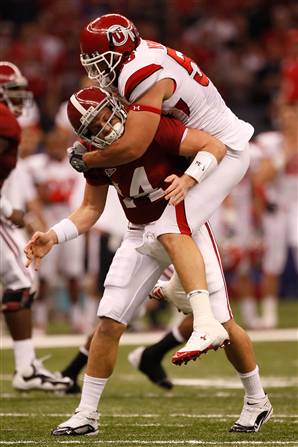
Utah Utes Alabama Crimson Tide Sugar Bowl

On a couple of occasions on this blog, I’ve argued in favor of an 8-team college football playoff system that uses the BCS bowls with their traditional conference tie-ins. While I still believe this would be the most viable solution to determine a national champion, I’m frankly getting completely sick of politicians trying to do anything with college football. Any sports fan that actually supports the federal government to get involved in this issue is completely insane. If there’s one system that’s guaranteed to be worse than the BCS today, it’s whatever convoluted format that Congress would come up with. Congressman Joe Barton needs to find a new issue to focus on, such as the economy, health care, or the multiple wars that our country is engaged in at this time. At the same time, the complaints from the bowl abolitionists such as the Mountain West Conference are getting as tired and worn out as Rachel Nichols’ campouts outside of Brett Favre’s Mississippi compound. The blind drumbeat that Utah was somehow disenfranchised last season has actually made me less sympathetic to the playoff issue since I wrote this post back in November largely supporting President Obama’s views on the matter. If you honestly can tell me that you would feel comfortable wagering your life savings that Utah would’ve beaten Florida, USC, Texas, and/or Oklahoma last season head-to-head, then you can go ahead and claim that the Utes deserved to be national champions. Otherwise, the fact that they went undefeated is irrelevant when compared to 1-loss teams from the much stronger SEC and Big 12. Besides, it’s incredulous to me that the Mountain West Conference and other fans are all of the sudden arguing how unfair the system is today even though the BCS expanded in 2006 to give the non-BCS conferences more opportunities to get into the top-level games and despite the fact those conferences bring very little of their own revenue (and definitely not many viewers as evidenced by the TV ratings) to the table. In the pre-BCS days, teams such as Boise State, Hawaii, and Utah would’ve never gotten a sniff of the Sugar Bowl and Fiesta Bowl, yet there were hardly any calls for a college football playoff prior to 1998 even though all bowls were completely about conference tie-ins and backroom deals.

Regardless, the college football playoff issue keeps coming back up like the Chinese water torture drip of baseball player names coming out from the 2003 steroid testing. The more that I investigate the issue, the more that I become convinced that even an 8-team playoff will never come to fruition (much less the extremely bad idea of a 16-team playoff). When the BCS bowls expanded to add a separate national championship game, thereby having 5 bowls with 10 participants, several things occurred.

First, it gave the non-BCS conferences a lot less incentive to push for a playoff. As stated before, those conferences were now getting access to revenue and bowls that they never did in the pre-BCS days, and that’s why all of those conferences opposed a playoff proposal in front of the BCS last week (except for the Mountain West, who submitted that proposal).  (Apparently, Senator Orrin Hatch didn’t realize that this automatic qualification existed for the non-BCS conferences in the Senate hearing on college football matters on Tuesday and actually openly speculated that this was some type of secret despite being published and written about everywhere.  This happens to be the Senator that called this hearing in the first place.  Once again, I don’t care how much you might hate the BCS – you don’t want these politicians anywhere near college football, particularly when you consider that Senator Hatch is relatively smart and thoughtful compared to the rest of that sorry lot.)  Therefore, those non-BCS conferences now have less incentive to mess with a system that they are now gaining revenue from (which they never would’ve had access to in the pre-BCS days).

Second, it clarified to the TV networks that the college football postseason is not like the NCAA Tournament. While the NCAA Tournament is partially about hyping Cinderellas in the first two rounds, the general public has shown year after year that it wants to sit down to watch the power teams in college football such as Florida, Texas, and Ohio State, even if they claim verbally that they want to see the Utahs and Boise States of the world. This is similar to when a lot of sports fans claimed to rejoice when neither the Red Sox nor Yankees were involved in the World Series last season, yet hardly any of those sports fans bothered to subsequently watch that World Series and drove the event to its worst ratings in history. Ever since the major conference realignments in the ACC and Big East that became effective in 2005, the only BCS bowl games other than the national championship games to have garnered over a 10.0 TV rating have all involved Big Ten schools (see historic data and this past year’s numbers). Meanwhile, the Boise State-Oklahoma 2006 Fiesta Bowl overtime classic that lots of non-BCS school proponents love to point out got trounced in the ratings that season by blowouts in the USC-Michigan Rose Bowl and LSU-Notre Dame Sugar Bowl. When ESPN, Fox, or some other network pays for sports rights, it cares about what people actually “do” as opposed to what they “say”, and what people keep doing is watch power programs in the major bowl games while ignoring the less sexy match-ups.

Third, the BCS expansion has better allowed the various bowls to retain their traditional tie-ins more often than not even if they lose a conference partner to the national championship game. The Rose Bowl has been getting its desired Big Ten-Pac-10 matchup even though Ohio State went to the national championship game 2 seasons in a row, while the Sugar Bowl has been able to always pick an SEC team despite the conference having sent its champ to the BCS title game for the past three seasons. This is an important point, particularly for the Rose Bowl, in terms of retaining the historical matchups that these bowls provide.

Finally, the Big Ten, SEC, and Big 12 have consistently established themselves as conferences that will almost always send 2 teams each to BCS bowls. Those conferences have teams from top-to-bottom with fan bases that both travel en masse to bowl games and bring in TV ratings. As a result, those conferences received even more benefits from the current BCS system since they are consistently receiving second BCS bowl game revenue shares to split among its members. Schools with horrific football histories such as Indiana, Vanderbilt, and Baylor now take in more bowl game revenue on a year-to-year basis than USC and Notre Dame. So, those 3 conferences aren’t ever going to vote for a system that would reduce their chances of sending 2 teams to the BCS.

The upshot is that even though the general perception is that a college football playoff would be a no-brainer money-maker, the fact is that the BCS conferences, TV networks, bowls, and even the non-BCS conferences actually don’t have much incentive to radically change the system that is in place today.  Team Speed Kills put together an excellent economic analysis of why it wouldn’t be financially rational for the BCS conference to alter the system (and this is coming from someone else that is on record as a playoff supporter).  This means that every sports fan out there needs to stop wasting their breath on advocating scrapping the whole system. You’ll see Sammy Sosa in the Baseball Hall of Fame before that happens.

However, we can still improve upon what we have now for everyone involved by implementing a plus-one model. For the uninitiated, the plus-one model consists of the BCS bowls all being played, having the national championship matchup being determined thereafter, and then a separate title game subsequently being played. I know that I have previously criticized the prospect of a plus-one as simply pushing off a #1 vs. #2 decision from December to January, but I’ve come around to it as a reasonable, if imperfect, alternative to today’s system. Here is how I would envision it working taking into account all of the financial and historical realities that are in place (which way too many fans either ignore or dismiss):

  1. The BCS would add the Cotton Bowl as a true 5th bowl game. As previously noted, there needs to be 10 total participants in order to maximize the opportunities for both the non-BCS conferences (to obtain single bids) and the largest power conferences (to obtain multiple bids).
  2. The BCS bowls will always have their traditional conference tie-ins. I know that this is anathema to a lot of fans that want to see straight seeding (or at least the top 4 teams seeded in a de facto 4-team playoff), but whether you agree with it or not, the Big Ten and Pac-10 aren’t going to give up the Rose Bowl. If the Cotton Bowl is added as a 5th BCS game, it would take the Big 12 champ if it’s from the Big 12 South (meaning any of the Texas or Oklahoma schools) while the Fiesta Bowl gets that conference tie-in if a Big 12 North team qualifies. This makes the most sense from both a historical (old Southwestern Conference connection with the Cotton and the Big 12 South schools) and traveling fan base perspective (Midwestern schools in the Big 12 North such as Nebraska and Missouri prefer going to Phoenix over Dallas). After that, the bowl of those two that doesn’t get the Big 12 auto bid gets the first pick of at-large teams using the same BCS ranking qualifications that are in place today (i.e. teams in the top 14 are eligible, top non-BCS conference school on top 12 must be picked by someone, a maximum of 2 teams can be picked from any one conference, etc.). After that, the bowls with open at-large spots will make selections from the BCS eligible pool in reverse order of the BCS rankings of the the teams that are already locked into those bowls. For example, the Orange Bowl had the lowest ranked team automatically committed to its game last year (#19 Virginia Tech as the ACC champ), so it would have been next in line with its selection, and so forth. This would be the mechanism to get as even of a distribution of teams across the bowls as possible (except that the Rose Bowl gets the Big Ten and Pac-10 champs no matter what). So, last year’s bowl matchups would’ve ended up like this (with BCS rankings after the regular season):Rose Bowl: #5 USC (Pac-10 champ) vs. #8 Penn State (Big Ten champ)

    Cotton Bowl: #1 Oklahoma (Big 12 champ) vs. #12 Cincinnati (Big East champ/6th at-large)

    Sugar Bowl: #2 Florida (SEC champ) vs. #6 Utah (non-BCS automatic qualifier/5th at-large)

    Fiesta Bowl: #3 Texas (1st at-large since Cotton got Big 12 champ) vs. #10 Ohio State (3rd at-large)

    Orange Bowl: #19 Virginia Tech (ACC champ) vs. #4 Alabama (2nd at-large)

  3. The day after the last BCS bowl is played, another set of BCS rankings will come out to determine the national championship matchup.  The title game will then be played on an open date thereafter (third Monday in January or one week before the Super Bowl).

Obviously, there’s still the prospect of controversy surrounding those final BCS rankings.  However, at least the outcomes of the BCS bowls provide some important information, such as whether a team such as Utah could handle Florida.  All of the catcalls about Utah last season were with the benefit of 20/20 hindsight after it beat Alabama in the Sugar Bowl.  Up to that point, reasonable college football fans wouldn’t have put Utah in the top 2 teams in the country, so it’s a bit disingenuous to state that they should’ve been in the national championship game based on the information that people had as of the final BCS rankings.  If the Utes were able to beat Florida in a plus-one system, though, then they would have had the marquee win necessary to have legitimately been in the championship discussion before the national title game (as opposed to after it).  Meanwhile, all of the BCS bowls become relevant to the national championship race as opposed to being glorified consolation prizes.  This is a throwback to the pre-BCS days when the first day of the year was one of the best sports days of the year.  The regular season also continues to have much more impact under the plus-one model.  Indeed, this is the biggest advantage of the plus-one system over any form of a playoff and why I’ve warmed up much more to the prospect of the idea.  We lose key historical moments like last year’s SEC championship game, the crazy last day of the 2007 regular season, and the 2006 Ohio State-Michigan game if all of those games become merely seeding exercises for a playoff.

So, the unseeded plus-one system is an option that the BCS conferences actually have a rational economic incentive to put into place.  Whether this could ever be put into place is obviously the continuing dilemma.

(Image from MSNBC.com)

The Presidential Commission on the Establishment of a College Football Playoff System

I will be the first to admit that I am one of the few in Chicago’s legal community that has a lot of issues with the political philosophy of President-elect Obama.  However, his apparent passion for the creation of a college football playoff system, as shown in the above video clip from his interview this past week on 60 Minutes, is admirable.  Indeed, as a fellow South Sider and White Sox fan, I would be more then willing to lead the Presidential Commission on the Establishment of a College Football Playoff System in the spirit of bipartisanship.  I can tell Obama has given this issue a ton of thought judging by the “You can’t remember to pick up a carton a milk from the store within 5 minutes of asking you to do it, but you can instantly recite the names, positions, and social security numbers of the 1992 Chicago Bears roster that had a 5-11 record” look from the future First Lady as soon as brought up the subject.  (Brad Muster, your table is ready.)  I have been on the receiving end of that look more than anyone in history assuming that the guy from “Stump the Schwab” hasn’t found a life partner yet.

The interest of the President-elect has brought back up one of the few posts that I have written that has aged relatively well: this “modest proposal” for taking the existing 4 BCS bowls, keeping the traditional conference tie-ins such as the Big Ten and Pac-10 always being in the Rose Bowl, and making it into an 8-game playoff.  (As horrific as the actual Rose Bowl game last year was for me as an Illini fan, once you’ve experienced the spectacular pagentary around Pasadena on New Year’s Day, you understand exactly why those two conferences don’t want anything to do with giving up that game.  President-elect Obama should be aware from a political standpoint that the all 8 of the Big Ten states and 3 out of the 4 Pac-10 states, with the lone exception being John McCain’s home state of Arizona, voted for him, making those conferences his strongest supporters in the BCS.  He should remember this when he starts hearing suggestions from SEC fans that believe that the winner of the SEC Championship Game should be automatically crowned the national champion, since Florida was the only Obama win among the 9 states in the conference.  On another note, I am sincerely humbled by the fact that Professor Michael McCann, Sports Illustrated’s legal expert, linked to my playoff proposal post on the Sports Law Blog.  I love my job, but I have certainly dreamed of becoming a sports law professor of Professor McCann’s stature.)  The only item that I’d alter from the original proposal from 2 ½ years ago would be the timing of the playoff so that it would be in line with the comment from Slant reader Richard Gadsden, such that the national championship game would be played one week prior to the Super Bowl.  It’s such an obvious open date on the sports calendar that I can’t see any downside to it (other than the faux bemoaning of how long the college football season would be at that point, which I addressed in my original proposal post).  That way, the Rose Bowl and the other BCS games would continue to be on or around New Year’s Day as they always have, while the semifinals would be one or two weeks later in prime time weeknight slots (so that they do not conflict with the NFL playoff games that occur on the weekends in January).  Otherwise, every single item that I brought up then would still apply today.

The main overarching point that I can’t emphasize enough is that the only reasonable way that we will ever see a college football playoff in my lifetime is if the process is driven by the BCS conferences as opposed to being imposed on them.  There are plenty of proposals out there that advocate an NCAA Tournament-style system with automatic bids to the non-BCS conferences and an abolishment of the bowl system, which might work if we were living in a theoretical vacuum, but pretty much removes any type of incentive for the BCS conferences, who are the ultimate decision-makers here, to actually agree to such a playoff.  If people advocate an “all or nothing” approach to a college football playoff system, then no one should be surprised when the BCS conferences reflexively opt for “nothing”.  The reason why I believe that my proposal would have a reasonable chance of actually being enacted is that it would simply add to the bowl system that already exists as opposed to taking anything away.

For his part, President-elect Obama has preached pragmatism to addressing America’s issues more than any Presidential candidate in recent history.  In this case, the pragmatic approach would be to provide an incentive to bring the BCS conferences to the table with a proposal that allows them to keep the same disproportionate share of television and postseason revenue that they currently enjoy while still adding a playoff system that the general public craves.  It’s very easy for people to throw out college football playoff proposals that they believe would be perfect for their personal purposes, but my proposal is aimed at instituting a playoff that the BCS conferences would actually agree to at the end of the day.  Otherwise, we’ll still be debating this same issue thirty years from now.

(Video from YouTube)