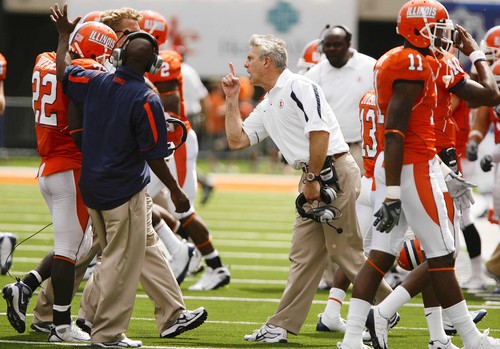
How Rutgers Could Work in the Big Ten

When I created the Big Ten Expansion Index, I was 99.9% sure that the Big Ten was simply looking for the perfect school #12, which led me to write that the “Only Real Choices” for that spot are Texas and Notre Dame.  Since that time, lots of rumors have been circulated, including ones about Missouri, Texas and Pitt.  The latest rumor is that Rutgers is supposedly at the top of the wish list after the no-brainers like Texas and Notre Dame.  That spurred me to write essentially that Rutgers was fool’s gold in terms of delivering the ever elusive New York market, where Scarlet Knights fans then responded that I ought to be re-enacting the critical scene in Deliverance.

After mulling it over for a little while and engaging in a great discussion with all of the commenters out there (who I must commend for a multitude of ideas and incredible wisdom during a literally 24/7 debate), I’ve come to the conclusion that Rutgers could make sense in the Big Ten as long as it’s in a 14-school conference that concurrently has another big national name involved.  Personally, I think that 12 schools is really the perfect size for a conference in practice and I’ve gone over how there needs to be a massive value proposition in order to make a 14-school conference work financially.  However, the Big Ten may decide that the New York market is too big to ignore even if they don’t really watch college football out there.  If that’s the case, here are 3 ways to do it correctly in terms of adding packages of 3 schools:

(1) JoePa’s Dream Conference (Notre Dame, Syracuse, Rutgers) – If any conference really wants to secure the New York market as much as it could possibly be secured, it needs that old standby Midwestern university involved: Notre Dame.  The Irish arguably have the largest fan base in the NYC market simply due to the large Catholic population constituting the Subway Alumni.  Adding Syracuse and Rutgers on top of Notre Dame and current Big Ten member Penn State would get the 4 top fan bases in NYC, which would create a “penumbra effect” where all of those schools together would turn New York into a Big Ten town.  This league would effectively be a high rent version of Joe Paterno’s proposed Eastern football conference merged into the Big Ten.  For the geographically inclined, there’s also a certain elegance to this hypothetical conference as it’s a pretty natural extension of the Big Ten’s footprint.  Out of the 5 schools examined in the Big Ten study that was leaked, I’m fairly certain that this had to be the highest value 3-school combination since it legitimately locks down the Northeast for the conference.

(2) JoePa’s Quasi-Dream Conference (Nebraska, Syracuse, Rutgers) – I’ll reiterate that I truly don’t believe that the Big Ten will expand without Notre Dame or Texas involved, but if there’s one school that could prove me wrong on that statement, it’s Nebraska.  In my discussions with commenters, I’ve noted that Nebraska is really “Notre Dame lite” as an expansion candidate.  When you really look at everything closely, the Cornhuskers provide the same main attributes that Notre Dame would bring to the table: a national football brand name and huge fan base that trump the lack of a substantive home market.  If Nebraska has the national name without a great home market while Rutgers has a great home market without a national name, then putting those two together could make financial sense together when either one on its own as school #12 in a 12-school conference wouldn’t cut it.  Add Syracuse on top of those schools to further solidify the Big Ten’s presence in the Northeast and the conference can come pretty close to getting the same value as it would’ve gotten with Notre Dame.

(3) Game of Risk Conference (Texas, Texas A&M, Rutgers) – Let’s say that the Big Ten can nab the two Texas schools and Notre Dame continues to refuse to join.  If the Big Ten has the entire state of Texas in the fold, then it’s playing with house money where it can make a bet to shoot the moon with the New York market on top of it with Rutgers.  It would be like a game of Risk where the Midwest would be flanked by the two power schools in the Southwest (Texas and Texas A&M) and then two major East Coast schools (Penn State and Rutgers).  On paper, the demographic power of the Big Ten would be staggering, with 4 of the 5 largest TV markets in the country in the fold (New York, Chicago, Philadelphia and Dallas-Fort Worth), 3 others in the top 15 (Houston, Detroit and Minneapolis-St. Paul) and 6 of the 11 largest states by population (Texas, Illinois, Pennsylvania, Ohio, Michigan and New Jersey).  This is one of the best situations that you could possibly construct in terms of maximizing the number of households available to the Big Ten Network outside of heading into the state of California.  All of this assumes, of course, that Rutgers can actually deliver New Jersey households for the Big Ten Network (which is a very open question).

So, Rutgers fans, I’m not entirely opposed to your school joining the Big Ten.  However, the Big Ten is going to need a marquee name to come along in order to back up the risk that the conference would be taking on whether Rutgers can deliver its home market.

(Follow Frank the Tank’s Slant @frankthetank111)

(Image from Takhoma.com)

Big Ten Study Leaked: What’s the Purpose?


The Chicago Tribune reports today that the Big Ten has received a study from William Blair & Co., a Chicago investment banking firm, that analyzed five expansion candidates: Rutgers, Syracuse, Pitt, Missouri and Notre Dame.  According to the Tribune’s source, the report indicated that the Big Ten members would be able to increase their current payouts of $22 million or more with expansion with the “right team or teams”.  The source also said that these were the “obvious candidates” and other schools could be considered.

I’ve worked on enough business deals and seen enough positioning in the media through the years (whether we’re talking about trades in sports or political wrangling) to know that leaks to the press rarely occur without a purpose that was authorized from above, especially when dealing with places that have tightly-run ships like Jim Delany’s Big Ten.  So, what was the purpose of this leak?  Was it to put cold water on the thoughts of Texas or even other schools like Nebraska or Maryland joining the conference?  Maybe Notre Dame is a legitimate candidate after all and we shouldn’t assume that they’ll never join?  Is it to try to get Big Ten fans comfortable with the idea that the 12th school isn’t going to be nearly as sexy as we hope?  Or could it be a classic stalking horse case, where the Big Ten is effectively telling the rest of the Big XII schools like Texas and Nebraska, “Just so you know, we make more TV money than you do now.  We’d make a lot more money if we take Missouri and we’re willing to do it, while you’d make even less.  So, maybe we should do lunch?”

All of those reasons are certainly possible.  My personal opinion is that it would be unconscionable to have Texas alums legitimately considering a move to the Big Ten (and generally not having a knee-jerk reaction to it in the same way as Notre Dame alums) and then add a school like Rutgers or Missouri instead, but I’m just an Unfrozen Caveman Lawyer.  Teddy Greenstein, who wrote the Tribune article, is of the opinion that Rutgers is at the top of the list (if you discount, in his words, the “pipe dreams” of Texas and Notre Dame).  Now, I believe that Greenstein is one of the better writers in the Chicago sports media (and believe me, having suffered through a period where both Skip Bayless AND Jay Mariotti were competing columnists here at the same time, I appreciate the good ones), but I have to take issue with this line of thinking:

Fans wonder: Does New York care about Rutgers? The simplest answer: When Rutgers wins, yes.

During Rutgers’ football nirvana season of 2006, its game against Louisville on ESPN drew an 8.1 rating in the New York market, a “phenomenal number,” according to one TV executive. That night, the Empire State Building was lit up in scarlet.

This anecdote continues to keep coming up and it’s a red herring.  I fully expect any school that’s competing for a possible slot in the national championship game to receive incredible ratings in its home market, even in a historically poor college football town like New York.  That’s not the issue!  Here’s what I stated in the original Big Ten Expansion Index post:

It must be emphasized that Football Brand Value puts much more weight on the long-term history and financial underpinnings of a program over short-term or recent success. Thus, Team A that has sold out 80,000-seat or even 100,000-seat stadiums for decades whether it wins or loses is much more valuable than Team B that only sells out a 40,000-seat stadium when it’s in the national championship race, even if Team A has had a mediocre seasons recently and Team B happens to rank in the top 3 of the BCS rankings this year. The “What have you done for me lately?” attitude of most sports fans doesn’t apply here. Instead, the proper question is the opposite: Even if the target school goes 0-12 in a season, will it still attract TV viewers and attendance? In other words, the true value of a football program is really measured by how much attention it still receives when it’s down as opposed to how much attention it gets when it’s up. The Big Ten will only consider programs that have large and real hardcore fan bases that will stick them in good times and bad as opposed to programs that have bandwagon fans that will bolt when there’s a 7-5 season.

The fact that then-35-year old Danny Almonte led his baseball team to the Little League World Series and was front-page news in New York for the better part of a month in 2001 didn’t turn the NYC market into a “Little League” town.  Even the New Jersey Nets could deliver the New York market once a decade when they’re competitive.  The problem is the other 9 years in the decade when they’re non-entities, where the fact that they play a few miles away from Midtown Manhattan becomes irrelevant.  Taking the NBA analogies further, commenter Dcphx brilliantly described Rutgers as “the 7′ 3″ athletic center that NBA GMs can’t avoid drafting.”  My initial response was that I was worried that Rutgers would be the expansion equivalent of Michael Olowokandi.  Like NBA GMs ignoring the fact that Olowokandi didn’t have a post-up game, basic boxing-out fundamentals, or any discernible basketball skills whatsoever other than being REALLY tall, it feels like a lot of people (particularly the TV executives that are disproportionately based in the NYC market) are blinded by the size of the the New York market or even just the New Jersey portion of it with respect ot Rutgers without taking into account their actual athletic history (whether it’s in football or basketball).  Upon further review, the thought of adding Rutgers might even be closer to the Pistons drafting Darko Milicic instead of Carmelo Anthony in 2003, where a team on the precipice of a championship felt it was better to keep its “chemistry” than adding a guaranteed superstar to a top-of-the-line squad.  As applied to Big Ten expansion, concerns about “geography” are the equivalent of the Pistons wanting Darko for “chemistry”.  (FYI – if you’re able to combine my concurrent dreams of being a conference commissioner and NBA general manager, I will turn into warm puddy.)

Let’s think of it this way: the Big Ten has spent the last two decades waiting around for Notre Dame.  During that process, they’ve actually looked at Missouri, Syracuse, Rutgers and Pitt several times and they were never deemed worthy of being invited before.  They’ve also given up conference championship game revenue during that period of time as a result of waiting for the Irish.  The Big Ten then took a massive risk of building its own TV network (which a lot of people ridiculed at the time), which has now paid off in spades in the form of TV revenues that far surpass what Notre Dame receives from NBC.  This means that the Big Ten has never had more leverage in terms of adding schools in its entire history.  So, after all of this time and at the height of its power, is the Big Ten really going to cash in all of its chips after all of that time on a potential project like Rutgers?  A “safe but not glamorous” choice like Missouri?  Is the Big Ten, with all of its financial advantages today, really going to add a school that doesn’t bring as much to the table as Penn State did to the conference or even Miami did to the ACC?  While there might be some Big Ten ADs out there like Ron Guenther that think small, Jim Delany is a big-time visionary and I have full faith that he’s not going to push a move just for the sake of making a move.  If the Big Ten doesn’t add Notre Dame, then it’s going to go after a school that’s even better (not secondary choices that are lower in terms of impact).  Call me naive, crazy or one-track minded, but money has a way of making “pipe dreams” on paper  in sports fan terms become much more realistic.

(UPDATE: This was written without taking into account today’s story, but The Rivalry, Esq. has a great look charting the ups-and-downs of talk regarding various Big Ten expansion candidates.)

(Follow Frank the Tank’s Slant on Twitter @frankthetank111)

(Image from Chicago Tribune)

List of 15 Big Ten “Candidates” is Who May Come With Texas or Notre Dame (not Instead of Them)

Lots of people have been discussing in the comments section on the “Template for Shooting Down Any Argument Against Texas Going to the Big Ten” post a story from the Milwaukee Journal-Sentinel stating that the Big Ten has hired a research firm to evaluate an “initial list” of 15 schools, with a quote from Wisconsin AD Barry Alvarez saying that Texas isn’t on that initial list.  (H/T to WolverinePhD, among others, for sending in the link.)  I don’t interpret this study as Texas not being a target.  As Dennis Dodd stated on CBS Sportsline (who has voiced skepticism about Texas joining the Big Ten):

[I]f Notre Dame and/or Texas showed a willingness to join the Big Ten, there wouldn’t be much research to do.  The two schools are seen as the only slam-dunk candidates in an otherwise muddied expansion picture.

Exactly.  The Big Ten doesn’t need to pay presumably tens of thousands of dollars (if not more) to hire a research firm to say that “Adding Texas and Notre Dame would be sweeeeeeeeeet!!!”.  The conference knows that already and its university presidents don’t need to be convinced of the attributes of those schools.  Instead, you hire a research firm to evaluate the schools that you AREN’T sure of and look at the positives and negatives of them.  A research firm that’s providing value is going to look at issues that aren’t obvious, such as whether Syracuse or Rutgers can really deliver the New York City market or Nebraska’s national brand name can compensate for its small home market.  It’s a waste of money to have someone come in and state that “Texas would really add a lot of eyeballs to the Big Ten Network while being awesome in sports and academics.”  No shit, Sherlock.  Tell me something that I don’t know.

The fact that the Big Ten has a list of 15 schools that it’s looking at is an indication that the conference is looking at numerous schools that are significantly outside of its conference geographic footprint.  To me, this exercise looks a lot more like an evaluation of “Who do we add on top of Texas and/or Notre Dame if we’re willing to go to 14 schools?”  From a realistic standpoint, schools from the SEC aren’t going to ever move while the 2 schools that the Big Ten would want from the Pac-10 (USC and UCLA) are no-brainers in the same category as Texas and Notre Dame where there’s no point in even examining them because they’re in if they want to join.  Here is my semi-educated guess as to who is on that list of 15 schools as well as the key questions that the Big Ten ought to be asking about them:

1.  Syracuse – Does it really bring in the NYC market?  Can it bring in the NYC market when it’s combined with Penn State?  If yes, does Syracuse or Rutgers do this better?

2.  Rutgers – See comment for Syracuse.

3.  UCONN – Can it make inroads into both the NYC and Boston markets?  It’s not an AAU member but its overall rankings are pretty solid, so is that good enough academically?  Is the youth of the football program at the Division 1-A level a complete non-starter?

4.  Pitt – Great for both academics and athletics, but can they really add much in terms of TV viewers with Penn State already delivering the Pittsburgh market, especially when there are other candidates that are similar but can bring in new markets?

5.  Maryland – Is it more trustworthy in its ability to deliver the DC and Baltimore markets than the other East Coast candidates with respect to their own markets?  What does a Maryland/Penn State combo do for the conference in terms of delivering the Mid-Atlantic region?  Is there enough commitment to the football program in terms of long-term competitiveness?

6.  Virginia – An unequivocal academic superstar, but are its athletic programs good enough to add more value?  Can it really deliver the DC market any better than Maryland?

7.  Virginia Tech – Rising in terms of academics but not an AAU member, so is that satisfactory?  Can it really deliver the DC market any better than Maryland or UVA?

8.  Boston College – Can it really deliver the Boston market?  Is the fan base large enough to justify inclusion?  Very strong undergrad program but isn’t an AAU member, so will it fit academically?

9.  Miami – Can it deliver the Florida market by itself?  It’s not an AAU member and doesn’t have great graduate programs, but it’s a top 50 undergrad school.  Is that enough in terms of academics?  Is the poor attendance and traveling fan base for the football program trumped by its extremely strong national TV drawing power?

10.  Missouri – Has the ability to draw in the St. Louis and Kansas City markets, but is that enough considering that there are options in more populous regions like the Northeast, Florida and Texas?  Many assume that it’s an academic fit as an AAU member, but it’s actually lower in the US News rankings than Nebraska, so does it really meet the Big Ten’s academic requirements?

11.  Nebraska – Is the national drawing power of its football program enough to compensate for its tiny home TV market?  Lots of questions as to whether it would be an academic fit even though it’s an AAU member already.  Does it meet the Big Ten’s academic standards?

12.  Colorado – Long assumed to be a top Pac-10 target, but could it be a viable Big Ten candidate since it’s actually a better academic and cultural fit with the Big Ten than anyone in the Big XII besides Texas?  Is the population growth trend in the Denver area more attractive than adding presently larger markets like the state of Missouri when looking at this decision 20 or 30 years down the road?

13.  Oklahoma – Obvious national football power, but without AAU membership (unlike Missouri or Nebraska) or high academic rankings (unlike UConn), can it fit in academically?

14.  Kansas – 99% of these decisions are about football, but Kansas isn’t any ordinary basketball school (where only Duke, UNC and Kentucky can compare nationally).  Is the elite status of its basketball program enough to compensate for a historically weak football program that no longer has the services of Baby Mangino?

15.  Texas A&M – Is the Big Ten truly fine with the thought of Texas A&M coming along with Texas in a package deal?  Are the Aggies really a threat to go to the SEC if the Big Ten doesn’t invite them?  What do they bring to the table that Texas doesn’t bring alone?

The Big Ten will NOT expand unless it adds Texas and/or Notre Dame.  The conference is in a financial position where it doesn’t make any sense to settle for anything less.  This “initial list” is examining who might come along for the ride on top of the main targets.

(Follow Frank the Tank’s Slant on Twitter @frankthetank111)

(Image from Scout.com)

The Big Ten Expansion Index: A Different Shade of Orange

The Big Ten has sent college conferences across America into a tizzy with its announcement that it will examine the possibility of expanding. Of course, the announcement was really a non-announcement – the conference has always looked at expansion issues every few years. However, this feels a little bit different this time around where it feels as if though the conference is finally starting to think about options outside of the Irish-born elephant located in the middle of the conference footprint in South Bend that always seems so stubborn (or what they would call “independent”).

A few years ago, I wrote that if the Big Ten ever wanted to expand with a school other than Notre Dame, then it ought to invite Syracuse for a variety of reasons. A lot of the same analysis still applies today, although I wanted to do a comprehensive review of the various candidates using a 100-point index (as I’ll expand upon in a moment). The conclusion is that the best available Big Ten candidate certainly wears orange, but it’s not who most of the general public is discussing (even though it makes incredible sense considering that a new school has to have a massive impact in order to make it worth it for the conference, which is the nation’s oldest and wealthiest, to split the pot 12 ways instead of 11). We’ll get to that in a bit.

I. GENERAL RULES

There are two overarching rules to examining potential Big Ten expansion candidates:

RULE #1: Think like a university president and NOT like a sports fan.

RULE #2: 11 + 1 = 13

The first rule is something that over 90% of the pundits (whether it’s in the “traditional” media or on blogs and message boards) violate with impunity on this subject. A massive number of sports fans see Team A vs. Team B as being a good matchup in this particular season and think that the Big Ten ought to expand solely based on that reasoning yet not even bother to address any academic requirements. Others put a high value on strict geography without even thinking about financial matters such as whether a school will add any new TV markets. Contrary to an Internet-fueled urban legend, there isn’t any rule that says that all Big Ten states much touch each other. Even if such rule existed, finding the right school completely trumps any geographic issues for a conference that looks at itself as an exclusive club. I’m going to hammer on this geography issue A LOT because too many sports fans are hung up on this when the university presidents really don’t care about it as much as being aligned with peer institutions for BOTH academics and athletics wherever they might be located.

As for the second rule, that isn’t just fuzzy math for a conference with 11 members that still calls itself the Big Ten. The reason why the Big Ten has stood at 11 members for so long is that Penn State, which has been an unqualified success in bringing an enormous amount of resources to the conference, is now the baseline standard for any type of expansion candidate. That is, a new school must bring financial, academic and fan base value to the conference that is way above and beyond what an average school would bring to the table. The Big Ten DOESN’T need 11 + 1 = 12, where all that does is add another mouth to feed without materially changing the fortunes of the current conference members. At the same time, the Big Ten absolutely positively will not even consider 11 + 1 = 11.5, where the revenue split per school would actually go down by adding a 12th member. Instead, a viable expansion candidate has to show that by becoming the 12th school in the conference that it would be the equivalent of bringing value that is above and beyond simply adding a conference championship game – essentially, the Big Ten needs 1 marquee school that is worth 2 average schools. Hence, the proper math for the Big Ten is 11 + 1 = 13.

(Note that the excellent Big Ten lawyer blog The Rivalry, Esq. borrowed a modified version of the 11 + 1 = 13 concept in its own analysis of Big Ten expansion candidates and gave a shout out my way in the process.)

So, when some columnist, blogger or message board poster starts talking about Big Ten expansion, remember those two overarching rules at a bare minimum when considering whether the writer has a financially and academically astute brain built for running conferences or a sports stereotype “What have you done for me lately?” brain. Only the former type of brain has any type of credibility.

II. EXPLANATION OF THE BIG TEN EXPANSION INDEX

As I alluded to earlier, I’ve built a 100-point Big Ten Expansion Index that evaluates the viability of each particular school’s Big Ten candidacy. There are 6 categories (Academics, TV Brand Value, Football Brand Value, Basketball Brand Value, Historic Rivalries/Cultural Fit, and Mutual Interest) that receive different weights depending upon how important they are in the decision-making process. If a school were to receive a perfect score in each category, then it would have 100 points. Here are detailed explanations of the categories and how they are weighted:

Academics (25 points) – This is a zero-sum category: either a school meets the academic requirements and receives the full 25 points or it doesn’t. Casual sports fans tend to ignore this component since they just see conferences for how they perform on the field or hardwood. However, academics are heavily weighted in this analysis because membership in the Big Ten also means membership in the Committee for Institutional Cooperation (CIC). That’s not a small consideration as the Big Ten universities plus former conference member University of Chicago share research and resources among each other for academic purposes. Therefore, any expansion candidate needs to fit in with academic discussions among U of C and Northwestern faculty just as much as they need to bring prowess to the football field against Ohio State and Michigan. Membership in the American Association of Universities is preferred but not required if a school is in the upper echelon of the U.S. News & World Report rankings. Tier 3 schools, however, are going to be eliminated right off the bat no matter how much they might bring to the athletic side of the equation.

TV Value (25 points) – An expansion candidate needs to either bring new major TV markets to the conference or be such a massive national name that it would overshadow a small market. Outside of the obvious school in South Bend, any school that overlaps a market that the Big Ten already has today without bringing new markets on top of that will receive 0 points – the most important point that people need to understand is that being within the current Big Ten footprint is a massive negative to the conference. Too many sports fans mistakenly think the opposite way, where they think that because School X is in the same state as Ohio State or School Y used to have a long rivalry with fellow in-state school Penn State means that they are good fits for the conference, when in reality those types of schools bring little or no value to the Big Ten because they don’t add any more TV households to the table. I’ll repeat the mantra here: think like a university president instead of a sports fan.

Another important consideration here is that the Big Ten’s future media revenues are going to be heavily dependent on the performance of the Big Ten Network. As with any basic cable channel, whether it’s ESPN or the Food Network, the Big Ten Network’s revenues and profitability are largely based upon getting into as many basic cable households as possible – pure and simple. The TV ratings for a particular school in a market don’t mean as much as whether such school has enough leverage and drawing power in a region or market to get the Big Ten Network onto basic cable there. What this means is that there’s going to be a heavy premium (if not outright requirement) that a new school delivers the largest number of cable TV households possible on top of what the Big Ten has now. On the flip side, if a school doesn’t add any new Big Ten Network subscribers, then that school is a non-starter.

Football Brand Value (30 points) – This is the most heavily weighted category as a reflection of the reality of the college sports landscape. The revenue generated from football is so massive in comparison to the other sports (including basketball) that no expansion is likely to happen in the Big Ten unless the new school is a bona fide gridiron power. It’s why the ACC was willing to water down its basketball conference with football schools like Miami and Virginia Tech a few years ago and the root of the massive unilateral pushback from the major conferences about any type of NCAA Tournament-esque college football playoff proposal – there’s so much money involved with football that there’s no rational economic reason for the BCS conferences to share it.

It must be emphasized that Football Brand Value puts much more weight on the long-term history and financial underpinnings of a program over short-term or recent success. Thus, Team A that has sold out 80,000-seat or even 100,000-seat stadiums for decades whether it wins or loses is much more valuable than Team B that only sells out a 40,000-seat stadium when it’s in the national championship race, even if Team A has had a mediocre seasons recently and Team B happens to rank in the top 3 of the BCS rankings this year. The “What have you done for me lately?” attitude of most sports fans doesn’t apply here. Instead, the proper question is the opposite: Even if the target school goes 0-12 in a season, will it still attract TV viewers and attendance? In other words, the true value of a football program is really measured by how much attention it still receives when it’s down as opposed to how much attention it gets when it’s up. The Big Ten will only consider programs that have large and real hardcore fan bases that will stick them in good times and bad as opposed to programs that have bandwagon fans that will bolt when there’s a 7-5 season.

Basketball Brand Value (10 points) – Personally, there’s nothing that would make me more delirious as a sports fan than Illinois winning the national championship in basketball. However, when it comes to conference expansion discussions, basketball simply won’t be much of a consideration, which is why the Football Brand Value category is weighted three times as much as the Basketball Brand Value category. A common argument that you’ll see on blogs and message boards is that “Team A won’t leave Conference X because Team A is a basketball school and Conference X is so much better in basketball than the Big Ten.” Once again, this is a sports fan view as opposed to a university president view. As I alluded to before, the financial value of football outweighs basketball interests by such a massive margin that every single all-sports athletic director in America will take a bad football program in a top drawing football conference over a championship caliber basketball program in the best basketball conference without hesitation.

That being said, if all things are relatively equal in the other categories, then basketball considerations could be the tipping point. In that event, this index assigns 10 points to a school that would be a legitimate marquee basketball program in the Big Ten, 5 points to a middle-to-upper middle class basketball school that isn’t quite a top program but would at least provide some depth and 0 points to a school that doesn’t bring anything to the basketball side of the equation whatsoever. There might also be a specific case where the conventional financial argument between football and basketball could be turned on its head (which will be addressed in examining how Big Ten Network distribution could work with a certain school located in Upstate New York).

Historic Rivalries/Cultural Fit (5) – This is more of a “smell test” category. Does a school have existing or historic rivalries with any Big Ten schools? Is the atmosphere balancing academics and athletics at the expansion target in line with the rest of the conference? When the average sports fan looks at the conference alignment, does it seem to make sense? 5 points are given to a perfect fit across the board, 3 points are given to a good fit in some respects but maybe less so in others, while 0 points are given to anyone that simply would stick out like a complete sore thumb (with much more emphasis on the character of the school as opposed to geography).

Mutual Interest (5) – The basic question is the likelihood of whether an expansion candidate would actually accept an invitation from the Big Ten. This is relevant because Notre Dame publicly declined an official Big Ten invitation in the late-1990s, which was a drawn-out process and left a lot of sour feelings among the conference members. As a result, the conference has no desire to invite anyone unless that school has confirmed with its university president and board of trustees that it will say “Yes” without a public debate or discussion. 5 points are given to a school whose university president will be on the next plane to O’Hare and start popping champagne the moment that the Big Ten extends an offer, 3 points to a school that will give an invitation heavy consideration but could go either way and 1 point to a school that will hear the Big Ten out yet will almost certainly reject any offer.

III. EVALUATION OF THE BIG TEN EXPANSION CANDIDATES

The candidates are listed in reverse order from least desirable to most desirable. For the purposes of this evaluation, I’m assuming that the only viable expansion candidates are currently independent or members of the Big East and Big 12. For various reasons, the Big East and Big 12 have the most unstable conference situations where a move to an extremely stable Big Ten would be attractive on paper, while there is little reason for any school to leave the SEC, ACC or Pac-10 at this time (meaning suggestions that I’ve seen elsewhere that the Big Ten should add the likes of Maryland, Vanderbilt and/or Kentucky aren’t going to be examined here). I’ve placed the candidates into tiers of Pretenders, Contenders and The Only Real Choices.

A. Pretenders

CINCINNATI
Academics: 0
TV Value: 0
Football Brand Value: 10
Basketball Brand Value: 5
Historic Rivalries/Cultural Fit: 0

Mutual Interest: 5
Total: 20
Overview
: This is the ultimate example of the short-sighted sports fan “What have you done for me lately?” choice based upon this particular year’s results as opposed to thinking like a university president. Cincinnati is in the third tier of the U.S. News rankings, doesn’t add any new Big Ten Network subscribers since Ohio State already has the city of Cincinnati covered for the conference (and then some) and it would be an urban commuter school in a conference that is largely composed of large flagship universities where nearly all of the students live on campus. For those that think that the Football Brand Value is too low at 10, remember that the criteria is a long history of football success as opposed to recent gains. At the end of the day, Cincinnati couldn’t sellout 40,000 seats until it was in the national championship race (which indicates a high level of bandwagon fandom), its coach couldn’t take the Notre Dame job fast enough despite being the #3 team in the country, and the school doesn’t even have a football practice facility. In contrast, Ohio State has practice facilities that put almost every NFL team to shame. Here’s my personal litmus test for expansion discussions: anyone that mentions Cincinnati as a viable Big Ten candidate loses all credibility whatsoever with me on the issue.

LOUISVILLE
Academics: 0
TV Value: 10
Football Brand Value: 15
Basketball Brand Value: 10
Historic Rivalries/Cultural Fit: 0
Mutual Interest: 5

Total: 40
Overview: Similar to Cincinnati, Louisville is a tier 3 school, which eliminates them off-the-bat. Elite basketball program and excellent fan base overall (even with the football team being in the doldrums lately), yet there rightfully isn’t much buzz about Louisville as a candidate.

IOWA STATE
Academics: 25
TV Value: 0
Football Brand Value: 10
Basketball Brand Value: 0
Historic Rivalries/Cultural Fit: 3
Mutual Interest: 5

Total: 43
Overview: The only expansion name that gets thrown out by the pundits more idiotically than Cincinnati might very well be Iowa State. I’m not exactly sure why the Big Ten would want to take one of the least valuable schools in the BCS that is located in a small state which is already covered by the conference with a much more popular flagship. If it wasn’t for Iowa State having a halfway-decent engineering school, it would be the worst possible Big Ten expansion candidate out there. Yet, Iowa State’s name gets tossed around merely because it’s within the Big Ten footprint, which I’ve already explained is actually a massive negative mark as it doesn’t open up any new markets. Therefore, I’ll amend my original litmus test for expansion discussions: anyone that mentions Cincinnati or Iowa State as a viable Big Ten candidate loses all credibility whatsoever with me on the issue.

WEST VIRGINIA
Academics: 0
TV Value: 10
Football Brand Value: 25
Basketball Brand Value: 5
Historic Rivalries/Cultural Fit: 3
Mutual Interest: 5

Total: 43
Overview: On the field, West Virginia is a solid school across-the-board: excellent football program with a great traveling fan base, an upper tier basketball program and a dormant rivalry with Penn State. However, the off-the-field considerations will kill any talk about the Mountaineers – it’s a third tier school academically and the school brings very few new TV households.

B. Contenders

PITTSBURGH
Academics: 25
TV Value: 0
Football Brand Value: 20
Basketball Brand Value: 10
Historic Rivalries/Cultural Fit: 3
Mutual Interest: 5

Total: 63
Overview: Pitt is mentioned by a lot of pundits as a top candidate for Big Ten expansion or maybe even the very best candidate outside of Notre Dame. Certainly, there is a lot to base this upon: excellent academic research reputation, long history in football, elite basketball program, a great-but-dormant rivalry with Penn State and there’s no doubt that Pitt would accept a Big Ten offer. However, WAY WAY WAY too many people have completely forgotten about the obvious problem with Pitt: just like Iowa State and Cincinnati, Pitt wouldn’t add a single new Big Ten Network subscriber. Penn State already delivers the Pittsburgh market and much more (Philadelphia and the rest of Pennsylvania), so Pitt’s TV value to the Big Ten is zero. It’s unfortunate that Pitt couldn’t trade locations with Rutgers – if that were the case, then Pitt would be an excellent candidate. Alas, the one thing that Pitt can’t change is its location, which means that it won’t ever receive an invite from the Big Ten.

RUTGERS
Academics: 25
TV Value: 15
Football Brand Value: 15
Basketball Brand Value: 0
Historic Rivalries/Cultural Fit: 3
Mutual Interest: 5

Total: 63
Overview: Another popular name that’s being discussed in the general public and it’s almost solely based on the location of Rutgers in the New York DMA. The problem is that it’s highly debatable as to whether Rutgers has the leverage to get the Big Ten Network onto basic cable in the New York City area overall or even in just New Jersey. In fact, a lot of neutral observers would say that the Big Ten already has the most popular school in that market in the form of Penn State, so adding Rutgers wouldn’t even do much on that front. Therefore, the market of Rutgers is fantastic on paper, but its ability to deliver that market is questionable at best, which results in it only having a TV Value of 15. Without guaranteeing the NYC market, Rutgers isn’t really very attractive.

MISSOURI
Academics: 25
TV Value: 15
Football Brand Value: 15
Basketball Brand Value: 5
Historic Rivalries/Cultural Fit: 3
Mutual Interest: 3

Total: 66
Overview: As an Illinois fan, it would be fun to see the Braggin’ Rights games for both football and basketball be taken in-house. However, as someone that always wants the best for the Big Ten overall, Mizzou is more of a “meh” move. There’s some decent value on all of the fronts in terms of academics, TV markets (the portion of the St. Louis market that the Illini don’t deliver and Kansas City), football, basketball and cultural fit, so it’s not as if though there’s anything particularly bad about the school. Yet, nothing screams out that adding Mizzou is a spectacular game changing move by the Big Ten, either. As I stated earlier, Penn State is the standard for Big Ten expansion, and on that front, no one can reasonably put Missouri anywhere near that level. If the Big Ten just wants to expand just for the sake of expanding, then Missouri is a decent choice, but I don’t think that’s the Big Ten’s modus operandi. Therefore, I think that the heavy talk about Missouri going to the Big Ten is mostly coming from the Mizzou side as opposed to the Big Ten side. (Please see this interview with the Missouri athletic director, who seemed to be saying, “Please invite us to the Big Ten!” in the most diplomatic way possible.) Plus, as I’ll get to later, it’s possible that all of the Big 12 schools are up for grabs, in which case there truly is a non-Notre Dame game changer available.

NEBRASKA
Academics: 25
TV Value: 15
Football Brand Value: 30
Basketball Brand Value: 0
Historic Rivalries/Cultural Fit: 3
Mutual Interest: 3

Total: 76
Overview
: I’m giving Nebraska the benefit of the doubt on the academics front here – its undergraduate admissions standards are significantly below anyone else in the Big Ten, but it’s an AAU member with solid graduate programs. Still, Nebraska brings maximum points in the most important category of Football Brand Value. Hypothetically, is Average Joe Sports Fan in Anytown, USA going to be that interested in watching Missouri vs. Ohio State/Michigan/Penn State or Rutgers vs. Ohio State/Michigan/Penn State? Probably not. However, Nebraska vs. Ohio State/Michigan/Penn State will get marked on the calendar by ABC for national distribution immediately an draw massive ratings year-in and year-out. Nebraska’s issue, though, is that while its national reputation is great for traditional TV contracts with ABC/ESPN, its tiny home state doesn’t help much with the Big Ten Network since the school probably won’t spur many cable providers outside of its home markets to add the channel. As a pure football move, Nebraska would be a fantastic addition, but I think the TV market issue is significant enough to keep the Cornhuskers from receiving an invite.

SYRACUSE
Academics: 25
TV Value: 20
Football Brand Value: 20
Basketball Brand Value: 10
Historic Rivalries/Cultural Fit: 3
Mutual Interest: 5
Total: 83
Overview
: As I noted earlier, Syracuse was my favorite Big Ten expansion candidate outside of Notre Dame for a long time. The analysis from my original post still largely stands. If the goal of the Big Ten is to gain entry into the New York market and effectively dominate the East Coast in the same way that it dominates the Midwest, then I believe Syracuse is a much smarter addition than Rutgers. While Syracuse football probably doesn’t have the leverage to get the Big Ten Network into New York DMA households just as Rutgers, the difference-maker here could be Syracuse basketball. New York is a terrible college football town, but it’s a pretty good college basketball city, and on that front, Syracuse is at or near the top in that market. So, NYC residents may not care to get the Big Ten Network for a handful of Rutgers or Syracuse football games per year, but they may very well have enough interest in 10-15 Syracuse basketball games per year to launch the BTN into basic cable distribution there. In essence, the “football means everything in college sports” mantra could be turned on its head here with respect to New York where basketball is the driving revenue factor. I’m not saying that this logic will hold in practicality, yet at least it seems more likely to me than the thought of either football programs at Rutgers and Syracuse really having an impact for the Big Ten in the NYC market.

C. The Only Real Choices

NOTRE DAME
Academics: 25
TV Value: 25
Football Brand Value: 30
Basketball Brand Value: 5
Historic Rivalries/Cultural Fit: 5
Mutual Interest: 1

Total: 91
Overview
: It’s pretty simple as of today – if Notre Dame wants to join the Big Ten, then it’s in. The national fan base of its football program is unparalleled and, frankly, it would propel the conference into East Coast markets such as New York better than pretty much any school that’s actually located on the East Coast.

Of course, it’s easy to see what’s in it for the Big Ten. However, the issue has always been about what’s in it for Notre Dame. While I personally believe that Notre Dame will continue with its current stance in favor of independence, the college sports financial landscape has drastically changed since the Fighting Irish rejected a Big Ten invite in the late-1990s. What the average sports fan doesn’t realize is that Notre Dame’s NBC contract, which is what the uninformed pundits point to as the major reason why the Irish wouldn’t join the conference, pales in comparison to what every single Big Ten and SEC school makes from their respective conference TV contracts. Notre Dame reportedly makes around $9 million per year from NBC, which was a level that made it the top TV revenue school back in 1999. In contrast, ESPN’s Outside the Lines reported last week that the Big Ten is currently making $242 million per year in TV revenue which is split equally among the 11 schools, meaning that everyone from Michigan to Northwestern is taking in $22 million per year. Think about that for a second: the vaunted Notre Dame was the #1 TV revenue maker in the entire country up until just a few years ago, yet it’s now only #3 in its own home state behind Purdue and Indiana (and less than half as much of each, at that).

How did this happen? It’s the fact that the TV landscape has tipped completely in favor of cable over the past decade. Cable channels have a dual revenue stream, where they make a certain amount of money for each subscriber it has every month plus advertising on top of that. In contrast, over-the-air networks can only rely on advertising. For instance, about $3 of your monthly cable bill goes to ESPN whether or not you watch it. ESPN is in over 100 million households, which means that it’s making $300 million per month and $3.6 billion per year in subscriber fee revenue… and that’s before the network sells a single ad… and that’s not counting its revenue from ESPN2, ESPNEWS, ESPNU and ESPN Classic. As a result, ESPN is the single most profitable entity in the entire Disney empire, which is why the network can afford to pay much more for high profile sports events such as Monday Night Football (note that ESPN is paying almost twice as much for MNF as NBC is for a better flex option slate of Sunday Night Football) and the BCS bowls than the traditional TV networks. When Comcast bought NBC Universal last month, the main prize was the stable of profitable cable channels such as CNBC, MSNBC and Bravo. In contrast, NBC itself is bleeding over several hundred million dollars per year in losses and is the main reason why General Electric wanted to sell the entertainment unit in the first place.

While the Big Ten has ensured that its top tier games continue to be shown on ABC for football and CBS for basketball, it has taken advantage of the sports landscape by securing massive cable revenue for its second tier games on ESPN and its own Big Ten Network. The SEC has done the same via its own wide-ranging media rights deal with ESPN. Notre Dame’s issue is that it’s almost impossible for it to take advantage of these financial changes by being outside of a conference unless it moves all or most of its games to cable (i.e. Versus, which is now a sister company to NBC in the new Comcast conglomerate), which defeats the main advantage of having an independent TV contract in the first place (nationwide over-the-air NBC coverage whether you have cable or just rabbit ears). As a result, independence has turned from Notre Dame’s greatest financial asset into possibly its greatest long-term financial liability.

Therefore, the “Notre Dame makes way too much money as an independent with the NBC contract to ever join a conference” argument is simply not true anymore. For the first time in a century, it may very well be in the rational economic interest of Notre Dame to join the Big Ten. The academics and faculty in South Bend already strongly supported a move to the Big Ten in the 1990s because of the CIC research opportunities and now the financial people might be on board. Of course, this type of logic doesn’t necessarily apply to Notre Dame alums (no offense intended for the Irish fan readers of this blog – I sincerely mean it in a positive way that describes the special passion that alums have for the school) – it’s “independence or die” for them. As I’ve thought about this issue more, this longstanding mentality might actually be as much of a roadblock for the Big Ten as it is for Notre Dame. On one side of the ledger, you have school that has spent most of its history protecting itself and profiting from independence. On the other side, you have the nation’s oldest collegiate conference where most of its members have dealt with each other for over 100 years, share everything equally and have a legitimate “all for one and one for all” mentality. Ohio State truly understands that what’s best for the Big Ten overall is best for Ohio State individually. Could Notre Dame ever adopt that type of worldview? It might be impossible, which could lead to a lot of heartburn down the road.

As a result, it would behoove the Big Ten to look toward another powerhouse university where there appears to be much more mutual interest than the pundits are generally acknowledging. This is a school that the Big Ten could add as a 12th member and unequivocally never think about Notre Dame again…

TEXAS
Academics: 25
TV Value: 25
Football Brand Value: 30
Basketball Brand Value: 10
Historic Rivalries/Cultural Fit: 3
Mutual Interest: 3
Total: 96
Overview
: You’re not seeing a misprint – the University of Texas-Austin is the single best possible addition for the Big Ten and the Longhorns are a whole lot more open to it than what the public seems to realize. The average sports fan that has been raised to view college conferences in a regional geographic context probably believes the notion of Texas going to the Big Ten is weird, crazy, upsetting and will never happen. However, as I stated under the Notre Dame overview, the college sports landscape has completely changed from a decade ago where national TV contracts and cable channel distribution now rule the day.

Putting aside any geographic concerns for the moment, Texas is a perfect fit in almost every possible way from the Big Ten’s perspective. The academics are top notch where Texas is one of the nation’s top 15 public universities in the latest U.S. News rankings and its graduate programs are right alongside Michigan, Illinois and Wisconsin as among the elite for public flagships. The football program in Austin was just ranked as the most valuable in all of college football by Forbes magazine (#2 is… Notre Dame) and, unlike Nebraska, the Texas basketball program is playing at an elite level, as well. As I’m writing this blog post, both the Texas football and basketball teams are ranked #2 in the country. At the non-revenue sport level, Texas would completely put Big Ten baseball back on the map. Finally, the value of the Big Ten’s traditional TV deals and Big Ten Network revenue would skyrocket with the addition of the #5 (Dallas-Fort Worth) and #10 (Houston) TV markets in the nation plus the entire state of Texas (the country’s 2nd most populous after California). While it’s questionable whether Syracuse or Rutgers could really break the Big Ten into the New York area, there’s absolutely no doubt that Texas would deliver the Big Ten Network to every single cable household in the Lone Star State. The market impact is incredible – the Big Ten, which already has the largest population base of any conference, would further increase such base by over 1/3 with Texas to over 90 million people. When you start thinking about Texas as a possible Big Ten candidate, the thought of inviting Missouri, Syracuse or Rutgers feels like a inconsequential move.

It’s clear why the Big Ten would want Texas. So, why on Earth would Texas want to join the Big Ten? Well, the financial implications are massive. As I stated earlier, the Big Ten receives $242 million per year in TV revenue to split evenly among its 11 members, which comes out to $22 million per year for every single school. In contrast, the Big 12 receives $78 million per year in TV revenue that is split unevenly among its 12 members based on national TV appearances. That comes out to $6.5 million per year for the average Big 12 school. Even Texas, which is a beneficiary of the Big 12’s unequal revenue distribution model since it receives a large number of TV appearances, received only about $12 million in TV revenue last season according the interview with Missouri’s AD that I linked to earlier. In other words, every single Big Ten school makes $10 million per year more than Texas does on TV revenue whether such school is on ABC 12 times or the Big Ten Network 12 times. Remember that the $10 million difference is more than what Notre Dame receives from its vaunted NBC contract. If Texas were to simply bring enough to the Big Ten to maintain the status quo of per school revenue, that would be an 83% jump in TV revenue for the Longhorns immediately off the bat. Considering that the addition of Lone Star households to the Big Ten Network’s distribution would yield an even greater increase in revenue, Texas would easily see in excess of a two-fold increase and maybe even close to a three-fold increase in TV revenue whether it wins or loses.

The average sports fan will look at those numbers and retort, “It’s not all about the money. It’s about rivalries and the passion.” That’s a fair enough point. However, consider that Texas has only been in the Big 12 for 15 years, compared to the original Big 8 members like Nebraska and Oklahoma that have been together for nearly a century. Texas cares about playing Oklahoma (which was a non-conference rivalry for decades up until the formation of the Big 12 in 1994) and Texas A&M. After those two schools, the general consensus among Texas fans is that they could care less about Texas Tech, Baylor and virtually everyone from the Big 12 North (who are all old Big 8 members). Similar to how most of the schools in the East (particularly Big East schools) consider Penn State to be a rival yet the Nittany Lions don’t reciprocate that feeling, all of the Southwestern schools think of Texas as their main rival while the Longhorns simply don’t care about them. Also note that outside of the states of Texas and Colorado, the Big 12 is a decidedly Midwestern conference, only those Midwestern states pale in population size compared to the Big Ten’s Midwestern base. What this means is that the Texas ties to the Big 12 are fairly loose and not ironclad at all in terms of history while the geographic factor really isn’t that important considering how many Big 12 schools are in the Midwest. If Texas maintains its rivalries with Oklahoma and Texas A&M in the non-conference schedule, the Longhorns keep their two most important regional rivalries alive while opening themselves up to the entire nation during the conference schedule.

Speaking in terms that the average sports fan in Texas ought to understand, think of the Dallas Cowboys. When the NFL realigned its divisions in the 1990s, it strongly considered moving the Cowboys to the NFC West. It made geographic sense and, at the time, the Cowboys were in the middle of its run of great games against the San Francisco 49ers, so there was some emotional juice that could’ve been taken to a higher level with those teams in the same division. However, Jerry Jones completely insisted that the Cowboys stay in the geographically-challenged NFC East. Why? Because the Cowboys wouldn’t be able to continue being “America’s Team” by playing teams in the South and West Coast. In order to obtain a national fan base, you need to play in the major markets in the East. If Texas were to move to the Big Ten, it would break out from being a school with a strong regional fan base into one that could be the equivalent of the NFL Cowboys with a national fan base by playing in a disproportionate share of the largest markets in the country located East of the Mississippi River.

Academics are also an extremely important selling point for Texas. The issue with the academic standards in the Big 12 is that there are no academic standards in the Big 12. Texas is the highest ranked Big 12 school in the U.S. News rankings tied at #47 (the Big Ten schools ahead or tied are #12 Northwestern, #27 Michigan, #39 Illinois, #39 Wisconsin and #47 Penn State) while every single other school in the Big 12 except for #61 Texas A&M is ranked lower than every other Big Ten school (the lowest ranked are Indiana, Michigan State and Iowa tied at #71). No one else in the Big 12 comes even close to the academic research abilities of Texas. The potential entry of Texas into the Big Ten would include membership in the CIC, which opens up a whole new level of academic research opportunities for the school that simply doesn’t exist in the Big 12. The first general rule that I mentioned about discussing Big Ten expansion was that people need to think like a university president as opposed to a sports fan. If moving to another conference would (1) make more money for the athletic department AND (2) improve the academic standing of the university, you’ve made quite a powerful argument to the Texas university president.

Finally, there’s a CYA aspect to all of this for Texas. Please take a look at this discussion about expansion options on Barking Carnival, which is my favorite Texas blog. I was shocked to find very few “BIG TEN FOOTBALL SUX”-type comments and instead saw a whole lot of consternation about the long-term viability of the Big 12 overall. Here’s something that I didn’t think about before: if Missouri were to hypothetically leave the Big 12 for the Big Ten, then the Big 12 could end up imploding (i.e. Colorado would bolt for the Pac-10) or at least be severely weakened. The reason is the subpar Big 12 TV contract that I mentioned earlier. St. Louis and Kansas City are decent markets and Missouri is a decent state for a conference like the Big Ten, but none of them have much of an impact when the conference already has Chicago, Philadelphia, Minneapolis and the entire states of Ohio and Michigan. In contrast, St. Louis and Kansas City are respectively the 4th and 5th largest markets for the Big 12 (and more importantly, respectively the 2nd and 3rd largest markets outside of Texas) and Missouri is by far the largest state in the conference other than Texas. Therefore, the loss of Missouri would cause the currently bad Big 12 TV contract to get even worse since no possible replacement school from, say, the Mountain West (i.e. BYU, Utah, etc.) would come close to replacing those markets and households. In turn, all of the Big 12 schools might be sent scrambling for new homes. While that might be a doomsday scenario, Mizzou leaving for the Big Ten would severely damage the Big 12 at the very least.

So, if all of the Big 12 schools could be theoretically up for grabs, why the heck would the Big Ten go after a minnow (Missouri) when it could get a whale (Texas) instead? Why the heck would the Big Ten take Missouri or even Nebraska and let Texas possibly walk off to the much less financially powerful Pac-10? Why the heck would Texas just let a middle tier school like Missouri leaving for another conference put its future in limbo? Simply put, if a decent-but-not-great school like Missouri leaving could have that much of a potential impact on the Big 12, then that’s clearly evidence that the conference is unstable and maybe a powerhouse school like Texas will understand that it needs to start evaluating more stable options (if it hasn’t already). This presents a monster opportunity for the Big Ten to swoop in and solidify its place as the nation’s most powerful sports conference.

Sports-wise, the Big Ten has a reputation of being staid and conservative. In terms of overall conference management, however, the Big Ten is quite forward looking and thinks outside of the box. It’s easy to say that the Big Ten Network is an obvious cash cow for the conference as of today, but at the time of its formation, it was a massive risk considering that it could’ve easily taken a massive traditional rights deal from ESPN in the same manner as the SEC without the pain of a year of fighting for basic cable distribution in the Midwest and Pennsylvania. It now looks like the Big Ten is going to benefit from that risk. Similarly, I’m convinced that the Big Ten isn’t going to make a “meh” move simply to get to the 12 teams needed to stage a football conference championship game. The new school has to be strong enough where if Notre Dame all of the sudden decides that it wants to join a conference in 10 or 20 years, the Big Ten can comfortably say “No” and not have buyer’s remorse about the 12th member that it added. I don’t think that Missouri, Syracuse or Rutgers would come close to meeting that standard, but Texas hits the mark and even more. Therefore, there’s one task for the Big Ten over the next year or so:

Hook ’em.

(Follow Frank the Tank’s Slant on Twitter @frankthetank111)

UPDATE #1 (1/4/2010) – Tons of great feedback on this post, so I’ve addressed some additional issues in Big Ten Expansion Index Follow-Up #1: Superconferences, Conference TV Revenue and More Reasons Why Texas to the Big Ten Makes Sense.

UPDATE #2 (1/8/2010) – Confirmation that the Big Ten “contiguous state” rule is a myth, responses to blogs and message boards from across the country and, most importantly, the views of Texas fans in Big Ten Expansion Follow-Up #2: Nationwide and Longhorns Fan Responses on Texas to the Big Ten.

UPDATE #3 (1/20/2010) – More on the financial gap between the Big Ten and Big 12, how Notre Dame almost joined the Big Ten and thoughts on the East Coast schools and fallout in other conferences in Big Ten Expansion Follow-Up #3.

UPDATE #4 (2/1/2010) – Why the “Pitt Joining the Big Ten” Rumors are False.

UPDATE #5 (2/11/2010) – Newspaper reporting that the Big Ten has entered into preliminary discussions with the University of Texas.

UPDATE #6 (2/17/2010) – Template for Shooting Down Every Argument Against Texas Going to the Big Ten

UPDATE #7 (2/21/2010) – Explaining why the “initial list” of 15 Big Ten candidates is an examination of who would join WITH Texas and/or Notre Dame (NOT instead of them).

UPDATE #8 (3/2/2010) – What’s the purpose of the Big Ten leaking a study of Notre Dame, Missouri, Rutgers, Syracuse and Pitt?

UPDATE #9 (3/6/2010) – How Rutgers could work in the Big Ten (as long as another national marquee name also comes along)

UPDATE #10 (3/9/2010) – Notre Dame AD Jack Swarbrick leaves an opening for the Irish to join a conference.

UPDATE #11 (3/19/2010) – Rumors that the Big Ten is looking to add Boston College, Notre Dame and Rutgers.

UPDATE #12 (3/24/2010) – How the Pac-10 could affect Big Ten expansion.

UPDATE #13 (3/29/2010) – Notre Dame’s AD runs his trap again.

UPDATE #14 (4/6/2010) – Big Ten considering a 16-school conference.

UPDATE #15 (4/12/2010) – How a multi-phase expansion could be a good idea for the Big Ten.

UPDATE #16 (4/19/2010) – The value of expansion candidates to the Big Ten Network.

UPDATE #17 (4/25/2010) – Getting krunk on expansion news (or lack thereof).

UPDATE #18 (5/2/2010) – Rumors about a 5-team expansion with Nebraska, Missouri, Pitt, Rutgers and Syracuse.

A Mid-Major Program in a Major Conference: DePaul Basketball Program Progress Report

jerry-wainwright-depaul-blue-demons

I was listening to Terry Boers and Dan Bernstein (for non-Chicagoans, they host the afternoon drive on WSCR 670 “The Score” and, in my opinion, have the best sports talk show in the city) last week and they had an extended conversation on the state of DePaul basketball, which was extremely unusual since I don’t believe that I’ve ever heard them discuss the Blue Demons in ten years of listening to their show.  Their main point was that DePaul doesn’t seem to know what type of program that it wants to be as of today – if the school doesn’t want to commit the resources to be competitive in the brutal Big East, then it ought to just resign itself to being a Loyola-type program.  Truer words have never been spoken.  When I wrote this high-level assessment of the DePaul program in the wake of its first Big East conference game three years ago (a victory over rival Notre Dame), I was optimistic about the school joining a conference that it felt it should have always belonged to (in the sense of being the dominant Catholic university in a major media market).  However, I also sounded the following warning:

Still, it’s not just enough for DePaul to simply join the Big East – the Demons need to establish a winning program within that conference.  Otherwise, DePaul is going to be to the Big East what Northwestern basketball is to the Big Ten: a Chicago outpost whose arena is filled up every game with fans of the opponents.

Unfortunately, it looks like the latter scenario is becoming the norm at Allstate Arena.  DePaul has lost its first five Big East games of the season, including a blowout loss at home against a horrific South Florida team.  While I knew that DePaul’s stadium situation would always put a damper on the program’s ability to draw recruits, what I didn’t expect was for the school to simply ignore the financial realities of what it takes to be able to compete in the Big East.  Let’s just put aside schools with football programs, such as Notre Dame and Syracuse, and take a look at a ranking of the 2007-08 athletic revenue and expenses of the Big East Catholic schools that don’t play Division I-A football (all of the Catholic schools except for Notre Dame):

  1. Georgetown
    Undergraduate Enrollment: 6,545
    Revenue: $28,956,475
    Expenses: $28,956,475
  2. St. John’s
    Undergraduate Enrollment: 11,567
    Revenue: $27,865,749
    Expenses: $27,750,357
  3. Villanova
    Undergraduate Enrollment: 6,663
    Revenue: $23,925,129
    Expenses: $23,925,129
  4. Marquette
    Undergraduate Enrollment: 7,482
    Revenue: $23,677,426
    Expenses: $23,677,426
  5. Seton Hall
    Undergraduate Enrollment: 4,577
    Revenue: $17,345,372
    Expenses: $17,345,372
  6. Providence
    Undergraduate Enrollment: 3,892
    Revenue: $17,314,913
    Expenses: $17,314,913
  7. DePaul
    Undergraduate Enrollment: 11,128
    Revenue: $14,342,873
    Expenses: $14,342,873

For some points of reference, Ohio State had the largest amount of athletic revenues in the nation last year with $117,953,712.  Among the schools in Chicago sphere of influence, Notre Dame had revenues of $83,352,439, Illinois had $57,167,843 (almost right at the median for schools with BCS football programs), and Northwestern had $41,835,733.  All information is from the fascinating institutional data site run by the U.S. Office of Postsecondary Education.

The expenses number is a pretty good proxy for each school’s athletic budget since athletic departments will typically spend every penny of it (which leads to some Enron-esque accounting to meet the balanced budget mandates of most schools, so that’s why every one of the Catholic schools listed above except for St. John’s reported revenues that equaled exactly to their expenses).  As you can see from the list, it’s clear that DePaul is far behind its peers in the rest of the Big East in terms of commitment of resources to athletics.

I’m not saying that DePaul should be prioritizing athletic spending over other parts of its educational mission.  However, if DePaul wants to be part of a power conference, then it’s going to have to make the commitment that is commensurate of a power conference team or else consider moving out.  When the Blue Demons have a smaller budget than Providence and Seton Hall, which are institutions with around 4,000 undergraduates (compared to DePaul with over 11,000), much less being nearly doubled by smaller schools in smaller markets like Marquette and Villanova, it appears as though the administration just wanted to be passive part of the Big East as opposed to actually competing in it.

I completely understand that DePaul is collecting much larger checks from ESPN and other sources as a Big East member compared to, say, if it had moved to the Atlantic 10 in the same manner as St. Louis University.  There’s also a certain cachet of being in the same conference as Notre Dame, Georgetown, and other Catholic universities that DePaul wants to consider its peers.  It was obvious five years ago that the invitation to the Big East was an opportunity that the school under the El tracks in Lincoln Park couldn’t possibly pass up and I was extremely excited about the move at the time.  However, DePaul hasn’t done much over the past several years, if anything, to justify that invitation.  As of now, DePaul has an athletic budget that’s closer to Loyola than Marquette, and while that’s fine for a mid-major school, it’s simply not befitting a Big East program.  DePaul needs to figure out what it wants to be in terms of sports.

(Image from Chicago Tribune)

A Trip Across the Pond and Frank the Tank’s Football Parlay – Christmas 2008 Edition

london-house-of-parliament-big-ben

I apologize for the brief hiatus since I had to travel to London for work last week.  While this might sound glamorous on paper (and certainly compared to my first job out of law school where I was sent to exotic locales such as Danville and Flint, it’s a significant step-up), I didn’t have time to do any sort of sightseeing because I was working over 13 hours a day (which would have killed me if it wasn’t for the fact that I had visited all of the major touristy items in London on a previous occasion).  Of course, the one thing about much of Europe is that they pay as much attention to American news as their own news, which is root of their insistence that we aren’t worldly since we don’t reciprocate.  The fantastic Rod Blagojevich story was front-page news in the London tabloids and at the top of the hour on the BBC all week long with the tie to Barack Obama’s Senate seat (everyone over there LOVES our President-elect, if you hadn’t figured that out already – he’s seriously just behind The Beatles in the U.K. exultation power rankings).  Also, thanks to Sky Sports 2 (the Deuce!), I was able to watch the start of the Bears-Saints game at 1 a.m.London time last Thursday evening/Friday morning (Minneapolis Red Sox aptly pointed out that the British have greater access to NFL Network games than Americans) prior to falling asleep.  Interestingly enough, former Bear Shaun Gayle provides studio commentary for NFL games in the U.K. – apparently, there is enough of a cult following for American football (along with the presence of ex-pats) over there that the NFL gets pretty good coverage.  (It’s better than, say, coverage of the English Premier League over here.  Speaking of which, my only disappointment from the trip was that my work schedule prevented me from seeing Chelsea play a Champions League game in the middle of the week, knowing full well that Chelsea fans brought soccer hooliganism to new heights during the 1980s.)  As far as British television was concerned, it felt as if though I never left Chicago.

Anyway, I fell asleep in the middle of the second quarter of the Bears game and when I woke up the next morning, I got to embark on a parents-from-Home-Alone-esque path to get home to Chicago.  When I arrived at the airport, I found out that my Virgin Atlantic flight from Heathrow to O’Hare was canceled due to “technical problems” (AKA the company wanted to consolidate a couple of less-than-full trans-Atlantic flights to save some money), which meant that I would need to have a stop-over in the Seventh Airport Gateway to Hell (AKA Dulles Airport outside of Washington, DC, which is not to be confused with the Airport Taxi Line to Hell at Las Vegas International) to transfer to a United flight to Chicago.  (Note that while I’m a cost-conscious consumer in general, I will ALWAYS pay for a direct flight when it’s my own money- I don’t have any tolerance for that transfer bullshit.  When it’s a company-paid flight on an expense account, as in this case, a direct flight is my God-given fucking right.  My indignation at Virgin Atlantic’s callousness in trying to tell me that having a transfer would “only” result in me getting home a couple of hours later than expected was only tempered by the fact that any rash action would likely be characterized as an “international incident”.)  At that point, I was in “whatever” mode and simply relieved that I wouldn’t be stranded overseas.

After having a pretty productive flight from a personal enrichment perspective (I finished up Malcolm Gladwell’s new book “Outliers”, who also currently has a great piece in the New Yorker comparing the difficulties in evaluating who will become successful NFL quarterbacks and schoolteachers, and watched both “Wall-E” and “Tropic Thunder” for the first time – all are highly recommended), I arrived at the Seventh Airport Gateway to Hell.  Since I was coming off of an international flight, I got to go through the glorious process of having to sit in line at customs, exit the secured area, pick up my luggage, check-in to my connecting flight and drop off my luggage, and then enter through the security checkpoint again.  Luckily, I had a whole twenty minutes to do all of this before my flight back to Chicago left.  As I sprinted across the corridors of the Seventh Airport Gateway to Hell and got to the front of the security line, the lovely TSA guard (AKA a Jawa without a brown robe) informed me with almost a certain sense of glee that my flight had been selected for provisional screening.  So, as my connecting flight was making a last call for boarding, I got to be pulled off to the side to patted down and have my bags thoroughly checked.  (I very politely informed another TSA guard who was a complete dead-ringer for Scott Van Pelt that I completely understood that this was a “necessary procedure” and just wanted him to be aware that my flight was about to leave.  He checked my ticket and responded, “Oooh.  I guess you’re right.  I guess we’ll try our best to do this quickly so that you can possibly make your flight.”  Mr. Van Pelt then proceeded to sit down in his chair for another five minutes before he realized that there were no other guards available and finally decided to start checking my bags.  My indignation was only tempered by the fact that any rash action would likely be characterized as a “domestic incident”.)  After finally getting through security, I would have run to my terminal, but the Seventh Airport Gateway to Hell is set up where you need to take a “bus” (AKA double-wide with a couple of wheels attached) between terminals.  Fortunately, I was able to jump onto a double-wide as it was leaving.  As you can see, this traveling day to end all traveling days, so it figured that when I finally arrived to Terminal D, I realized that my gate was the VERY LAST FUCKING ONE AT THE END – and this was a LONG FUCKING TERMINAL.  I did my best Usain Bolt impression while weighed down by a full laptop bag and literally ran as fast I could to reach my gate.  Amazingly, the plane was still there and I was able to get on.  Unfortunately, a number of my passenger-mates from London didn’t make it and, to my knowledge, no one has heard from them again.

In the only smooth part of the day (and at which point, I was pushing close to being awake for 24 hours straight), my flight from the Seventh Airport Gateway to Hell to O’Hare landed almost 45 minutes early.  The traveling gods had to throw in one last “we’re completely fucking with you today”, though, as I gave all of that early landing time back and then some waiting for my luggage to arrive… which never came.  It was, of course, still sitting at the Seventh Airport Gateway to Hell along with everyone else’s luggage from the original London flight.  At that point, it was just meant to be.  I got back to my house over 8 hours after I was scheduled to get home (with my luggage arriving the next morning).

The moral of the story: take a boat the next time that you go to England.

Thank you all for allowing me to vent – here are this week’s picks (home teams in CAPS where applicable):

COLLEGE FOOTBALL PARLAY

(1) EagleBank Bowl:  Navy Midshipmen (+3) over Wake Forest Demon Demons

(2) Las Vegas Bowl:  BYU Cougars (+3) over Arizona Wildcats

(3) Hawaii Bowl:   Notre Dame Fighting Irish (-1.5) over Hawaii Warriors

Frank the Tank’s College Football Parlay Record
Last Week: 1-2

Illini Games for the Season: 5-6
Overall Season: 19-22-1

NFL FOOTBALL PARLAY

(1) Atlanta Falcons (+3.5) over MINNESOTA VIKINGS

(2) Carolina Panthers (+3) over NEW YORK GIANTS

(3) CHICAGO BEARS (-4) over Green Bay Packers

Frank the Tank’s NFL Football Parlay Record
Last Week: 1-2

Bears Games for the Season: 3-81
Overall Season: 18-18-3

Alright, so the NFL picks this week just happen to align with exactly what the Bears need in order to keep their playoff hopes alive.  It honestly wasn’t planned that way – I just thought they were pretty reasonable spreads.  (In the case of the Panthers-Giants game, if the Giants lose, then they would go into Minnesota in Week 17 needing to win just get any type of home game in playoffs, but if they win this week, then they lock up home-field advantage throughout the playoffs and likely would sit everyone against the Vikings.  As a result, Bears fans need to root for Carolina all the way this weekend.)

Also, it’s very unfortunate that I won’t be able to spend the day after Christmas checking out the Illini in the Motor City Bowl (instead, it’s a whopper of a game with Central Michigan vs. Florida Atlantic).  Still, there’s a return of a holiday tradition that used to rank right up there with the Lions ruining the Thanksgivings of everyone in Detroit:  Bulls basketball!  That’s right – it’s a Rose vs. Beasley matchup next Friday night.  It makes me reminisce of the golden days around Christmas:

I can’t help you if you’re not pumped up after watching that.  My BCS bowl and NFL week 17 picks) will come at some point next week.  Merry Christmas, everyone!

(Image from Study Languages)

It’s Funny Because It’s True: The ESPN College Basketball Fan Casting Call

espn-8-the-ocho

I’m normally not one for hyperbole, but the following find from Awful Announcing might very well be the most awesome sports-related story that I’ve come across since starting this blog: the ESPN casting call for college basketball fans representing different schools.  Due to the fact that it’s so over-the-top in its stereotypes and littered with spelling and grammatical errors, you might think that this is an Internet hoax.  However, ESPN contacted Awful Announcing to make it clear that the casting call was being canceled, which meant that the most powerful cable network in the nation really was going to use these parameters to find people to represent various universities (before they got caught, of course).

Let’s see if I would have met the requirements to be Mr. Illini:

[ ILLINOIS ]
MALE. African-American. Young Obama. Think Toofer-the straight-laced, Harvard grad write r from 30 Rock (Keith Powell)

Well, as a half-Chinese/half-Polish guy, it doesn’t look like ESPN believes that I could represent my Illini.  Believe me when I say that Illinois was treated very positively compared to some other schools.  In comparison, let’s take a look at the alma mater of my man crush Derrick Rose:

[ MEMPHIS ]
MALE. What can we say about Memphis? He’s a southern BLACK kid, really culinary and polite. He’s artistic, and draws comic books really well.

As Awful Announcing noted, an “African-American” gets to be a Harvard graduate, while a “BLACK” can draw comic books really well.  I see that ESPN’s casting director really took to heart America’s historic election of a new President last week.  Anyway, I was able to find a surprising starring role that I could fit into:

[ NOTRE DAME ]
MALE He’s an ASIAN kid who is in to all things Notre Dame, ridiculously so. Oh, and he’s always fighting. Every time we encounter him he always has some words or another, be it the faint traces of a black eye, or a scab or whatever. He epitomizes the fightin’ Irish.

As someone that grew up during the Lou Holtz era on the South Side of Chicago (alright, it was the south suburbs, but all North Siders seem to believe that the Chicago area ends at around 57th Street) where every other person was Irish Catholic, I obviously believe that an Asian kid with a black eye “epitomizes the fightin’ (sic) Irish.”  It’s interesting that Notre Dame was the one program that ESPN’s proxies seemed to go out of their way to avoid so many of the school’s stereotypes (well, other than the black eye and scab part), but there was another Midwestern Catholic university where they sincerely nailed it:

[ MARQUETTE ]
FEMALE. Marquette, on a scale of 1-10, she’s a six. A B-, C in every category you can define a person by. Her defining characteristic is you don’t really remember her. You’re not breaking your arm to get to her, but you’re not chewing it off to get away. She does have a winning personality though. Midwest, sweet girl.

Never have truer words have been spoken about Marquette.  (Yes, I’m a DePaul Law alum.)

That was just a mere sampling – 24 schools in all were up for casting and there are many more gems (although ESPN’s lack of a college basketball contract with the Pac-10 has deprived us of roles for USC and Berkeley).  I’m simultaneously mortified that this is not a joke and gleeful that this will live on the interweb forever.

UPDATE: USA Today appears to be the first in the mainstream media to have picked up this story.

(Image from Scream Punch)

Quick Bears, White Sox, and Illini Thoughts and Frank the Tank’s Football Parlay – 9/26/2008

I’m short on time this week, so I’ll direct you to (1) a rant from Da’ Bears Blog that accurately reflects my feelings about the Bears – Bucs game that I suffered in person at Soldier Field this past weekend, (2) Minneapolis Red Sox talking me off the ledge slightly with the Royals’ recent history of playing the spoiler in the AL Central (the White Sox definitely know how to player spoiler for themselves, though) and (3) a back-and-forth between Black Shoe Diaries (the preeminent Penn State blog) and Illinois Loyalty regarding this weekend’s matchup.  On the eve of a State of Illinois versus Commonwealth of Pennsylanvia football weekend with Illinois – Penn State and Bears – Eagles (along with the White Sox grasping for its last lifeline and the Cubs finishing up a week where they , here are this week’s parlay picks for both college football and the NFL without explanation (home teams in CAPS):

COLLEGE FOOTBALL PARLAY
(1) Colorado State Rams (+26.5) over CALIFORNIA BEARS
(2) Purdue Boilermakers (+1) over NOTRE DAME FIGHTING IRISH
(3) Illinois Fighting Illini (+14.5) over PENN STATE NITTANY LIONS (The Illini have woken up form their slumber and are showing up for this game, right? Right???)

Frank the Tank’s College Football Parlay Record
Last Week: 1-1-1

Illini Games for the Season: 0-2
Overall Season: 6-5-1

NFL FOOTBALL PARLAY
(1) DALLAS COWBOYS (-11) over Washington Redskins
(2) Green Bay Packers (+1) over TAMPA BAY BUCCANEERS
(3) Philadelphia Eagles (-3) over CHICAGO BEARS (If the Bears could allow Brian Griese to completely shred the secondary, I’m not sure if it even matters whether Brian Westbrook is suiting up for the Eagles.)

Frank the Tank’s NFL Football Parlay Record
Last Week: 1-2

Bears Games for the Season: 0-21
Overall Season: 4-4-1

Ragin’ Crap From the Illini and Frank the Tank’s College Football Parlay – 9/18/2008

I attended the Illinois – Louisiana-Lafayette game this past weekend in person and let’s just say that I enjoyed the company and the new look of the west side of Memorial Stadium, but little about the actual contest on the field.  Juice Williams telegraphed several passes to the opposing defense as usual, the wide receivers ended up dropping passes even when Juice ended up throwing the ball well, Rejus Benn seemed to be on the field for 58 out of 60 minutes yet was a complete non-factor, the Illinois defense allowed significant plays to an inferior offense, and all phases of the Illini suffered from a lackadaisical attitude and idiotic penalties.  Deron Williams deserved a much better effort after his return to campus just off of winning a gold medal in Beijing.  (Speaking of Beijing, check out this Chicago Tribune article on the significant impact that the University of Illinois has had on the development of the Paralympic Games both here in the U.S. and around the world.)  The only positive comparison that I’ve seen is how the Illini played against Western Illinois last season, where the team similarly looked sluggish against a clearly inferior team yet went on to reach the Rose Bowl.  I hope that’s the case, but I’m concerned that Juice is still making some of the same mistakes as a junior that he was incurring as a freshman.  I’ll give him credit that he’s making some more accurate downfield throws this year and I’m long past the point of believing that he’ll ever be a great pocket passer, but his habit of looking straight at the receivers that he’s about to throw to is not going work when Big Ten conference play starts in two weeks at Penn State (let’s hope he looks a bit better on our first prime time ABC telecast of the season than Ohio State’s tandem of quarterbacks did last week).  Juice’s arm is going to be much more of a factor for the rest of this season with the Illini running attack clearly truncated without the presence of Rashard Mendenhall.  The fact that we open up the Big Ten portion of the schedule with back-to-back road games in Happy Valley and Ann Arbor means that we need to use this bye week to get things back into order very quickly if we want to make a January bowl game.  The bye week also gives me the chance to pick three games without having to worry about the Illini (home teams in CAPS):

(1) Notre Dame Fighting Irish (+8.5) over MICHIGAN STATE SPARTANS – I’ve seen the horror story called “Michigan State hosting Notre Dame” way too many times.  I doubt that Michigan State is going to give up 97 turnovers in a game in the same manner as its in-state rival last week, but there will be a brain-freeze by the Spartans at some point which will at least allow the Irish to cover the spread (if not win the game outright).

(2) Iowa Hawkeyes (+1) over PITTSBURGH PANTHERS – Dave Wannstedt is still coaching Pitt… ’nuff said.

(3) FLORIDA INTERNATIONAL GOLDEN PANTHERS (+28) over South Florida Bulls – I’ll admit this is a complete gut feeling here since FIU has lost 2 games by a combined score of 82-10, including a 40-10 loss to a Kansas team that USF just beat last week.  Still, FIU is at home opening a brand new on-campus stadium against a USF team that I’m already on the record of being skeptical of the Bulls on the road.  Such a large spread with the road team as a favorite is a red flag in my eyes, so I’m taking the points here.

Frank the Tank’s College Football Parlay Record
Last Week: 1-2

Illini Games for the Season: 0-2
Overall Season: 5-4

(Image from Chicago Tribune)

Offensive Spread and Frank the Tank’s College Football Parlay – 9/11/2008

In my opinion, one of the most underrated keys to gambling “effectively” is knowing when to not put money down (you’ve got to know when to fold ’em).  For instance, regular poker players usually feast on amateurs that make the mistake of needing the action and playing too many hands.  Likewise, there are certain times where you’re better off putting all of your savings on “black” at the roulette table than even entertaining the thought of betting on certain football games.  When looking at mgoblog’s account of how the line on the Notre Dame – Michigan game swung 5 points in one direction a week ago and then 9.5 points in the other direction this week, it’s apparent that the Vegas bookies have thrown up their hands with a collective “WTF?!” as to predicting either the Irish or the Wolverines.  I’d advise that those heading to Las Vegas this weekend stay far away from ND/UM considering that I trust the following sources with predictions in life in this order: (1) the Iowa Electronic Markets, (2) Vegas bookies, (3) Warren Buffet, (4) the Farmer’s Almanac, (5) Nostradamus, and (6,602,224,175) Woody Paige.  On to this week’s parlay (home teams in CAPS):

(1) Ohio State Buckeyes (+10.5) over USC TROJANS – The most highly anticipated inter-conference matchup of the season has some of the buzz removed as a result of tOSU’s troubles with tOU last week and the injury to Beanie Wells.  Couple this with the increasing aura around USC its dismantling of Virginia in week one and you now have the national conventional wisdom that the Trojans are going to slap the Buckeyes out of L.A. in the same manner as my Illini back in January.  Given my preternatural disposition to going against such a tidal wave of group think and the fact that Ohio State has a history of looking lackadaisical the week before a big game (i.e. Illinois seems to catch Ohio State off guard on a regular basis partly because they usually play the week before the OSU/Michigan game) but then following it up with a performance up to par with the team’s talent, I believe that this is going to turn into the instant classic that college football fans were banking on during the offseason.  And make no mistake, people, the Buckeyes, even without Wells, still have a loaded team.  At the end of the day, 10.5 points is way too large of a spread for two relatively well-matched teams in what should be an emotional game – take the points here.

(2) Wisconsin Badgers (-1.5) over FRESNO STATE BULLDOGS – tOSU isn’t the only Big Ten school heading to California this weekend.  Quite frankly, I’m shocked that Wisconsin, which has largely adopted the 1990’s Kansas State approach of scheduling entire non-conference slates of women’s prison league teams, is actually playing on the road against any school, much less a ranked non-BCS conference team.  In the same manner as the Ohio State – USC point spread, the spread in this game is partly a function of the lackluster performance by the Badgers last weekend against a clearly inferior opponent.  Still, I believe that Wisky is legit – as much as I correctly loved East Carolina and Central Florida in their respective home stadiums last week, I’m giving the points for the major conference school on the road this week.

(3) ILLINOIS FIGHTING ILLINI (-24.5) over Louisiana-Lafayette Ragin’ Cajuns – Add non-conference body bag games with spreads of over three touchdowns to the list of contests that I would never actually put money on.  At the same time, judging by the fact that I’m perfect so far in my pro and college picks on games not involving my favorite teams while laying a goose egg on the Bears and Illinois, there’s a reaffirmation of the wise old adage of never betting on a team that you actually care about in real life.  Still, this is an Illini blog with a promise to include the Illini game in the weekly parlay, so I’ll give the points here relying on the assumptions that (a) Juice Williams will avoid telegraphing his passes to defenders in the first quarter, (b) the Ragin’ Cajuns come out with as little in the tank as it did in its 30-point loss to Southern Mississippi two weeks ago, and (c) Illinois couldn’t possibly fail to cover the spread when Frank the Tank is attending this game in person in Champaign.

The NFL parlay picks are coming tomorrow.

Frank the Tank’s College Football Parlay Record
Last Week: 2-1

Illini Games for the Season: 0-1
Overall Season: 4-2

(Image from New York Times)