Notre Dame to the Big Ten: Thy Will Be Done?

Big Ten expansion news continues to fire out at a rapid pace, which means that there isn’t any rest for me other than watching the latest episode of LOST and wondering if Bruce Weber was giving Demetri McCamey a lesson on the Bolshevik Revolution this past Sunday.  (OT rant – Joe Lunardi, why are you fucking with my head on the Illini?  What the hell do you see in us?  Does the NCAA Tournament Selection Committee secretly like teams with RPIs in the 70s that go down by double-digit deficits in the first half, mount furious comebacks within the last 10 minutes of the game, and then commit insane fouls like tackling opposing players to blow any chance of winning?  You’re telling me that I actually still need to care this week during the Big Ten Tournament and Selection Sunday?  Damn it all to hell. /OT rant)  Everytime that I think this story is going to slow down until the summer, something pops up that throws everyone for a loop.  The surprise this week is that the latest expansion tidbits are coming from the almighty University of Notre Dame itself.  Irish Athletic Director Jack Swarbrick basically said that Notre Dame’s hand could be effectively forced to give up independence in the event of a “seismic” shift in the college sports landscape.

Just as I wondered what purpose the Big Ten had in leaking its study of 5 different expansion candidates last week (including Notre Dame), I’m perplexed as to why Swarbrick started spouting his mouth about whether Notre Dame would end up joining a conference.  Up until today, there seemed to be a media consensus that Notre Dame was a “pipe dream” for the Big Ten (which I never really believed, but that was the perception), so it wasn’t as if though he was trying to bat down any specific rumors.  Maybe Notre Dame was just testing the waters with its own alumni base to see how they’d react?  (I already know the answer to this: it is vitriolic anger and they’d rather drop to football program entirely than dare join a conference.)  Perhaps the Irish were getting a little tired of hearing how great Rutgers would be in the Big Ten or that Texas would actually be way better for the Big Ten than the Domers ever could be?  Or could Swarbrick and Notre Dame’s administration be seeing the proverbial writing on the wall where conference membership will become a necessity in terms of having a financially viable athletic department and they’re preparing their alums for an unpopular decision down the road?

I really don’t think that Swarbrick is really saying anything that contradicts with what he’s stated before.  As I noted in point #2 in this post, he’s a shrewd attorney skilled at wordsmithing and there isn’t a single comment that he’s uttered over the past several months that would be considered to be a lie if Notre Dame joined the Big Ten tomorrow.  What’s a little more unusual in Swarbrick’s latest comments is that he stepped out with an affirmative acknowledgement that Notre Dame could indeed consider conference membership under the right circumstances.  Of course, everyone wants to know what those circumstances would be.

I’m not going to presume anything about Notre Dame.  As much as the Irish are criticized as being selfish, they have actually been willing to leave money on the table in order to preserve certain traditions.  Notre Dame doesn’t play games in South Bend in prime time even though NBC would love to see that happen, there isn’t any advertising in Notre Dame Stadium and its NBC contract is worth a lot less today than the Big Ten’s TV deals.  In contrast, Texas became the #1 revenue generating sports school in the country because it squeezes every penny out of its athletic department.  The Longhorns have every home football game sponsored by a major corporation (i.e. “Texas vs. Louisiana-Monroe is presented by JetBlue Airlines”) along with an electronic scoreboard that would make Jerry Jones proud.  It’s difficult for me to see Texas leaving any money on the table, which is why I’ve scoffed at the notion that an extra $10 million or more doesn’t mean anything to that school.  That’s not a criticism at all.  They’re just acting rationally in their economic self-interest in the same manner that almost every other school in the country would.

So, I fully acknowledge that Notre Dame is different from everyone else.  If you’ve been fortunate enough to attend a game in South Bend as I have (courtesy of Sully), it’s one of the most amazing settings that you’ll ever come across in sports.  The school’s self-image is intertwined with independence going back to the days when there was a horrible anti-Catholic sentiment across much of the country in the early 1900s, including within the Big Ten (who wouldn’t allow Notre Dame to join on those religious grounds).  Notre Dame became the team for Catholics across the country even if they didn’t have any direct connection to the school itself (AKA the Subway Alumni), which provided it a unique national fan base that has reinforced its independent nature.  That being said, it has been easy for Notre Dame to claim an adherence to independence over the past few decades when it was in its financial interests to do so.  When Notre Dame rejected an invitation from the Big Ten back in the 1990s, the Irish were making about twice as much TV money as every Big Ten school.  As of today, though, the positions are reversed.  I noted in the Big Ten Expansion Index post that Notre Dame is now #3 in TV money… in its own home state behind Purdue and Indiana.  Independence isn’t quite the no-brainer choice for Notre Dame that it used to be from the financial side of the ledger.

Here’s the other thing to consider and which I’ve alluded to before: whether the school wants to admit it or not, Notre Dame has the freedom to be independent only as long as it believes that it can join the Big Ten whenever it wants.  The Irish can proceed with independence with very little risk if the worst case scenario is having to join the Big Ten, which is the best case scenario from a financial standpoint for virtually every other school in the country.  When talk about Big Ten expansion centered on Rutgers and Missouri, that certainly didn’t give Notre Dame any pause at all.  Even if the Big Ten added Rutgers or Mizzou as school #12, Notre Dame could be confident that they could be added in a larger Big Ten if the Irish ever needed to join a conference 20 or 30 years down the road.  When Texas and Texas A&M entered the discussion, though, then that completely changed the story.  If the Big Ten added the Texas schools plus one other random school (i.e. Rutgers, Missouri, Alaska-Anchorage, Toronto, Little Sisters of the Poor, etc.) for a 14-school conference, that’s a scenario where Big Ten membership could very well be closed off to Notre Dame forever.  The Big Ten legitimately doesn’t need or even want Notre Dame if it adds a school like Texas.  That turns Notre Dame’s current worst case scenario from joining the Big Ten, with all of its academic and financial advantages, into having to join the Big East in all likelihood, whose ENTIRE football TV contract last year was worth $13 million to be split amongst 8 schools (compared to $22 million for every single Big Ten school).  Thus, Notre Dame faces a real risk of being completely screwed in the long-term if it passes up an invitation to the Big Ten in this round of conference realignment, which is something that it hasn’t faced before.

This leads to the key question: what change on the college sports landscape would be “seismic” enough to get Notre Dame to join a conference?  Swarbrick mentioned the notion of 16-school superconferences, although I have a hard time believing that those will come to fruition in the near future.  However, I would certainly consider the Big Ten adding Texas and Texas A&M to be a massive seismic shift in college sports.  Could Notre Dame seriously let someone else take the 14th spot in the Big Ten if that were to happen?  That would certainly satisfy the Irish need for a national schedule.  If the Big Ten couldn’t get the Texas schools, would simply adding 2 Big East schools be enough?  The scenario that I described as “JoePa’s Dream Conference” where the Big Ten would add Notre Dame, Rutgers and Syracuse could also represent a seismic shift.  That would effectively kill off the Big East while creating a massive East Coast presence for the Big Ten.  As much as Notre Dame might claim to not care about basketball and its non-revenue sports, I think that it still cares that those athletes are participating in a BCS power conference.  I have a feeling that the Atlantic-10 or even a league made up only of the Catholic members of the Big East wouldn’t suffice for Notre Dame if the Big East split apart.  Regardless, Notre Dame’s administration is starting to realize that it might not be an island that is immune to the greater market forces around them.  The alumni can continue to take a hardline stance regarding independence based on tradition and emotion, but Notre Dame’s leadership is going to be facing some extremely tough choices in the new economic paradigm in college sports.

Remember what I said at the end of my post on the Big Ten study that was leaked: “If the Big Ten doesn’t add Notre Dame, then it’s going to go after a school that’s even better (not secondary choices that are lower in terms of impact).  Call me naive, crazy or one-track minded, but money has a way of making ‘pipe dreams’ on paper  in sports fan terms become much more realistic.”  Jack Swarbrick just confirmed that at least one “pipe dream” might not be that far from becoming a reality.

(Follow Frank the Tank’s Slant on Twitter @frankthetank111)

(Image from ESPN.com)

When the NCAA Tournament Becomes Less Fun

chester-frazier-illinois-fighting-illini

There are essentially three types of people that watch the NCAA Tournament. The first set of people consists of the ones that don’t pay attention to college basketball the entire season but then rabidly fill out brackets at work and get engrossed by the tournament. Just like how most Americans don’t watch an iota of swimming or track and field except for two weeks every four years during the Olympics, these people don’t know the existence of college basketball other than for three weeks in March every year. There’s certainly nothing wrong with these short-term basketball watchers (as many of them are some of my best friends and I don’t mind dishing out well-intentioned gambling advice on Selection Sunday that invariably turns out to be wrong), but they are able to approach the NCAA Tournament purely as an entertaining reality television event in the same manner as American Idol and thus aren’t invested in its outcome in an emotional sense (it might be a different story financially).

Then, there’s the second set of people that are fans and alums of schools where simply making the NCAA Tournament is the end goal. These could be teams from tiny conferences whose only time in the national limelight every year is to get smashed by a #1 seed in the first round (for example, despite my continuing interest in studying the locations and conferences of every possible college out there, I have to admit that this year was the first time in my life that I had ever heard of play-in game winner Morehead State) or schools from large conferences that are largely devoid of any basketball success (I’m looking at you, Northwestern). While these fans have some more emotional investment in the tournament than the first set described above, they also can walk away from their respective teams’ losses with the comfort of knowing that they were playing the role of the proverbial Cinderella and thus look back at the tourney experience itself with some fond memories.

Finally, there’s the third set of fans and alums that are from schools where the NCAA Tournament is an expectation as opposed to an aspiration and satisfaction doesn’t come unless there’s at least a Final Four appearance and ultimately a national championship banner. While these people may participate in brackets and other gambling pools as much or more than anyone else (I’m looking at myself in the mirror), there’s also a sense of dejection and emptiness when your team loses that is a bit harsher than any other sport because everyone else around you that’s emotionally detached from the situation is still partying up and enjoying the tourney (especially in the first two rounds when games are constantly going on). The best comparable situation is the feeling of watching your favorite football team play the Super Bowl (the main sports event other than the NCAA Tournament that draws in a disproportionate number of non-sports fans) and they are getting killed on the field (or, in my case, Rex Grossman is chucking deep balls into triple coverage) – 99% of America is having a great time downing beer, nachos, and pizza at parties, while you’re part of that 1% that is swearing unmercifully at the television screen and questioning why you ever started watching sports. That’s what it feels like if you’re a fan of a basketball program that’s expected to actually advance in the NCAA Tournament and they end up losing, with the crucial difference being that your favorite NFL team probably doesn’t make the Super Bowl very often (if ever), so that lonely feeling is rarely or never experienced (except for those poor Buffalo Bills fans of the 1990s – how cruel is it for those people to now have the NFL openly nudge that franchise toward Toronto), while a fan of a top tier basketball school has to deal with this type of loss in the midst of a national party nearly every single year.

You have probably figured out that I’m in the third set of NCAA Tournament watchers. When Illinois lost in the 2005 National Championship Game to North Carolina, I couldn’t even watch that season’s “One Shining Moment” montage for several months (and I’m telling you in all seriousness that I hadn’t missed a “One Shining Moment” film since I was cognizant of the existence of the NCAA Tournament as a young child – this was like me ignoring Christmas for a year or not bringing up the John Tesh’s Roundball Rock and the 1990s NBA on NBC intros at every available opportunity on this blog). The pain from that day was so horrid for Illini fans that it was even encapsulated in a Nike Jumpman commercial that’s been running during this year’s tournament.

So, why would anyone be willing to deal with the type of constant dejection that I just described? The reason is that this emotional investment has a pay-off unlike any other in sports when it all goes right. When your team is on the winning end of one of those crazy games or buzzer-beaters and you see your school’s jersey in the “One Shining Moment” montage, it’s a direct connection that doesn’t quite exist to the same extent in other realms. Any person can wake up and decide to cheer for the Bears, Packers, White Sox, or Cubs, but there are only a finite number of people in the world that attended the University of Illinois, so there’s a certain sense of ownership when the Illini come through. I’ve been blessed enough to witness all three of my favorite pro sports teams – the Bears, Bulls, and White Sox – win world championships in my lifetime in dramatic fashion, but there’s only one sporting event that is on both of the DVRs in my house so that I can watch it at any moment on any TV: the 2005 NCAA Tournament Chicago Regional Final. The 15-point comeback by Illinois in the last 4 minutes of that game against Arizona was the most exhilarating experience that I’ve ever had (and probably ever will have) as a sports fan (even more than Michael Jordan’s brilliance in the last 41 seconds of the 1998 NBA Finals, which is a reel that I’ll show my future children over-and-over again as to how a perfect basketball player can take over a game by using explosiveness to drive to the rim to make an easy lay-up, come back down the floor and use defensive intelligence and anticipation to straight-out strip the ball from arguably the greatest power forward in the history of the game, and then dribble right back the other way and nail the iconic jumper in textbook form from the top of the key to win the NBA title – I have broken down those final 41 seconds more than Oliver Stone has watched the Zapruder film, yet it’s still just behind the 2005 Illini comeback as my favorite sports moment) where I honestly didn’t sleep that evening from shaking so much and how excited I was that we had made the Final Four in a way that it would be shown on ESPN Classic in perpetuity.

This year’s Illini squad obviously didn’t have anywhere close to the expectations as the 2005 team that made it to the national title game. In fact, Seth Davis pronounced Western Kentucky as the winner of the first round matchup between them and Illinois before the South Region bracket was even fully announced on Selection Sunday. It didn’t surprise me that Davis would engage in his typical Duke-baggery prognostications, but it REALLY irritated me when essentially every pundit in the country (other than Erin Andrews, who I will say is the only pundit that matters) also picked WKU and its nightmare fuel of a mascot. While it was certainly understandable that this would be a somewhat trendy 12-over-5 upset pick, I felt as if though Illinois was getting slammed for its high profile 33-point clunker against Penn State in February, yet no one was giving the Illini credit for hammering fashionable pick (and eventual Elite Eight participant) Missouri by 26 points (and the game wasn’t even that close – it would have been a 40-point spread if Bruce Weber hadn’t called off the dogs) on a neutral floor in the Braggin’ Rights Game, soundly beating another fashionable pick (and eventual Sweet Sixteen participant) in Purdue both at home and on the road, and finishing in second place in a resurgent (if not quite great) Big Ten. Bruce Weber picked up on this national media swarm, as well, and I thought for sure that Illinois would come in with the “nobody believed in us” card and frothing at the chance to kick Cinderella to the curb.

Alas, the national media turned out to be correct on this one, although I firmly believe that it was because Illinois played its worst game of the season (outside of the aforementioned Penn State game) as opposed to Western Kentucky’s play (which was spotty other than two separate two-minute spurts where they couldn’t miss from the three-point arc). I thought that we would miss the presence of Chester Frazier to a certain extent, but the way that we were able to handle a run-and-gun Michigan team (another trendy pick at the beginning of the tournament that was able to win its first round game) a week prior to that on a neutral floor in the Big Ten Tournament gave me a bit more confidence that we could at least get through the first round without him. (I must say that Frazier turned into one of my favorite Illini players of all-time and wish that he could get a fifth year of eligibility.  He endured such unfair criticism and catcalls last season from the Assembly Hall home crowd when he was thrust into a role he should never have been in when the Eric Gordon situation went down, yet he didn’t complain and came right back to solidify himself as the heart and soul of this team this season.  By the end, Illini fans couldn’t imagine this team without his leadership and defensive intensity as he played through.  While Frazier will never be in the discussion as one the best Illinois players in history from a pure talent standpoint, he may very well be the toughest.)  Of course, this is why I write this blog for free as opposed to being paid as a coach that supposedly knows what the hell he is talking about. After I was ready to swear off the team when it was down 17 points with four minutes left to go, Illinois charged back to within a possession provide me with some thoughts that this could be another 2005-like comeback that would live on in Illini history. However, it was the old “too little, too late” story, where the Hilltoppers hung on to win a sloppy game. As most others in the bar where I was watching the game were merrily finishing up their drinks and wings after a marathon opening day of the NCAA Tournament, TK, the other Illini fans in attendance, and I sat around wondering how this team could have come out so flat after talking about all week how they weren’t being respected.

Now, I’ll be the first to say that back in October, I didn’t think Illinois would even get a sniff of the NIT this season, much less the NCAA Tournament. So, logic should have put me and the rest of Illini Nation into the second set of fans this year, where we should have been just happy to be invited to the dance. However, while Illini fans were pretty realistic for the most part about the limitations of this year’s team, there’s a residual bad taste in the collective mouth for having ended the season on a downswing. At the same time, I’m not sure if there’s any fan base in the country that has a dying need to win the National Championship more than us. Illinois is almost always at or near the top of discussions of “the best programs that have never won the National Championship”, which is a dubious distinction that we want erased as soon as possible. We came about as close as you can get to the pinnacle without having actually reached it in 2005, so every entry in the NCAA Tournament that doesn’t end up at that pinnacle is another opportunity lost.

Still, the beauty of college sports is that players don’t get signed to 10-year $200 million contracts unless they attend Florida State or UConn. New blood turns into new hope, where Bruce Weber appears to have reversed his prior recruiting issues and secured elite classes for the next couple of years. At the same time, current sophomores Demetri McCamey, Mike Davis, and Mike Tisdale showed a great deal of improvement this season and will all be returning, and hopefully Alex Legion will be able to live up to his hype once he’s able to spend a full season with the team.  All of this means that expectations in Champaign are going to be ramped up more than ever when Midnight Madness comes around in October, which in turn leads to even greater scrutiny next March. We just ask that there will be one year in our lifetimes where we actually get to celebrate on the first Monday in April.

(Image from Chicago Tribune)

A Year Ahead of Schedule: Illini Basketball Mid-Season Report

demetri-mccamey-illinois-fighting-illini

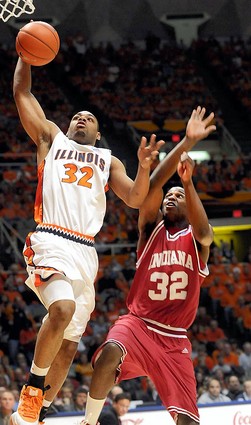
As Illinois anihilated Indiana by 31 points on Sunday, I felt a certain amount of vindication with the plight of the Hoosiers.  My hatred of the Indiana Hoosiers has been well-documented on this blog over the past couple of years with the actions of Satan’s Spawn – I want these guys get pummeled more than any other team in all of sports, including the Packers and Duke.  The tough thing going forward, though, is that I have a massive amount of respect for new IU coach Tom Crean, particularly with how he was always able to produce extremely competitive teams in the Big East at a Catholic school in Marquette that doesn’t have a football program to supply loads of revenue (unlike the horrific first 4 years of DePaul in arguably the toughest basketball conference in the nation, which I’ll be writing about in a separate post shortly).  Despite that, I can guarantee you that I’ll never get over the way Indiana completely bent Illinois over in the Eric Gordon situation – when one of your biggest rivals takes steps to completely fuck over your program in the long-term, you can never forget.

Fortunately, this season for the Illini has been more than a fantastic surprise on my end.  Back in October, I was basically counting down the days until Alex Legion could be activated and looked at it as a rebuilding year overall.  In fact, I thought that Illinois would look a lot like last year’s team and be hard-pressed to receive a bid to the NIT, much less the NCAA Tournament.  Instead, the Illini have proven to be a pretty good (not great) team in a revitalized Big Ten and would easily be in the NCAA Tournament if the season ended today.  Assuming that we don’t end up taking conference’s automatic bid in the Big Ten Tournament, winning on the road at Purdue and the blowout of Missouri in the Braggin’ Rights Game are already excellent entries on our NCAA Tourney resume.

There are a few key items that I’ve noticed as we get into the heart of conference play.  First and foremost, the Illini can finally score again with regularity after two straight seasons of anemic Bears-like offensive output.  Four Illinois starters are averaging double-digit scoring each game and the team’s overall free throw percentage is over 73% (compared to a Shaq-esque 60.8% last season).  Even though Illinois lost at Michigan a week ago (which will hopefully be avenged on Wednesday night in a quirk in the Big Ten schedule having to play the Wolverines twice in the first four conference games), I was actually refreshed to see the Illini keep up with the frenetic three-pointing ability of scUM up until the last few minutes of the game.  If last season’s Illinois team were on the court, Michigan would have crushed us by over 30 with that type of long-range shooting performance.

The offensive balance has impressive with Trent Meacham and Demetri McCamey both drastically improving their outside shooting and Mike Davis and Mike Tisdale becoming consistent presences in the post.  That balance was something that didn’t exist at all last year, when if the ball didn’t get into Shaun Pruitt, the Illini were pretty much dead in the water.  Just as important is that Chester Frazier has been able to finally get placed into the role that fits him, which is to concentrate on bringing defensive intensity to the floor.  He was unfairly subjected to more booing than anyone last season from the Assembly Hall crowd mostly because he was thrust into a spot where Eric Gordon should have been, meaning that Frazier was being to asked to perform tasks (particularly on the offensive end) no one should have reasonably expected.

Speaking of Frazier’s defense, the rest of the team has performed an excellent job overall on that end of the floor, as well (as characteristic of Bruce Weber-coached squads).  The one concern that I have is that we will have issues with teams that have more athleticism (as exposed by Michigan and will be seen even more so against Michigan State on Satruday) – Illinois has shown to be a better than average running team, but they are more suited to agressive half-court sets throwing down to Tisdale or Davis for short baskets or kicking out to McCamey or Meacham when the buckets in the paint aren’t there.

This year’s Illini feel like the 2005 Ohio State team that happened to upset a perfect Illinois regular season, where Buckeye fans were initially looking forward a year to the incoming Greg Oden/Mike Conley recruiting class but were pleasantly surprised by the quality play of that veteran-laden team.  Similarly, most Illinois fans (including me) were focused on the excellent recruiting classes that will be coming to Champaign over the next couple of years, yet these Illini are making everyone take notice a year ahead of time.  I’m just thrilled to see Illinois safely back on the Bracketology projections again.

(Image from Chicago Tribune)