The Best of Both Worlds: A Modest Proposal for a College Football Playoff That Keeps the Bowls

Sports leagues and teams enact measures all the time that make them more money yet are detrimental to fans, such renaming ballparks for corporate sponsors (Comiskey, despite being the last name of the cheapest bastard in baseball history, should still be the namesake of wherever the White Sox call home forever) to stretching out postseason play to last two months (I seriously love David Stern and the NBA Playoffs, but we do need have some parameters in place). Yet, if you ask the average sports fan how he or she would like to have the champion of college football be determined, the overwhelming response is that there needs to be some type of playoff system. At the same time, the television networks would fall all over themselves in writing checks that would dwarf what CBS currently pays for the NCAA Men’s Basketball Tournament (which hopefully won’t be screwed up) to broadcast college football’s “December Madness”.

Despite such a rare confluence of interests between the fans and the financially-driven institutions, however, the college presidents seem to get more stubbornly deadset against a playoff system every season while backing the less-than-satisfactory Bowl Championship Series. This continues to be one of the world’s great mysteries, right up there with the location of the Holy Grail and how “Two and a Half Men” is not only still on the air, but is a certified top 10 hit.

Therefore, I propose the following relatively simple solution that ought to appease the fans’ clamor for a playoff system, keep the bowls intact for the college presidents, and has a realistic chance to be actually implemented: take the 4 BCS bowls, keep the traditional matchups (i.e. Big Ten vs. Pac-10 in the Rose Bowl) with the at-large bids given to the two highest ranked teams that didn’t win their BCS conference or were champions of a non-BCS conference, and make those games the quarterfinals in a national championship playoff that will be played on a weekend in the middle of December. The winners would then advance to semifinals that are played on New Year’s Day and the championship game would be played a week later.

From my perspective, this playoff/bowl hybrid would address all of the most frequently cited reasons and impediments against having a playoff system. Let’s go through the reasons why I believe this hybrid model would work and have a reasonable chance to be put in place:

1) BCS Schools Keep Control – Forget about all of that lip service about academics or the season being too long (although I’ll touch on those subjects later). The largest reason, by a landslide, as to why there isn’t a playoff system in place right now is that the BCS schools receive wildly disproportionate financial benefits under the current bowl arrangements. Thus, they have little monetary incentive to have an NCAA Tournament-style playoff for football.

Under the playoff/bowl hybrid, the BCS schools would be able to retain their financial advantage, or even add to it, while finally giving the fans what they want. This might not appease the supporters of the smaller conferences that want more access to the top tier games, but they would at least have an equitable chance at an at-large spot under my proposal (as opposed to having Notre Dame get invited as long as they win 9 games regardless of their ranking because of the school’s popularity). The reality is that the BCS schools will never willingly go to a completely NCAA Tournament-style open playoff system or give up their automatic bids (they would seriously secede from the NCAA before that ever happens). If a playoff for college football is ever going to be put into place, the BCS schools are going to insist upon receiving similar advantages that they currently have. In the end, a playoff/bowl hybrid, even if the BCS retains its power, is a whole lot better option than what’s in place now.

2) The Season Wouldn’t Be Extended Any Longer Than It Is Now
– I have always felt that the detractors of a playoff citing that the season would be too long were always full of bunk. The lower divisions of college football all have playoffs, while BCS bowl participants currently have a layoff of a month or more between their last regular season games and the bowls. Not only that, the national championship game will be played on January 8th beginning next season.

There’s no reason for such a long layoff between games (don’t give me academics as a reason – Division 1-AA teams play in playoff games that go straight through December), so that’s why I proposed moving the quarterfinals to a weekend in mid-December. That would allow the semifinals to be played on New Year’s Day (with the added benefit of having the games being played on that holiday mean something again) and the championship game would be played no later than it is now. As a result, the “season would be too long” argument carries no water here.

3) Regular Season Would Mean More Rather Than Less – The small number of fans that are against going to a playoff system almost always argue that they do not want to diminish the importance of the college regular season (i.e. they say that the season is already a 12-week playoff). I sympathize with those thoughts. The beauty of the playoff/bowl hybrid is that every BCS conference regular season championship race now also has national championship implications as opposed to having just one or two games that matter across the country by the end of October.

A perfect example of the problems of the current system is how last season played out, where by the middle of the year the only games that had national implications were the ones involving USC and Texas. In my opinion, spending half the season where 60 games per week don’t really matter isn’t a great way to have a strong and interesting regular season for fans across the country. By using the playoff/bowl hybrid, however, the regular season will have more meaningful games involving more teams and conferences up until the last week since winning a BCS conference championship automatically means a chance to play for the national championship.

4) No More Judgment Calls Regarding Championship Participants – One of my biggest pet peeves over the past two seasons is hearing people state that the BCS system has “worked” since the best two teams have been placed in the National Final. This is a ridiculous notion – the BCS got lucky by having two straight years where there were only two teams at the end of the season that were undefeated. Did all of those current system supporters suddenly forget the previous seasons when there were multiple one-loss teams vying for a spot in the championship game based upon a convoluted formula? That is anything but a system that works.

Now, my proposal keeps the BCS rankings, but they are instead used for the two at-large spots as opposed to determining who should play in the final. While there would inevitably be controversy regarding which teams deserve those at-large spots, that would be no different than arguing about the last at-large spots to the NCAA Men’s Basketball Tournament. Besides, if a team takes care of business during the regular season and wins its BCS conference, that school is going to have an automatic chance for the national championship. Having controversy over a team that didn’t win a BCS conference getting into the playoffs is a lot more acceptable than what has happened under the current system, where top teams that did win their conferences have been denied a spot in the national final. It’s not perfect, but I believe that it’s a solid trade-off that’s on par with what is in place its college basketball counterparts.

5) Tradition of the Bowls are Kept Intact – As a Big Ten alum and fan, there is definitely something special about the conference’s relationship with the Rose Bowl and the Pac-10 that I would never want to see go away. Under the playoff/bowl hybrid proposal, the paegentry and tradition of each of the BCS bowls would still carry on. Not only that, all of those bowls would matter again as the quarterfinals to the national championship as opposed to being the glorified consolation prizes that they are now.

There you have it – a proposal to create a college football playoff that also keeps the bowls and addresses all of the arguments that have been levied against a normal playoff system. The vast majority of sports fans want to see this happen and the BCS would make even more money than they do now. So, the only question is how much longer the presidents of the BCS schools continue to be stubbornly tied to a position that makes no sense. Judging by what little advancement there has been on this issue over the years, it will probably a lot longer than I’d care for.

Chi-Town vs. Motown: Rivalries Across the Board

Dennis Rodman. Ben Wallace. John Salley. Magglio Ordonez. Al Simmons. Chris Chelios. Erik Kramer. Bobby Layne. All of these prominent sports figures from past and present have one thing in common: they have played for teams in both Chicago and Detroit during their careers. Chicago sports teams might have individual rivals from cities other than Detroit such as the Green Bay Packers and St. Louis Cardinals that are more pronounced. However, Chicago and Detroit are linked by having geographically defined and historic rivalries in every sport across the board whether it’s in the professional or college (when taking into account the Big Ten plus Notre Dame) ranks. Not even New York vs. Boston (they have the pro sports covered, but you couldn’t pay enough money to the average person on the street to watch Rutgers play Boston College in anything on the college front) or Los Angeles vs. San Francisco (L.A. doesn’t have an NFL team while the Bay Area only has a quasi-NBA franchise in the Warriors) have sets of sports rivalries that run as wide and deep as Chicago vs. Detroit. With the important series between the White Sox and Tigers (the Sox took game 1 last night after a marvelous performance by Jon Garland) occurring this week, here’s my ranking of the top Chicago vs. Detroit rivalries taking into account history and present fervor:

1) Bulls vs. Pistons – As I’ve stated before, the Bad Boy Pistons were the first team I ever had pure hatred for during my childhood. During the late-1980s and early-1990s, this was the most heated rivalry in all of sports with annual nationally televised Christmas Day matchups at the old Chicago Stadium and inevitable meetings in the NBA Playoffs, coming to a peak when the Pistons walked off of the court after being eliminated by the Bulls in 1991 without even acknowledging Michael Jordan and his team. The rivalry subsided when the Bulls, during their 1990s dynasty, eventually found new foils in the Knicks and Pacers and then the Pistons rose back to dominance after the start of the new millennium right when Chicago went into the cellar. However, with Ben Wallace defecting from a Motown fan base that loved him to go to Chicago out of all places (the basketball equivalent of Johnny Damon spurning the Red Sox for the Yankees), these two franchises are going to be rekindling that old hatred this season and beyond.

jordandumars_030311.jpg

2) Notre Dame vs. Michigan – Michigan fans will tell you that while Ohio State, without question, is their biggest rival, they save their harshest vitriol for the Irish. At the same time, even though Domers count USC as their most important game of the season, there’s a certain respect for the Trojans in contrast to the pure hatred for the Wolverines. Notre Dame and Michigan are the two winningest programs in college football history with fight songs that are beaten into everyone’s heads, whether or not they care one iota about these teams, from birth. When you add in the pompous fans on both sides, the only thing comparable to this game is watching the Yankees play themselves in an intrasquad game: you hope there’s a way that both teams can lose. Regardless of how much I might hate these teams, the college football season really doesn’t start until Notre Dame plays Michigan in September.

(Sidenote: I really wish I could put Illinois vs. Michigan on this list, but I’ve learned over time that the “rivalry” is completely one-sided with my Illini brethren. Now, the most emotionally scarring sports moment that I have ever witnessed at an event that I actually attended was the 2000 Illinois – Michigan football game, where the Illini had the game stolen by the Big Ten referees who, with less than four minutes left in the game with Illinois ahead, incorrectly called a fumble by Illinois’ Rocky Harvey when he was actually down and then seconds later inexplicably didn’t call a fumble on Michigan’s Anthony Thomas when he dropped the ball when his knees weren’t anywhere near close to the ground. Michigan would go on to score the winning touchdown on that drive. The errors were so egregious that the Big Ten issued an unprecedented apology to Illinois a couple of days later and spurred the conference to begin using instant replay. What happened in Champaign that Saturday evening wasn’t a case of heartbreak a la Illinois losing in the 2005 NCAA Championship Game. Instead, it was probably the only time I’ve ever felt completely violated after watching a sporting event. To say the least, my disdain for Michigan peaked at that point.

However, when I went to law school at DePaul, the two undergraduate schools that matriculated the most students there by a substantial margin were Illinois and Michigan. Everytime I spewed my anger toward the Maize and Blue, my Michigan alum classmates were sincerely and genuinely perplexed. They had absolutely no feelings toward playing us whatsoever. In fact, a number of them upon moving to Chicago even started cheering for Illinois when they weren’t playing Michigan. They simply didn’t think about us at all as any sort of rival – we might as well have been Northern Illinois. While learning about this apathy was initially even more enraging from a personal standpoint, it also made me realize that Illinois vs. Michigan was a fictional rivalry and we, as Illini fans, look pretty petty into making the matchup into something more than what it actually is. This is now so apparent across the Big Ten that the Michigan Daily even had an article a couple of years ago examining how much we hate them in contrast to their ambivalence toward us. From that point on, I decided that if I was going to hate a team that really wasn’t a true rival of the Illini, I’d redirect more of my sports rage toward someone outside of the Big Ten: Duke. Of course, that’s not to say that I won’t continue to drop “Muck Fichigan” lines at every opportunity.)

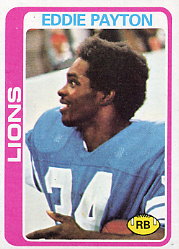
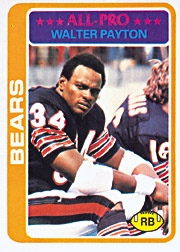
3) Bears vs. Lions – In 1934, the Detroit Lions began their tradition of playing on every Thanksgiving Day by matching up against the Chicago Bears. When examining longevity and frequency, only the Packers are bigger rivals to the Bears than the Lions. While in terms of sporting excellence this rivalry has seen better days, the Bears and Lions are, year-in and year-out regardless of records, the most important franchises in their respective cities. So, as we wait for Matt Millen to put together an offensive formation that features one quarterback and ten wide receivers, we can appreciate the history between these two NFL teams along with the passionate fan bases that they bring to the table.

walter-payton-1978.jpg eddie-payton-rookie-card.jpg

4) Blackhawks vs. Red Wings – As I mentioned a few weeks ago, this rivalry once would have been the clear and undisputed #1 on this list. However, this matchup is looking more like Illinois vs. Michigan as opposed to Bulls vs. Pistons with every inept team that the Blackhawks trot out on the ice. Still, there’s incredible history here, from their mutual status as Original Six franchises to the Bobby Hull vs. Gordie Howe boxing matches.

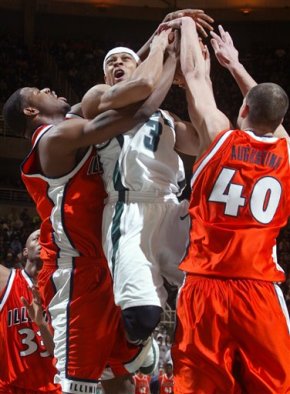
5) Illinois vs. Michigan State – A continually growing college basketball rivalry that is based more on excellence as opposed to bad blood. When looking at the Big Ten over the past decade, these two programs have perennially been at the top of the conference, which makes their annual matchups that much more important. For the record, if I had to pick the one head coach in college basketball other than Bruce Weber that I respect and admire over everyone else, it would definitely be the Spartans’ Tom Izzo.

illini-msu030406.jpg
6) White Sox vs. Tigers – This season, these two teams are battling for supremacy in the American League. I’ve got to rank this rivalry at #6, however, because they have spent the last one hundred seasons as pretty lackluster franchises. It wasn’t very long ago that the Tigers were battling to avoid losing 120 games in a season, while the White Sox finally broke an 88-year World Series championship drought in 2005. If these two clubs can sustain some success over multiple seasons after this year, then we’ll have another true rivalry on our hands.

And finally…

7) Cubs vs. Tigers – This isn’t a real rivalry at all, but it serves me with an opportunity to remind my readers that are Cubs fans that your team (a) hasn’t won a World Series since 1908, when they defeated none other than the Detroit Tigers in five games and (b) hasn’t won a National League pennant since 1945, when they then lost to the Detroit Tigers in the World Series in the maximum seven games. The Circle of Life continues (as well as the Curse of the Billy Goat).

(Images from Pistons.com, Beckett.com, Beckett.com, FightingIllini.com)

Beaming Up the Big Ten Channel

As I noted yesterday, the Big Ten has entered into a deal with Fox and DirecTV to launch the Big Ten Channel in August 2007. After reviewing the details of this network coupled with the conference's new agreement with ABC/ESPN (which in and of itself also improved the conference's exposure), I believe the Big Ten has made a great deal both financially for its member institutions and in terms of exposure for its fans across the nation.The key element of this deal, from my perspective, is that DirecTV is going to be carrying the channel nationally on its Total Choice tier (the equivalent of basic cable) as opposed to the premium sports tier (which subscribers need to pay extra for a la HBO or Showtime). That means every DirecTV subscriber in the country will receive the network. Considering that NBA TV, ESPNU, and CSTV are all on the premium sports tier, this new deal is indicative of how powerful the Big Ten Conference is on its own.

How does this change things for the average Big Ten fan? The largest item is that there will no longer be the syndicated ESPN Plus package for football and basketball games on local television stations – all of those games will be moved to the new Big Ten Channel. There are some pluses and minuses to this. On the positive end, all of those previously locally televised games will become national telecasts with, at the very least, respect to DirecTV.

The potential problems stem from the prospect of the Big Ten Channel first, not having those games available to those that do not have cable and second, for those without DirecTV, not being able to get onto basic cable in, at minimum, its home team markets in the Midwest and Northeast. For instance, if the Big Ten Channel isn't able to get onto the basic tier of service on Comcast Cable in Chicago, Illinois fans and other Big Ten alums in the Windy City will be shut out from a significant portion of their teams' telecasts. I'm a DirecTV subscriber (and I absolutely recommend it 110% over Comcast – if at all possible, get the dish) so it won't affect me personally, but it will not be a positive change if the average Big Ten fan either has no access or has to pay extra for access to games that were previously provided for free over-the-air. Getting onto the basic cable systems in the Big Ten home media markets is essential (any carriage outside of that would be gravy).

The network is a significantly positive development for the fans living outside of their favorite team's home market since those that are DirecTV subscribers will get access to games that they previously had to pay extra for on ESPN Full Court. Thus, this won't only benefit the Illini fan living in Florida, but also the Ohio State fan living in the heart of Big Ten Country in Chicago or Indianapolis. This also means that I'll be able to watch every single Big Ten football and basketball game from the comforts of my leather sofa, which means that I'm probably not going to be moving away from my television much from September through March. (Note: my appetite for Big Ten sports is so insatiable that I end up watching most Northwestern games, who play something that vaguely resembles basketball, just to tide me over between Illini games and other big conference matchups).

With all of the hub-bub regarding the new network, it's easy to forget that the Big Ten also significantly improved their deal with ABC/ESPN, with every ABC regional football game being broadcast nationally on one of the ESPN networks in the markets where the ABC affiliate isn't showing the Big Ten game along with more basketball telecasts on ESPN with a new nationally televised Thursday night game that's in addition to Super Tuesday (hooray for more games not involving Duke or UNC). That means that the Big Ten has increased the number of nationally televised football and basketball games on both ABC and, most importantly, the worldwide leader of ESPN.

On top of all that, there's the monetary aspect of the deal. Sources from Iowa and Michigan State report that each school is expected to receive an additional $7.5 million in revenue in the first year for the Big Ten Channel alone. Keep in mind that this figure doesn't even include the Big Ten's separate contracts with ABC/ESPN and CBS for men's basketball games (the old television contracts are expected to give the Big Ten $6.4 million in 2006, which is a number that should go up with the new ABC/ESPN contract). That means the Big Ten is looking at upwards of $14 million per year in television revenue for each school. To put this in perspective, Notre Dame, which is the standard-bearer when it comes to money and college sports, made $6.43 million per year in its deal that ended in 2004 with NBC (figures for the current Notre Dame/NBC deal are unavailable, but the annual rights fees in the contract ending in 2004 were actually lower than the first deal signed between the two entities in the 1990s). (Update: Other reports pegged the amount of the Notre Dame/NBC deal at $9 million per year).

These numbers mean two things: (1) the Big Ten has put itself into position to be the most financially dominant conference in the country, if it wasn't already and (2) expansion of the conference will almost certainly not happen unless that new member is named Notre Dame. I suggested a few months ago that if the Irish continued to balk at the prospect of joining the Big Ten, the conference ought to look at Syracuse as a potential 12th member. With this new deal, however, it will take a new member to provide upwards of $14 million per year in additional revenue just for the current schools to make the same amount of money with 12 teams as they had with 11 teams. Even with additional money from the creation of a Big Ten football championship game, I doubt that anyone other than Notre Dame could possibly provide the additional revenue that would make expansion worth it for the conference.

There are certainly risks from taking content that networks would surely pay a lot of money for in-house, but the Big Ten is the one conference that overcome such negative prospects. The Big Ten's home base of markets that includes Chicago, Detroit, and Philadelphia is the largest and strongest out of any other conference while its alums are spread widely from the Michigan and Penn State grads on the East Coast to the Illinois and Wisconsin expats in the Sun Belt and West Coast. All in all, this looks to be a great deal for the Big Ten and reaffirms it as the preeminent conference in college sports.

Other thoughts from across the nation on the Big Ten Channel:

1) A Look at the Big Ten Channel (IlliniBoard)

2) Big Ten Network is Set Up with Fox (New York Times)

3) Big Ten Gambles on TV Channel (Chicago Tribune)

4) A Big Ten Channel Would Be A Big Boon (Sporting News)

5) Will Cable Outlets View Big Ten Channel as Must-Carry TV? (Capital Times)

6) Big Ten Creates its Own Network (SportsBiz)

And finally…

7) Big Ten Network Unfortunately to Include Northwestern, Purdue and Minnesota Games (Sports Pickle)

Land-o-Links – 6/21/2006

What an evening! Mark Cuban got fined $250,000, Dwyane Wade lived up to the Michael Corleone analogy Shaq dropped a few months ago (where Kobe Bryant is Sonny and Penny Hardaway is Fredo), the White Sox hammered in 20 runs on the Cardinals, and Ozzie Guillen turned a new rookie into a sacrificial lamb in yet another beanball war. On top of that, there was such a plethora of fantastic news that I just had to post some more links for today:

1) Guillen Has Choice Words for Mariotti (Chicago Tribune) – How those in professional sports feel about Jay Mariotti.

2) Jay the Joke – How all of the rest of us feel about Jay Mariotti (actually, Ozzie summed it up pretty well above, but the detail on this blog is a public service to society as a whole).

3) YWML Suddenly Huge With 13-Year-Olds (Deadspin) – Frequent Deadspin readers will understand why this is such a ridiculously hilarious development. For those that need a refresher course, just consult your friendly Wikipedia.

4) Nine Lives, Still Intact (Hartford Courant) – The life of Lewis the Cat was spared by a Connecticut judge yesterday, although he'll be on house arrest for the rest of eternity. We in the legal field call this "The Martha Stewart Treatment" (celebrities get all of the breaks).

5) Big Ten Creates Another Revenue Channel (The Wizard of Odds) – All Big Ten, all the time. You had me at hello.

And finally…

6) Career Suicide (Siberia, Minnesota) – There are some things that you see and you can't unsee them.

Land-o-Links – 5/16/2006

I hope all of you got your helpings of "Grey's Anatomy" and "24" last night without any delays caused by Dubya. Anyway, on to today's links:

1) What Happened to Michael Jackson's Fortune? – This ought to be the first installment of a new E! or VH1 series about how celebrities have blown their fortunes, such as "What Happened to Hammer's Fortune?" or "What Happened to Gary Coleman's Fortune?" That's got to be better than another installment of some stupid list show that invariably concludes with a story about a Brad-Angelina-Tom-Katie cyborg baby.

2) Lost on Thursdays? – ABC might have finally figured it out regarding non-stop seasons. (Update: ABC has made it official that it will run "Lost" continuously and without repeats next season, but it's staying on Wednesday nights.  Instead, "Grey's Anatomy" is moving to Thursday.)

3) NU Probes Alleged Hazing – I'm proud to say that the representatives of my alma mater's athletic department actually have some class and dignity, unlike those Dookies and Wildcats.

And finally…

4) Ron Zook Rocks It, Dude, Totally (submitted by Minneapolis Red Sox) – Um, let's scratch what I just stated above.

Who Do You Root For? The Choice is Yours… or Not.

If you've read "Now I Can Die in Peace" by Bill Simmons (ESPN.com's Sports Guy), he has a list of rules in the book's introduction on how and when you can be a fan of a sports team. Essentially, you need to cheer for the teams in the region that you grew up in (for college sports, you or your parents need to be alums or you grew up in a town or region where college sports dominated the scene) or the teams that your parents that transplanted from or went to school elsewhere raised you to root for unless your favorite team relocates to another city (or, as in the case of the Blackhawks, the team's owner destroys all will of the fan base completely). Dan Shanoff, also from ESPN.com, has some more flexible rules regarding how you can pick a team (such as "fan-in-law" status by marriage – I don't know if I buy that one). Finally, Minnesota Red Sox broached the subject of raising your child as a fan of a team other than your own in order to avoid constant heartbreak (great article, although Minnesota Red Sox must freely admit that he broke a number of the Sports Guy's rules, such as committing "sports bigamy" by being a diehard fan of both the Cubs and Red Sox along with having to answer questions from a higher power at the pearly gates in the future as to how he could ever, ever, ever cheer for the Packers after being raised in Chicago).

I tend to agree with the more restrictive tenets set forth by the Sports Guy. It's one thing to jump on the bandwagon of a great story, such as the Red Sox comeback in 2004 or George Mason this year, but a person should only be a true fan of one team for every sport. For me, it's the Fighting Illini, Bears, White Sox, and Bulls. There are other teams that I follow with a lot of interest, such as DePaul and the Cubs, but make no mistake about it – there will never, ever be an instance where my rooting interests aren't 100% clear if any of those two teams meet. I spent three years in law school at DePaul and want the Blue Demons to do well, but if Illinois ever plays them in basketball, every ounce of me will be cheering for the Illini.

What infuriates me are sports cherrypickers. For instance, I read a Steve Rosenbloom interview with Penny Marshall a few months ago where she expressed how she is a diehard fan of both the Yankees and the Lakers. Jack Nicholson and a host of other celebrities claim to have the same loyalties. This is why half of America believes that Hollywood doesn't have a soul. Certainly, it doesn't have a sports soul when its citizens pick the two most powerful franchises in sports to root for that, by the way, are located on opposite ends of the country. It's like rooting for both Hitler and Stalin. That's just sickening.

Almost as bad is our favorite Duke apologist Dick Vitale also being honored as an honorary alum of Notre Dame as well as being a season ticketholder for Irish football games. A Duke basketball/Notre Dame football fan – could you imagine anyone being more insufferable? At least Dicky V has somewhat of an excuse since he's sent his kids to Notre Dame. In his aforementioned column, Shanoff states that a parent that spends $40,000-plus per year sending a kid to a school gives that parent every right to cheer for that school. Considering that tuition for a year at Notre Dame could buy me White Sox season tickets for the next 40 years, I'll side with Shanoff on this one. Still, just the thought of a Duke/Notre Dame combo gives me the heebie-jeebies.

I'll grant that there are large sections of this country that might not have a natural rooting interest dictated by geography or people that went to schools that either don't have sports teams or don't care about sports. So, at first, I thought that those people could be entitled to a "team draft" of sorts, where they could pick teams to root for but couldn't get greedy. For instance, if I'm a person that lives in North Dakota, I could root for the Yankees, but since I picked such a dominant baseball, I would need to take, say, the Arizona Cardinals as my football team. That would ensure that evil combos such as the Yankee/Laker fan wouldn't become a nationwide epidemic.

As I started thinking about it more, however, it became clear to me that there are just certain teams that no one should ever cheer for unless there is some type of geographic/family/alumni connection. Here's my top ten list counting down in reverse order:

10) New York Knicks – Every year, teams vie for the ESPY Award for The Most Putrid Team That Sportscenter Pays Way Too Much Attention To. We've had a banner year in this category, with the top contenders being the Eagles ("T.O. is selfish, crazy, and wants to get paid? This calls for a breaking Sportscenter Update!"), Cubs ("Prior and Wood are both hurt at the same time? I haven't heard that one before!"), and Lakers ("From an unconfirmed source, Shaq reportedly said he saw Kobe and R. Kelly handing out room keys at the Brookwood Junior High graduation dance"). Unfortunately for all of these teams, the Knicks have captured this award for the 57th year in a row, which just happens to be how long the NBA and its New York franchise have been in existence.

9) Indiana Hoosiers – If you went to a different Big Ten college, you don't need any explanation. If you didn't go to a Big Ten college, all you need to know is that they're evil.

8) Michigan Wolverines – See #9 above.

7) San Francisco Giants – This doesn't have anything to do with the franchise itself, which has blessed baseball fans with Bobby Thompson's "Shot Heard 'Round the World" and Willie Mays. The Giants are here simply because of the "Despicable Athlete" exemption (other qualifiers from the past and present: any team with Terrell Owens or Bill Laimbeer), although Bay Area fans seriously need to get some perspective. I know all about blindly cheering for your team, but c'mon, folks, this is beyond being in denial.

6) Dallas Cowboys – Honestly, I really don't care about T.O. that much – he just seems to be a common thread on this list so far. With or without T.O., however, the Cowboys would be high on this list one way or another as a carryover from their high-minded attitude during their dominance in the 1990s. Now, with T.O. plus Bill Parcells, the Cowboys might become the foremost challenger the Knicks have ever had to that ESPY Award described in #10 above (as long as Isiah Thomas is at the helm, though, put your money on the Knicks).

5) USC Trojans – If you skimmed the top 1% of the Laker fan base in terms of income and snobbiness, you'd be left with USC supporters. In addition, have I told you how much I hate their fight song? For some reason, the average person on the street believes that the USC Trojan Marching Band is an elite group since they appeared on some televised Fleetwood Mac concert a few years ago. Rest assured, I heard them play that goddamned fight song live for four hours straight at the first college football game I ever went to in Champaign – they royally suck. Of course, I'll be the first to admit that it would have been a ridiculous amount of fun to go to school there.

4) Notre Dame Fighting Irish – To me, just because you're Irish Catholic doesn't mean that you've got to worship the Golden Dome (which seems to be common refrain here in Chicago). Now, I'll grant Irish fans that going to a game is quite an experience for any sports fan. It's a beautiful campus and seeing Touchdown Jesus on gameday is spectacular. In general, however, if you took away the nice weather, attractive women, and recent national success from their rivals at USC but raised the pompous arrogance up a notch commiserate with having a contract with N(D)BC, you'd end up with Notre Dame.

3) Los Angeles Lakers – All of the other teams on this list do have one admirable thing in common: they've got rabid fans that would die for their teams (even if they are annoyingly insufferable). Lakers fans, however, are without question has the biggest bandwagon jumping fan base of any franchise in sports. The beautiful celebrities show up for games in droves when the Lakers are winning and flee for better clubbing atmospheres when they're losing. The Lakers would be #1 on this list if their fans weren't so pathetic.

2) New York Yankees – In the Sports Guy's book, he noted that one his favorite emails of all-time from a reader stated the following: "Rooting for the Yankees is like rooting for the house in blackjack." Absolutely perfect.

1) Duke Blue Devils – A combination of all of the worst traits of the aforementioned rest of the top 4: the Borg-like perfection/conformity of the Yankees, the loudmouthed and spoiled fan base of Notre Dame, and the bandwagon backers of the Lakers. Coach K doesn't consider himself a basketball coach that happens to be a leader; Coach K considers himself a leader that happens to coach the team that no one anywhere should ever cheer for (unless they fall into one of the exceptions and even those people are suspect) if they have a sports soul.

Illinois is a More Balanced Sports School Than People Think

Tom Dienhart of the Sporting News wrote a post on his blog listing out all of the BCS conference schools and determining whether each one is a basketball school or a football school. He categorized Illinois as a basketball school, but said, “The Whiz Kid and Flyin’ Illini trump Butkus and Halas – barely.”

I note this because, for once, an observer that didn’t attend the University of Illinois actually nailed this right on the head – kudos to Dienhart for this. Most people outside of Illini Nation seem to automatically assume that Illinois is strictly a basketball school that doesn’t care about football. This isn’t an unreasonable premonition considering that Illinois has had one of most successful basketball programs in the country over the past decade while the football program has been correspondingly awful.

However, I’ve had to explain many times to others that Illinois isn’t anything like its Big Ten neighbor Indiana, where football season is considered a mild diversion until Midnight Madness. We do care about football and we do go to games. Is the passion for football in Champaign equal to what one would witness at Michigan, Ohio State, or Notre Dame? Certainly not, but remember that there are only a handful of schools across the country that come anywhere close to the high levels of consistent football support seen at those schools.

My point is that no one should assume that Illinois is just a basketball school. We love the basketball program dearly and it’s definitely been the main generator of excitement for alums and those on campus for quite awhile. However, we also deeply want the football program to get back into the upper echelon of the Big Ten and finally win some Rose Bowls again. Unlike the Hoosiers, Jayhawks, or Blue Devils, it’s in the DNA of Illini Nation to truly care about the state of the football team. Hopefully, we’ll be rewarded with some gridiron success soon to match our prowess on the hardwood court.

More Than a Bracket or a Bowl: Schoolhouse Rocks Over Pros

When I was growing up as a kid in Chicago’s south suburbs, I didn’t think much about the Illinois Fighting Illini. Sure, I followed college sports as a general fan of football and basketball (and my gambling gene came to fruition by fifth grade, when I first started filling out NCAA Tournament brackets), but the teams I obsessed over when I was young were the Bulls, Bears, and White Sox.

This could have been the product of parents who attended the Chicago campus of the University of Illinois (as opposed to Urbana-Champaign), which has never been exactly a college sports hotbed. Plus, while Chicago has a great college sports presence with its proximity to Illinois, Northwestern, the other Big Ten schools, DePaul, and Notre Dame (that’s a wide and passionate fan base compared to New York or Boston), it’s still a pro sports town first and foremost. Certainly, Chicago isn’t a place like, say, Nebraska or even our neighboring state of Indiana, where the travails of the local colleges are the top sports stories not only during the season but in the offseason, as well.

Against all this, however, my sports priorities changed for the rest of my life ten years ago this fall. That was when I attended my first college football game as a University of Illinois student. Unfortunately, the Illini were pasted that day 550-0 by USC (that’s not a typo – I think they’re still scoring on us right now) in front of an ABC national television audience – an ominous foreshadowing of the performance of the Illinois football program until… well, until now. With nothing left to really be happy about (translation: we ran out of smuggled-in booze), we the members of the student section were at least able to taunt the Trojan bench with an “O.J. Simpson” cheer.

Despite having that damned Trojan fight song pounded into my head so badly that I now lash out everytime I hear it, from that point on I was an Illini forever. No other team – not the White Sox, not the Bears, not the Bulls – can evoke as much joy, frustration, and passion for me as the Fighting Illini, whether it’s basketball or football. The school bond transcends everything else.

That’s why March Madness is my favorite time of year. It’s the period where the most passionate sports bond you could possibly have – the one with your school – is on full display across the nation. Since a good number of my friends are people I went to college with, I sometimes forget that there are a lot of people out there who don’t understand or fully appreciate my outright fanatacism about the Illini. They might have gone to a school where sports weren’t on the radar of students or didn’t go to college at all. To them, the NCAA Tournament is the only time of the year where they pay any attention to college basketball, mostly to fill out brackets in an office pool.

There’s certainly nothing wrong with that – whether a school is in a BCS conference shouldn’t be a factor in determining where the average person ought to go to college – but it’s just that those people will never get to experience the pure exhiliration of dying hard for their schools. Anyone can wake up one day and decide to cheer for the White Sox, Cubs, or any other pro sports team (i.e all of the sudden, decent seats at U.S. Cellular Field are really tough to come by). However, there is only a finite number of people in the world, including the athletes that we cheer for, that attended the University of Illinois and we all spent the most memorable times of our lives in the same place. That’s a powerful connection that transcends cheering for pro players that may or may not have any roots in your hometown.

I’m still as obsessive about the White Sox, Bears, and Bulls as anyone. It’s only that my obsessiveness with the Illini is at an even higher level, if my friends and family believe that’s even possible. Despite Chicago having a reputation of having long-suffering fans, I’ve got to admit that I’ve been pretty fortunate as a sports fan. I witnessed the Bears put together the most dominating team in NFL history in 1985. Michael Jordan and the Bulls provided me with the best sports memories of my childhood with their NBA dynasty. The White Sox ended 88 seasons of futility with their World Series championship last year. Considering that my pro baseball, football, and basketball teams have all won championships in my lifetime, I’m pretty blessed.

However, I’d honestly trade all of those trophies for Illinois to win the national championship in basketball and the Rose Bowl in football. My sports life won’t be complete unless I see both of those things happen. Starting tomorrow, the dream of seeing Illinois cut down the nets during “One Shining Moment” could become a reality with 6 more wins. Even though the odds are against that happening this season, that ultimate sports dream is why March Madness is more than just a bracket to me.

Big East Should Have Gone to Graceland

Most people following college basketball this season have come to the conclusion that the newly expanded Big East is the strongest and deepest conference in the nation – certainly, a record 8 bids in the NCAA Tournament makes the case for that argument. What hasn’t been talked about, however, is that the Big East could have been even better.

When the Big East decided to expand a couple of years ago in the wake of Miami, Virginia Tech, and Boston College moving to the ACC, the East Coast conference for the most part found schools from Conference USA that were logical fits. DePaul and Marquette are large city Catholic basketball schools to go along with the likes of Georgetown, Villanova, and St. John’s. Meanwhile, Louisville and Cincinnati are basketball-focused schools that have decent football programs, similar to UConn and Syracuse. Those 4 additions have made a lot of sense even though the geographic reach of the conference is stretched farther west than the original Big East members could have ever imagined.

The 5th addition, however, was stunning: the University of South Florida.  The Conference USA school that was left holding the bag was Memphis, who desperately wanted a Big East invite. Needless to say, the Memphis Tigers grabbed a #1 seed in the NCAA Tournament while USF failed to win a single Big East conference game. As ridiculously stacked as the Big East has been this season, the league could have taken it to a pantheon level if it had Memphis, as well, since UConn and Villanova also grabbed #1 seeds. A single conference with three out of the four #1 seeds would have been the greatest season any league anywhere would have ever had in history.

Of course, adding a conference member needs to be a decision taking into account the long term viability and benefits of a school as opposed to the performance of a team in a single season. But even on that front, USF never made sense. The rationale that the Big East commissioner gave for inviting USF was that the conference needed to have a place in the Florida market. I’m a corporate attorney by day, so I perfectly understand the importance of strong media markets. As I stated before, I believe that the Big Ten ought to invite Syracuse as a 12th team over Pitt, West Virginia, or Missouri (assuming that Notre Dame wouldn’t join) precisely because of the New York and East Coast presence that the Orange would bring. At the same time, I am one of the minority that believes that Boston College makes perfect sense for the ACC. It’s in the best interest of every conference to get the largest and highest quality geographic footprint possible.

The catch, however, is that a school needs to be more than just located in a desirable market; it must be able to deliver that market, as well. This is where USF fails. In a market that boasts Florida, Florida State, and Miami, the Sunshine State doesn’t have much room to pay attention to a fourth college sports team. Plus, USF is at best a mediocre football program while having a simply awful basketball team. The Big East is deluding itself if USF has much of a chance to make any dent on the Florida sports scene.

Instead, the Big East could have grabbed an elite basketball school with a solid football program in the Memphis Tigers. Not only that, Memphis is able to deliver its home market, which is large enough to be an NBA city.

Let’s hope that the Big East corrects its mistake soon. As nice as it is for the other conference schools to get a trip to Tampa during the winter every season, it’s a lot better to add a school that (1) actually has a true fan base in a major league market and (2) can cement the Big East’s status as the top basketball conference in the country.

Big Ten from Eleven to Twelve? If There’s No Luck of the Irish, Bring in More Orange

A Big Ten Wonk post from a couple of weeks ago explored some views from conference fans about adding a 12th team to the Big Ten. The primary advantage to this is that a conference with 12 teams can split into two divisions and hold a football championship game at the end of the season. That was the main impetus of the ACC grabbing Miami, Boston College, and Virginia Tech from the Big East a couple of years ago.

The obvious twelfth team for the Big Ten would of course be Notre Dame. The Fighting Irish have the one football program that consistently draws national attention every year regardless of whether they are good or bad and have long-standing rivalries with a number of Big Ten teams, including Michigan, Michigan State, Purdue, and Penn State. The problem is that there's no program in the nation that has less of an incentive to join a conference than Notre Dame. The Irish recently renewed their TV contract with NBC and the new BCS rules essentially guarantee that the team will receive a major bowl berth if they can get through the regular season with only two losses.

I do believe that Notre Dame will eventually want to join a conference for football and when that time comes, there's no question that they would choose the Big Ten over the Big East. Paraphrasing Groucho Marx, Notre Dame doesn't want to be a member of any club that would have it as a member. That is, the Big Ten is already arguably the most powerful conference in the nation – it would be great if the Irish joined, but the conference is more than strong enough to stand on its own and doesn't need Notre Dame. The Big East, while having a monster basketball conference, is simply awful in football and is desperate to add any decent football program out there. Is Notre Dame, a school that is obsessed with its national profile, going to choose a conference where the best opposing programs are Michigan, Ohio State, and Penn State or one with Pittsburgh and West Virginia as the dominant teams? When thinking along these lines, there's no way that Notre Dame is ever going to join the Big East for football. I wouldn't say the same for the Big Ten.

Still, if there was a 110% guarantee that Notre Dame will never, ever join any conference for football (the Irish rejected a formal invitation from the Big Ten in 1999), the Big Ten ought to move on and add a different 12th team. There's been banter about taking Missouri from the Big 12 or adding Pittsburgh or West Virginia. However, one of the emails printed in the aforementioned Big Ten Wonk post nailed exactly who I believe ought to be that 12th team if there's no shot at Notre Dame: the Syracuse Orange.

To me, Syracuse is the only school other than Notre Dame that would make sense for the Big Ten. The most predominant reason is that the ACC/Big East shakeup has essentially made the Northeastern portion of the United States up for grabs in college football. If the Big Ten has Syracuse paired with Penn State, the conference will have the two schools with the largest fan bases on the East Coast to go along with its dominance in the Midwest.

There are some Big Ten fans that have bemoaned the lack of geographic purity of the conference since we added Penn State. To put it nicely, I think those fans are inward looking people who have no concept whatsoever of the big picture. In this ESPN World where it's critical for college sports leagues to present matchups that have implications at a national level rather than a regional level, it's incredulous to me that we would want to limit the reach of the greatest conference in the country to the Midwestern states.

Let's look at the other candidates mentioned most often. Pittsburgh would be a natural rival for Penn State, but the problem with Pitt is that Penn State already covers the Pittsburgh media market itself better than the Panthers. West Virginia is an even worse choice: the Mountaineer fan base doesn't extend very far past Morgantown – and Morgantown or even the entire state of West Virginia is certainly not big enough in terms of population that the powers that be in the Big Ten would care to grab that market. Missouri is one of the biggest rivals for Illinois, but the Illini also already provide coverage for the Big Ten in St. Louis. The Tigers do open up Kansas City for the Big Ten, but even then, Mizzou has little reason to move when it's already in the financially and competitively strong Big 12 conference. Moving to the Big Ten would be a step up in academic prestige for them, yet that wouldn't be enough to pay for a messy and expensive divorce with the Big 12.

That leaves Syracuse. It's the team that the ACC originally wanted instead of Virginia Tech and for good reason. Syracuse, while down last year, has traditionally had a strong football program. At the same time, the Orange basketball program is consistently one of the best in the country. With Penn State already a member of the Big Ten, Syracuse would have a natural East Coast traveling partner and would not be physically isolated the way Boston College is with the other ACC teams. Since the Big East has been emaciated in football, Syracuse has a strong incentive to switch conferences. Last, and certainly not least, Syracuse has one of the biggest college fan bases in New York City and is considered one of the "home teams" there.

If the Big Ten is going to expand, it should expand its geographic footprint instead of looking within its present boundaries. It's pretty simple to me – New York City and the rest of New York State becoming Big Ten country is a whole lot more valuable than duplicating coverage in Pittsburgh and St. Louis or adding Morgantown. As I said before, Syracuse would make the Big Ten the top football conference on the East Coast as well as keeping its title as the predominant place for college sports in the Midwest. Other than the obvious choice of Notre Dame, I can't think of another school other than Syracuse that could add as much value to the Big Ten.