Big Ten Expansion Index Follow-Up #2 – Nationwide and Longhorns Fan Responses on Texas to the Big Ten

Leading up the National Championship Game (which Texas sadly lost despite about as good of an effort that you could’ve expected from redshirt freshman quarterback Garrett Gilbert having to replace injured starter Colt McCoy in the first quarter), the original Big Ten Expansion Index post and its first follow-up somehow exploded over message boards and blogs over the past few days.  So, I’d like to address a few overarching issues that particular fan bases have brought up and, most importantly, what Texas alums and fans actually think about this (and if those Longhorns supporters are indicative of what that school’s fan base overall believes, then fans of other Big 12 schools are VERY far off on how Texas is approaching this expansion cycle and they better hope their schools are engaging in some CYA of their own).  Obviously, you can only take so much from blogs and message boards since you’ll get a lot of extreme comments, but it’s been fascinating to review the general views and themes that I’ve been seeing from various fan bases.  Once again, I’ll need to put off the additional analysis of other expansion candidates since there’s a whole lot to chew on already.

There’s one issue that I wanted to clear up immediately – a lot of people have questioned my statement that there isn’t any rule that all Big Ten states must be contiguous.  Here is confirmation from an official Big Ten spokesman that there is absolutely no such geographic rule and he also confirms that AAU membership isn’t an outright requirement.  While I believe as a practical matter that the lack of AAU membership is really geared toward allowing an exception for the non-AAU member of Notre Dame (and no one else), I really hope that it gets hammered home that there is no rule whatsoever in the Big Ten charter about geography and conference states having to touch each other.  As I originally stated, that rule is purely an Internet urban legend.  Now that we’ve put that to bed, let’s get to my observations on how the sports message board community is responding to the Big Ten Expansion Index:

1.  Big Ten fans love it – I haven’t come across a single overall fan base that wouldn’t be absolutely ecstatic to see Texas in the conference.  The geographic issues seem to be irrelevant when it comes to a school of the stature of Texas.  In particular, Penn State fans have generally been extremely supportive of the prospect of the move (see Blue White Illustrated, Penn Live and Penn State Hoops as some examples) which was the main fan base that I was interested in feedback from since there has long been the perception that they want an Eastern travel partner like Syracuse or Rutgers.  That perception has turned out the be erroneous – while they might wonder what a school like Missouri would do for them, they are extremely knowledgeable about what Texas would bring to the Big Ten and would be gung-ho about it.  Please also see thoughts from Ohio State (edit: lots of Buckeye fans have jumped on this – here’s another example that includes conversations with Texas alums), Iowa, Michigan State, Wisconsin and Michigan fans.  Simply put, the Big Ten fan bases generally have little concern about where Texas is located.  Of course, there is healthy skepticism as to whether it could ever be pulled off.

2.  Rutgers fans don’t like it and think that I overrated Syracuse – This Rutgers message board was really the one that started the avalanche of visitors.  I started to engage a number of the posters on that board, yet with all of the new comments on my blog post itself coming through, I had to stop the discussion on my end.  The main thrust of the Rutgers supporter argument is that Syracuse doesn’t really deliver the New York City market and even if Rutgers can’t deliver the entire New York DMA, it can at least provide the New Jersey portion, which is valuable in and of itself.  That’s a compelling argument, yet I’m still skeptical that Rutgers can deliver even just New Jersey, much less the entire Tri-State area.  I might be wrong on this and I’m sure this is an issue that the Big Ten will examine closely over the next 12-18 months.  Regardless, I believe my skepticism is valid and it’s why I gave Rutgers a relatively low TV Market Value score despite its great location on paper.  Until there is proof that Rutgers can truly deliver its home market (and not just be located in it), that school is an open question mark.

4.  Missouri fans don’t like it and think that I overrated Nebraska – The general public has long talked about Missouri as one of the front-runners to join the Big Ten, so they certainly didn’t like being ranked below two of their conference-mates, especially Nebraska.  Mizzou fans have a valid point that Nebraska may not meet the academic qualifications, which is something that I acknowledged when I stated in the original post that I was giving the Cornhuskers “the benefit of the doubt” on that front.  I would not be surprised at all if Nebraska got nixed automatically by the Big Ten on academic grounds, yet it’s arguable that the school’s AAU membership will still carry some weight.  The Missouri fans also expressed something in common among Big 12 fans outside of Longhorns fans…

5.  Non-Texas Big 12 fans are convinced that Texas won’t ever want to leave the Big 12 – Please see the message boards from Missouri, Nebraska, Colorado and, of course, Texas A&M virtually all expressing the same strain of thought.  To them, Texas wouldn’t want to (a) go “play in the snow” in Big Ten country, (b) leave their rivals of Texas A&M and Oklahoma, (c) incur massive backlash from the Longhorns fan base and major donors, (d) deal with the political heat in the state of Texas if they were to leave, and, most importantly and by far the biggest reason, (e) ever give up the “control” of the Big 12 that they now have.  As we’ll see from the general feedback from Longhorns fans, only one of the thoughts has really crossed their minds at all on this issue, but we’ll get to that in a moment,

6.  Other fans think that I’ve been ingesting some strong peyote for even suggesting this – Taking a look at boards from LSU, Virginia, the Rivals national college football site and, as we’ll always have to deal with regarding Big Ten expansion, Notre Dame, the thought of Texas going to the Big Ten is so foreign and ridiculous that no financial and academic reasons could rationally support it.  From their perspective, I should’ve just thrown out that the Big Ten should invite USC and Florida, too, with such a low likelihood.  To be fair, the original posters on these threads typically enjoyed my blog post or at least acknowledged that it was an interesting take, where it was then shot down by others like Sonny Corleone at a toll booth.

So, let’s take a look at the people that actually matter in this discussion, which are the Texas alums and fans…

7.  Texas fans are more open to this than I could’ve ever possibly imagined – When I wrote the original Big Ten Expansion Index post, I had a feeling that it would appeal to the financially and academically-minded people that understood the massive differences in revenue between the Big Ten and Big 12, the inherent instability within the Big 12 and the academic benefits of the CIC.  What I didn’t know, however, was how the “average sports fan” at Texas that I referred to so much in that post would take this suggestion.  I could list out all of the financial and academic advantages to Notre Dame fans, yet I was certain they would be steadfast in having an immediate rejection of any thought of joining the Big Ten.  Would Texas fans be the same way?

Well, the feedback that I’ve received from Texas alums and fans has been absolutely astounding, especially when so many have taken the time to review my blog posts when what I would’ve been doing if I was in their position was to look at national championship game stories for days on end.  Please take a look at the following Texas message boards discussing my blog posts at HornsFans and OrangeBloods (subscription required), the comments from my previous two posts, and as these two Barking Carnival posts here and here about the prospect of Texas switching conferences that were written before I had created the Big Ten Expansion Index (so those were organically and separately discussed by Texas fans without my index being a catalyst).  As you’ll see, there was certainly a good number of people opposed to the idea.  There were concerns about the effect on non-revenue sports, particularly baseball, where Texas has a power program.  Some people expressed a preference for going to the Pac-10 or even becoming an independent like Notre Dame.  Recruiting could possibly a factor if there are more road games played outside of Texas.  Finally, there was the important topic about whether it would be politically feasible in the state of Texas for the school to make the move to the Big Ten.

However, the overarching message was very clear to me: Texas fans have virtually no emotional attachment whatsoever to the Big 12 and the alumni are more than willing to seriously listen to the Big Ten.  There was nary a mention about supposed Texas control of the Big 12 nor was there much of a concern of having to play their rivals of Texas A&M and Oklahoma in the non-conference schedule.  Having been through the Southwestern Conference implosion of the 1990s, they are very aware that there are inherent problems in the Big 12, such as the poor TV contract, that will be almost impossible to rectify because of the small TV markets that conference has outside of Texas and they are determined not to be in that situation again.  In fact, it is almost the antithesis of the Notre Dame situation.  Whereas the general public seems to think Notre Dame should join a conference, the Notre Dame alums reflexively reject that notion.  In contrast, the general public appears convinced that Texas would never leave the Big 12, yet a strong contingent of Texas alums have stated upfront that they have no qualms about leaving that conference.

Note that these views didn’t come from a SharePoint-hosted discussion forum from the McCombs MBA program.  These are comments from sports fans on general purpose and widely read Texas Longhorns message boards who you would think would be the very first ones to say, “NFW R WE GONNA LEAVE THE BIG XII CUZ BIG TELEVEN FOOTBALL IS SLOOOW AND SUX AZZ!!!”  So, if fans like these who are more likely to make comments based on emotion are willing to consider moving to the Big Ten, then you cannot discount the accountants in the athletic department that know that they would receive nearly twice the TV money in the worst case scenario, the faculty that would relish access to CIC research funding, and the administrators at the university that need to balance the financial budget and the interests between sports and academics being extremely interested in a conference move, as well.

The intertwined issues of Texas state politics and what happens to Texas A&M were cited as the single greatest obstacles for Texas in joining the Big Ten.  It would be interesting if what Longhorn Lawyer noted in his comment on my initial index post about making sure that “Texas A&M is taken” care of would mean that, perhaps, the Aggies could head over to the Pac-10 along with that conference’s long-time rumored target of Colorado and turn the West Coast league into its own extremely strong 12-school offering.  I’ll have to amend my 99.99999% probability figure that the Big Ten would not go past 12 schools down to about 95% to allow for the possibility that even if the conference’s revenue needs to be split among 14 schools, getting Texas might be so valuable that if it means that the conference also needs to take A&M (which is a pretty valuable school in and of itself), then it’s more than worth it (as Trashtalk Superstar noted in his own comment).  Add on, say, Syracuse to the Big Ten to kick it up to 14 schools and now you’ve added both the states of Texas and New York to the Big Ten footprint and pretty much as close to a national conference as you can get.  I still think that the Big Ten would much prefer simply adding Texas to keep the conference tight-knit at 12 schools (since most of the gains in that 14-team conference could be achieved by adding only Texas only), so that’s really only a very last resort.

Regardless, here are the real takeaways that I want you to have from these discussions are the following:

A.  Remember the Methodology – The way I assigned values to various schools can be endlessly debated, which is more than understandable.  However, the use of the methodology itself is really what I’m aiming for people to internalize.  When you talk about Big Ten expansion, remember to think like a university president and not like a sports fan, 11 + 1 = 13, and put academics, new TV markets and football brand value at the very top of the list in terms of criteria.

B.  Texas is Legitimately Willing to Leave the Big 12 – Maybe the whole Texas to the Big Ten scenario isn’t likely and political obstacles will get in the way.  However, this whole discussion has proven to me that, at the very least, Texas is definitely willing to leave the Big 12 and, as such, would consider a Big Ten invitation extremely seriously.  This means that I’m not setting forth a completely pie-in-the-sky dream scenario for the Big Ten, as a whole lot of people that aren’t associated with Texas have suggested.  Instead, this is a potential move that is certainly a possibility that would radically alter the college sports landscape.  As a result, it behoove the Big Ten to put effectively all of its efforts into luring the people in Austin (meaning both the university officials and, more importantly, the people in the state capitol).  Maybe Texas can take a whole lot more trips to Pasadena in the future.

(Image from USA Today)

The Big Ten Expansion Index: A Different Shade of Orange

The Big Ten has sent college conferences across America into a tizzy with its announcement that it will examine the possibility of expanding. Of course, the announcement was really a non-announcement – the conference has always looked at expansion issues every few years. However, this feels a little bit different this time around where it feels as if though the conference is finally starting to think about options outside of the Irish-born elephant located in the middle of the conference footprint in South Bend that always seems so stubborn (or what they would call “independent”).

A few years ago, I wrote that if the Big Ten ever wanted to expand with a school other than Notre Dame, then it ought to invite Syracuse for a variety of reasons. A lot of the same analysis still applies today, although I wanted to do a comprehensive review of the various candidates using a 100-point index (as I’ll expand upon in a moment). The conclusion is that the best available Big Ten candidate certainly wears orange, but it’s not who most of the general public is discussing (even though it makes incredible sense considering that a new school has to have a massive impact in order to make it worth it for the conference, which is the nation’s oldest and wealthiest, to split the pot 12 ways instead of 11). We’ll get to that in a bit.

I. GENERAL RULES

There are two overarching rules to examining potential Big Ten expansion candidates:

RULE #1: Think like a university president and NOT like a sports fan.

RULE #2: 11 + 1 = 13

The first rule is something that over 90% of the pundits (whether it’s in the “traditional” media or on blogs and message boards) violate with impunity on this subject. A massive number of sports fans see Team A vs. Team B as being a good matchup in this particular season and think that the Big Ten ought to expand solely based on that reasoning yet not even bother to address any academic requirements. Others put a high value on strict geography without even thinking about financial matters such as whether a school will add any new TV markets. Contrary to an Internet-fueled urban legend, there isn’t any rule that says that all Big Ten states much touch each other. Even if such rule existed, finding the right school completely trumps any geographic issues for a conference that looks at itself as an exclusive club. I’m going to hammer on this geography issue A LOT because too many sports fans are hung up on this when the university presidents really don’t care about it as much as being aligned with peer institutions for BOTH academics and athletics wherever they might be located.

As for the second rule, that isn’t just fuzzy math for a conference with 11 members that still calls itself the Big Ten. The reason why the Big Ten has stood at 11 members for so long is that Penn State, which has been an unqualified success in bringing an enormous amount of resources to the conference, is now the baseline standard for any type of expansion candidate. That is, a new school must bring financial, academic and fan base value to the conference that is way above and beyond what an average school would bring to the table. The Big Ten DOESN’T need 11 + 1 = 12, where all that does is add another mouth to feed without materially changing the fortunes of the current conference members. At the same time, the Big Ten absolutely positively will not even consider 11 + 1 = 11.5, where the revenue split per school would actually go down by adding a 12th member. Instead, a viable expansion candidate has to show that by becoming the 12th school in the conference that it would be the equivalent of bringing value that is above and beyond simply adding a conference championship game – essentially, the Big Ten needs 1 marquee school that is worth 2 average schools. Hence, the proper math for the Big Ten is 11 + 1 = 13.

(Note that the excellent Big Ten lawyer blog The Rivalry, Esq. borrowed a modified version of the 11 + 1 = 13 concept in its own analysis of Big Ten expansion candidates and gave a shout out my way in the process.)

So, when some columnist, blogger or message board poster starts talking about Big Ten expansion, remember those two overarching rules at a bare minimum when considering whether the writer has a financially and academically astute brain built for running conferences or a sports stereotype “What have you done for me lately?” brain. Only the former type of brain has any type of credibility.

II. EXPLANATION OF THE BIG TEN EXPANSION INDEX

As I alluded to earlier, I’ve built a 100-point Big Ten Expansion Index that evaluates the viability of each particular school’s Big Ten candidacy. There are 6 categories (Academics, TV Brand Value, Football Brand Value, Basketball Brand Value, Historic Rivalries/Cultural Fit, and Mutual Interest) that receive different weights depending upon how important they are in the decision-making process. If a school were to receive a perfect score in each category, then it would have 100 points. Here are detailed explanations of the categories and how they are weighted:

Academics (25 points) – This is a zero-sum category: either a school meets the academic requirements and receives the full 25 points or it doesn’t. Casual sports fans tend to ignore this component since they just see conferences for how they perform on the field or hardwood. However, academics are heavily weighted in this analysis because membership in the Big Ten also means membership in the Committee for Institutional Cooperation (CIC). That’s not a small consideration as the Big Ten universities plus former conference member University of Chicago share research and resources among each other for academic purposes. Therefore, any expansion candidate needs to fit in with academic discussions among U of C and Northwestern faculty just as much as they need to bring prowess to the football field against Ohio State and Michigan. Membership in the American Association of Universities is preferred but not required if a school is in the upper echelon of the U.S. News & World Report rankings. Tier 3 schools, however, are going to be eliminated right off the bat no matter how much they might bring to the athletic side of the equation.

TV Value (25 points) – An expansion candidate needs to either bring new major TV markets to the conference or be such a massive national name that it would overshadow a small market. Outside of the obvious school in South Bend, any school that overlaps a market that the Big Ten already has today without bringing new markets on top of that will receive 0 points – the most important point that people need to understand is that being within the current Big Ten footprint is a massive negative to the conference. Too many sports fans mistakenly think the opposite way, where they think that because School X is in the same state as Ohio State or School Y used to have a long rivalry with fellow in-state school Penn State means that they are good fits for the conference, when in reality those types of schools bring little or no value to the Big Ten because they don’t add any more TV households to the table. I’ll repeat the mantra here: think like a university president instead of a sports fan.

Another important consideration here is that the Big Ten’s future media revenues are going to be heavily dependent on the performance of the Big Ten Network. As with any basic cable channel, whether it’s ESPN or the Food Network, the Big Ten Network’s revenues and profitability are largely based upon getting into as many basic cable households as possible – pure and simple. The TV ratings for a particular school in a market don’t mean as much as whether such school has enough leverage and drawing power in a region or market to get the Big Ten Network onto basic cable there. What this means is that there’s going to be a heavy premium (if not outright requirement) that a new school delivers the largest number of cable TV households possible on top of what the Big Ten has now. On the flip side, if a school doesn’t add any new Big Ten Network subscribers, then that school is a non-starter.

Football Brand Value (30 points) – This is the most heavily weighted category as a reflection of the reality of the college sports landscape. The revenue generated from football is so massive in comparison to the other sports (including basketball) that no expansion is likely to happen in the Big Ten unless the new school is a bona fide gridiron power. It’s why the ACC was willing to water down its basketball conference with football schools like Miami and Virginia Tech a few years ago and the root of the massive unilateral pushback from the major conferences about any type of NCAA Tournament-esque college football playoff proposal – there’s so much money involved with football that there’s no rational economic reason for the BCS conferences to share it.

It must be emphasized that Football Brand Value puts much more weight on the long-term history and financial underpinnings of a program over short-term or recent success. Thus, Team A that has sold out 80,000-seat or even 100,000-seat stadiums for decades whether it wins or loses is much more valuable than Team B that only sells out a 40,000-seat stadium when it’s in the national championship race, even if Team A has had a mediocre seasons recently and Team B happens to rank in the top 3 of the BCS rankings this year. The “What have you done for me lately?” attitude of most sports fans doesn’t apply here. Instead, the proper question is the opposite: Even if the target school goes 0-12 in a season, will it still attract TV viewers and attendance? In other words, the true value of a football program is really measured by how much attention it still receives when it’s down as opposed to how much attention it gets when it’s up. The Big Ten will only consider programs that have large and real hardcore fan bases that will stick them in good times and bad as opposed to programs that have bandwagon fans that will bolt when there’s a 7-5 season.

Basketball Brand Value (10 points) – Personally, there’s nothing that would make me more delirious as a sports fan than Illinois winning the national championship in basketball. However, when it comes to conference expansion discussions, basketball simply won’t be much of a consideration, which is why the Football Brand Value category is weighted three times as much as the Basketball Brand Value category. A common argument that you’ll see on blogs and message boards is that “Team A won’t leave Conference X because Team A is a basketball school and Conference X is so much better in basketball than the Big Ten.” Once again, this is a sports fan view as opposed to a university president view. As I alluded to before, the financial value of football outweighs basketball interests by such a massive margin that every single all-sports athletic director in America will take a bad football program in a top drawing football conference over a championship caliber basketball program in the best basketball conference without hesitation.

That being said, if all things are relatively equal in the other categories, then basketball considerations could be the tipping point. In that event, this index assigns 10 points to a school that would be a legitimate marquee basketball program in the Big Ten, 5 points to a middle-to-upper middle class basketball school that isn’t quite a top program but would at least provide some depth and 0 points to a school that doesn’t bring anything to the basketball side of the equation whatsoever. There might also be a specific case where the conventional financial argument between football and basketball could be turned on its head (which will be addressed in examining how Big Ten Network distribution could work with a certain school located in Upstate New York).

Historic Rivalries/Cultural Fit (5) – This is more of a “smell test” category. Does a school have existing or historic rivalries with any Big Ten schools? Is the atmosphere balancing academics and athletics at the expansion target in line with the rest of the conference? When the average sports fan looks at the conference alignment, does it seem to make sense? 5 points are given to a perfect fit across the board, 3 points are given to a good fit in some respects but maybe less so in others, while 0 points are given to anyone that simply would stick out like a complete sore thumb (with much more emphasis on the character of the school as opposed to geography).

Mutual Interest (5) – The basic question is the likelihood of whether an expansion candidate would actually accept an invitation from the Big Ten. This is relevant because Notre Dame publicly declined an official Big Ten invitation in the late-1990s, which was a drawn-out process and left a lot of sour feelings among the conference members. As a result, the conference has no desire to invite anyone unless that school has confirmed with its university president and board of trustees that it will say “Yes” without a public debate or discussion. 5 points are given to a school whose university president will be on the next plane to O’Hare and start popping champagne the moment that the Big Ten extends an offer, 3 points to a school that will give an invitation heavy consideration but could go either way and 1 point to a school that will hear the Big Ten out yet will almost certainly reject any offer.

III. EVALUATION OF THE BIG TEN EXPANSION CANDIDATES

The candidates are listed in reverse order from least desirable to most desirable. For the purposes of this evaluation, I’m assuming that the only viable expansion candidates are currently independent or members of the Big East and Big 12. For various reasons, the Big East and Big 12 have the most unstable conference situations where a move to an extremely stable Big Ten would be attractive on paper, while there is little reason for any school to leave the SEC, ACC or Pac-10 at this time (meaning suggestions that I’ve seen elsewhere that the Big Ten should add the likes of Maryland, Vanderbilt and/or Kentucky aren’t going to be examined here). I’ve placed the candidates into tiers of Pretenders, Contenders and The Only Real Choices.

A. Pretenders

CINCINNATI
Academics: 0
TV Value: 0
Football Brand Value: 10
Basketball Brand Value: 5
Historic Rivalries/Cultural Fit: 0

Mutual Interest: 5
Total: 20
Overview
: This is the ultimate example of the short-sighted sports fan “What have you done for me lately?” choice based upon this particular year’s results as opposed to thinking like a university president. Cincinnati is in the third tier of the U.S. News rankings, doesn’t add any new Big Ten Network subscribers since Ohio State already has the city of Cincinnati covered for the conference (and then some) and it would be an urban commuter school in a conference that is largely composed of large flagship universities where nearly all of the students live on campus. For those that think that the Football Brand Value is too low at 10, remember that the criteria is a long history of football success as opposed to recent gains. At the end of the day, Cincinnati couldn’t sellout 40,000 seats until it was in the national championship race (which indicates a high level of bandwagon fandom), its coach couldn’t take the Notre Dame job fast enough despite being the #3 team in the country, and the school doesn’t even have a football practice facility. In contrast, Ohio State has practice facilities that put almost every NFL team to shame. Here’s my personal litmus test for expansion discussions: anyone that mentions Cincinnati as a viable Big Ten candidate loses all credibility whatsoever with me on the issue.

LOUISVILLE
Academics: 0
TV Value: 10
Football Brand Value: 15
Basketball Brand Value: 10
Historic Rivalries/Cultural Fit: 0
Mutual Interest: 5

Total: 40
Overview: Similar to Cincinnati, Louisville is a tier 3 school, which eliminates them off-the-bat. Elite basketball program and excellent fan base overall (even with the football team being in the doldrums lately), yet there rightfully isn’t much buzz about Louisville as a candidate.

IOWA STATE
Academics: 25
TV Value: 0
Football Brand Value: 10
Basketball Brand Value: 0
Historic Rivalries/Cultural Fit: 3
Mutual Interest: 5

Total: 43
Overview: The only expansion name that gets thrown out by the pundits more idiotically than Cincinnati might very well be Iowa State. I’m not exactly sure why the Big Ten would want to take one of the least valuable schools in the BCS that is located in a small state which is already covered by the conference with a much more popular flagship. If it wasn’t for Iowa State having a halfway-decent engineering school, it would be the worst possible Big Ten expansion candidate out there. Yet, Iowa State’s name gets tossed around merely because it’s within the Big Ten footprint, which I’ve already explained is actually a massive negative mark as it doesn’t open up any new markets. Therefore, I’ll amend my original litmus test for expansion discussions: anyone that mentions Cincinnati or Iowa State as a viable Big Ten candidate loses all credibility whatsoever with me on the issue.

WEST VIRGINIA
Academics: 0
TV Value: 10
Football Brand Value: 25
Basketball Brand Value: 5
Historic Rivalries/Cultural Fit: 3
Mutual Interest: 5

Total: 43
Overview: On the field, West Virginia is a solid school across-the-board: excellent football program with a great traveling fan base, an upper tier basketball program and a dormant rivalry with Penn State. However, the off-the-field considerations will kill any talk about the Mountaineers – it’s a third tier school academically and the school brings very few new TV households.

B. Contenders

PITTSBURGH
Academics: 25
TV Value: 0
Football Brand Value: 20
Basketball Brand Value: 10
Historic Rivalries/Cultural Fit: 3
Mutual Interest: 5

Total: 63
Overview: Pitt is mentioned by a lot of pundits as a top candidate for Big Ten expansion or maybe even the very best candidate outside of Notre Dame. Certainly, there is a lot to base this upon: excellent academic research reputation, long history in football, elite basketball program, a great-but-dormant rivalry with Penn State and there’s no doubt that Pitt would accept a Big Ten offer. However, WAY WAY WAY too many people have completely forgotten about the obvious problem with Pitt: just like Iowa State and Cincinnati, Pitt wouldn’t add a single new Big Ten Network subscriber. Penn State already delivers the Pittsburgh market and much more (Philadelphia and the rest of Pennsylvania), so Pitt’s TV value to the Big Ten is zero. It’s unfortunate that Pitt couldn’t trade locations with Rutgers – if that were the case, then Pitt would be an excellent candidate. Alas, the one thing that Pitt can’t change is its location, which means that it won’t ever receive an invite from the Big Ten.

RUTGERS
Academics: 25
TV Value: 15
Football Brand Value: 15
Basketball Brand Value: 0
Historic Rivalries/Cultural Fit: 3
Mutual Interest: 5

Total: 63
Overview: Another popular name that’s being discussed in the general public and it’s almost solely based on the location of Rutgers in the New York DMA. The problem is that it’s highly debatable as to whether Rutgers has the leverage to get the Big Ten Network onto basic cable in the New York City area overall or even in just New Jersey. In fact, a lot of neutral observers would say that the Big Ten already has the most popular school in that market in the form of Penn State, so adding Rutgers wouldn’t even do much on that front. Therefore, the market of Rutgers is fantastic on paper, but its ability to deliver that market is questionable at best, which results in it only having a TV Value of 15. Without guaranteeing the NYC market, Rutgers isn’t really very attractive.

MISSOURI
Academics: 25
TV Value: 15
Football Brand Value: 15
Basketball Brand Value: 5
Historic Rivalries/Cultural Fit: 3
Mutual Interest: 3

Total: 66
Overview: As an Illinois fan, it would be fun to see the Braggin’ Rights games for both football and basketball be taken in-house. However, as someone that always wants the best for the Big Ten overall, Mizzou is more of a “meh” move. There’s some decent value on all of the fronts in terms of academics, TV markets (the portion of the St. Louis market that the Illini don’t deliver and Kansas City), football, basketball and cultural fit, so it’s not as if though there’s anything particularly bad about the school. Yet, nothing screams out that adding Mizzou is a spectacular game changing move by the Big Ten, either. As I stated earlier, Penn State is the standard for Big Ten expansion, and on that front, no one can reasonably put Missouri anywhere near that level. If the Big Ten just wants to expand just for the sake of expanding, then Missouri is a decent choice, but I don’t think that’s the Big Ten’s modus operandi. Therefore, I think that the heavy talk about Missouri going to the Big Ten is mostly coming from the Mizzou side as opposed to the Big Ten side. (Please see this interview with the Missouri athletic director, who seemed to be saying, “Please invite us to the Big Ten!” in the most diplomatic way possible.) Plus, as I’ll get to later, it’s possible that all of the Big 12 schools are up for grabs, in which case there truly is a non-Notre Dame game changer available.

NEBRASKA
Academics: 25
TV Value: 15
Football Brand Value: 30
Basketball Brand Value: 0
Historic Rivalries/Cultural Fit: 3
Mutual Interest: 3

Total: 76
Overview
: I’m giving Nebraska the benefit of the doubt on the academics front here – its undergraduate admissions standards are significantly below anyone else in the Big Ten, but it’s an AAU member with solid graduate programs. Still, Nebraska brings maximum points in the most important category of Football Brand Value. Hypothetically, is Average Joe Sports Fan in Anytown, USA going to be that interested in watching Missouri vs. Ohio State/Michigan/Penn State or Rutgers vs. Ohio State/Michigan/Penn State? Probably not. However, Nebraska vs. Ohio State/Michigan/Penn State will get marked on the calendar by ABC for national distribution immediately an draw massive ratings year-in and year-out. Nebraska’s issue, though, is that while its national reputation is great for traditional TV contracts with ABC/ESPN, its tiny home state doesn’t help much with the Big Ten Network since the school probably won’t spur many cable providers outside of its home markets to add the channel. As a pure football move, Nebraska would be a fantastic addition, but I think the TV market issue is significant enough to keep the Cornhuskers from receiving an invite.

SYRACUSE
Academics: 25
TV Value: 20
Football Brand Value: 20
Basketball Brand Value: 10
Historic Rivalries/Cultural Fit: 3
Mutual Interest: 5
Total: 83
Overview
: As I noted earlier, Syracuse was my favorite Big Ten expansion candidate outside of Notre Dame for a long time. The analysis from my original post still largely stands. If the goal of the Big Ten is to gain entry into the New York market and effectively dominate the East Coast in the same way that it dominates the Midwest, then I believe Syracuse is a much smarter addition than Rutgers. While Syracuse football probably doesn’t have the leverage to get the Big Ten Network into New York DMA households just as Rutgers, the difference-maker here could be Syracuse basketball. New York is a terrible college football town, but it’s a pretty good college basketball city, and on that front, Syracuse is at or near the top in that market. So, NYC residents may not care to get the Big Ten Network for a handful of Rutgers or Syracuse football games per year, but they may very well have enough interest in 10-15 Syracuse basketball games per year to launch the BTN into basic cable distribution there. In essence, the “football means everything in college sports” mantra could be turned on its head here with respect to New York where basketball is the driving revenue factor. I’m not saying that this logic will hold in practicality, yet at least it seems more likely to me than the thought of either football programs at Rutgers and Syracuse really having an impact for the Big Ten in the NYC market.

C. The Only Real Choices

NOTRE DAME
Academics: 25
TV Value: 25
Football Brand Value: 30
Basketball Brand Value: 5
Historic Rivalries/Cultural Fit: 5
Mutual Interest: 1

Total: 91
Overview
: It’s pretty simple as of today – if Notre Dame wants to join the Big Ten, then it’s in. The national fan base of its football program is unparalleled and, frankly, it would propel the conference into East Coast markets such as New York better than pretty much any school that’s actually located on the East Coast.

Of course, it’s easy to see what’s in it for the Big Ten. However, the issue has always been about what’s in it for Notre Dame. While I personally believe that Notre Dame will continue with its current stance in favor of independence, the college sports financial landscape has drastically changed since the Fighting Irish rejected a Big Ten invite in the late-1990s. What the average sports fan doesn’t realize is that Notre Dame’s NBC contract, which is what the uninformed pundits point to as the major reason why the Irish wouldn’t join the conference, pales in comparison to what every single Big Ten and SEC school makes from their respective conference TV contracts. Notre Dame reportedly makes around $9 million per year from NBC, which was a level that made it the top TV revenue school back in 1999. In contrast, ESPN’s Outside the Lines reported last week that the Big Ten is currently making $242 million per year in TV revenue which is split equally among the 11 schools, meaning that everyone from Michigan to Northwestern is taking in $22 million per year. Think about that for a second: the vaunted Notre Dame was the #1 TV revenue maker in the entire country up until just a few years ago, yet it’s now only #3 in its own home state behind Purdue and Indiana (and less than half as much of each, at that).

How did this happen? It’s the fact that the TV landscape has tipped completely in favor of cable over the past decade. Cable channels have a dual revenue stream, where they make a certain amount of money for each subscriber it has every month plus advertising on top of that. In contrast, over-the-air networks can only rely on advertising. For instance, about $3 of your monthly cable bill goes to ESPN whether or not you watch it. ESPN is in over 100 million households, which means that it’s making $300 million per month and $3.6 billion per year in subscriber fee revenue… and that’s before the network sells a single ad… and that’s not counting its revenue from ESPN2, ESPNEWS, ESPNU and ESPN Classic. As a result, ESPN is the single most profitable entity in the entire Disney empire, which is why the network can afford to pay much more for high profile sports events such as Monday Night Football (note that ESPN is paying almost twice as much for MNF as NBC is for a better flex option slate of Sunday Night Football) and the BCS bowls than the traditional TV networks. When Comcast bought NBC Universal last month, the main prize was the stable of profitable cable channels such as CNBC, MSNBC and Bravo. In contrast, NBC itself is bleeding over several hundred million dollars per year in losses and is the main reason why General Electric wanted to sell the entertainment unit in the first place.

While the Big Ten has ensured that its top tier games continue to be shown on ABC for football and CBS for basketball, it has taken advantage of the sports landscape by securing massive cable revenue for its second tier games on ESPN and its own Big Ten Network. The SEC has done the same via its own wide-ranging media rights deal with ESPN. Notre Dame’s issue is that it’s almost impossible for it to take advantage of these financial changes by being outside of a conference unless it moves all or most of its games to cable (i.e. Versus, which is now a sister company to NBC in the new Comcast conglomerate), which defeats the main advantage of having an independent TV contract in the first place (nationwide over-the-air NBC coverage whether you have cable or just rabbit ears). As a result, independence has turned from Notre Dame’s greatest financial asset into possibly its greatest long-term financial liability.

Therefore, the “Notre Dame makes way too much money as an independent with the NBC contract to ever join a conference” argument is simply not true anymore. For the first time in a century, it may very well be in the rational economic interest of Notre Dame to join the Big Ten. The academics and faculty in South Bend already strongly supported a move to the Big Ten in the 1990s because of the CIC research opportunities and now the financial people might be on board. Of course, this type of logic doesn’t necessarily apply to Notre Dame alums (no offense intended for the Irish fan readers of this blog – I sincerely mean it in a positive way that describes the special passion that alums have for the school) – it’s “independence or die” for them. As I’ve thought about this issue more, this longstanding mentality might actually be as much of a roadblock for the Big Ten as it is for Notre Dame. On one side of the ledger, you have school that has spent most of its history protecting itself and profiting from independence. On the other side, you have the nation’s oldest collegiate conference where most of its members have dealt with each other for over 100 years, share everything equally and have a legitimate “all for one and one for all” mentality. Ohio State truly understands that what’s best for the Big Ten overall is best for Ohio State individually. Could Notre Dame ever adopt that type of worldview? It might be impossible, which could lead to a lot of heartburn down the road.

As a result, it would behoove the Big Ten to look toward another powerhouse university where there appears to be much more mutual interest than the pundits are generally acknowledging. This is a school that the Big Ten could add as a 12th member and unequivocally never think about Notre Dame again…

TEXAS
Academics: 25
TV Value: 25
Football Brand Value: 30
Basketball Brand Value: 10
Historic Rivalries/Cultural Fit: 3
Mutual Interest: 3
Total: 96
Overview
: You’re not seeing a misprint – the University of Texas-Austin is the single best possible addition for the Big Ten and the Longhorns are a whole lot more open to it than what the public seems to realize. The average sports fan that has been raised to view college conferences in a regional geographic context probably believes the notion of Texas going to the Big Ten is weird, crazy, upsetting and will never happen. However, as I stated under the Notre Dame overview, the college sports landscape has completely changed from a decade ago where national TV contracts and cable channel distribution now rule the day.

Putting aside any geographic concerns for the moment, Texas is a perfect fit in almost every possible way from the Big Ten’s perspective. The academics are top notch where Texas is one of the nation’s top 15 public universities in the latest U.S. News rankings and its graduate programs are right alongside Michigan, Illinois and Wisconsin as among the elite for public flagships. The football program in Austin was just ranked as the most valuable in all of college football by Forbes magazine (#2 is… Notre Dame) and, unlike Nebraska, the Texas basketball program is playing at an elite level, as well. As I’m writing this blog post, both the Texas football and basketball teams are ranked #2 in the country. At the non-revenue sport level, Texas would completely put Big Ten baseball back on the map. Finally, the value of the Big Ten’s traditional TV deals and Big Ten Network revenue would skyrocket with the addition of the #5 (Dallas-Fort Worth) and #10 (Houston) TV markets in the nation plus the entire state of Texas (the country’s 2nd most populous after California). While it’s questionable whether Syracuse or Rutgers could really break the Big Ten into the New York area, there’s absolutely no doubt that Texas would deliver the Big Ten Network to every single cable household in the Lone Star State. The market impact is incredible – the Big Ten, which already has the largest population base of any conference, would further increase such base by over 1/3 with Texas to over 90 million people. When you start thinking about Texas as a possible Big Ten candidate, the thought of inviting Missouri, Syracuse or Rutgers feels like a inconsequential move.

It’s clear why the Big Ten would want Texas. So, why on Earth would Texas want to join the Big Ten? Well, the financial implications are massive. As I stated earlier, the Big Ten receives $242 million per year in TV revenue to split evenly among its 11 members, which comes out to $22 million per year for every single school. In contrast, the Big 12 receives $78 million per year in TV revenue that is split unevenly among its 12 members based on national TV appearances. That comes out to $6.5 million per year for the average Big 12 school. Even Texas, which is a beneficiary of the Big 12’s unequal revenue distribution model since it receives a large number of TV appearances, received only about $12 million in TV revenue last season according the interview with Missouri’s AD that I linked to earlier. In other words, every single Big Ten school makes $10 million per year more than Texas does on TV revenue whether such school is on ABC 12 times or the Big Ten Network 12 times. Remember that the $10 million difference is more than what Notre Dame receives from its vaunted NBC contract. If Texas were to simply bring enough to the Big Ten to maintain the status quo of per school revenue, that would be an 83% jump in TV revenue for the Longhorns immediately off the bat. Considering that the addition of Lone Star households to the Big Ten Network’s distribution would yield an even greater increase in revenue, Texas would easily see in excess of a two-fold increase and maybe even close to a three-fold increase in TV revenue whether it wins or loses.

The average sports fan will look at those numbers and retort, “It’s not all about the money. It’s about rivalries and the passion.” That’s a fair enough point. However, consider that Texas has only been in the Big 12 for 15 years, compared to the original Big 8 members like Nebraska and Oklahoma that have been together for nearly a century. Texas cares about playing Oklahoma (which was a non-conference rivalry for decades up until the formation of the Big 12 in 1994) and Texas A&M. After those two schools, the general consensus among Texas fans is that they could care less about Texas Tech, Baylor and virtually everyone from the Big 12 North (who are all old Big 8 members). Similar to how most of the schools in the East (particularly Big East schools) consider Penn State to be a rival yet the Nittany Lions don’t reciprocate that feeling, all of the Southwestern schools think of Texas as their main rival while the Longhorns simply don’t care about them. Also note that outside of the states of Texas and Colorado, the Big 12 is a decidedly Midwestern conference, only those Midwestern states pale in population size compared to the Big Ten’s Midwestern base. What this means is that the Texas ties to the Big 12 are fairly loose and not ironclad at all in terms of history while the geographic factor really isn’t that important considering how many Big 12 schools are in the Midwest. If Texas maintains its rivalries with Oklahoma and Texas A&M in the non-conference schedule, the Longhorns keep their two most important regional rivalries alive while opening themselves up to the entire nation during the conference schedule.

Speaking in terms that the average sports fan in Texas ought to understand, think of the Dallas Cowboys. When the NFL realigned its divisions in the 1990s, it strongly considered moving the Cowboys to the NFC West. It made geographic sense and, at the time, the Cowboys were in the middle of its run of great games against the San Francisco 49ers, so there was some emotional juice that could’ve been taken to a higher level with those teams in the same division. However, Jerry Jones completely insisted that the Cowboys stay in the geographically-challenged NFC East. Why? Because the Cowboys wouldn’t be able to continue being “America’s Team” by playing teams in the South and West Coast. In order to obtain a national fan base, you need to play in the major markets in the East. If Texas were to move to the Big Ten, it would break out from being a school with a strong regional fan base into one that could be the equivalent of the NFL Cowboys with a national fan base by playing in a disproportionate share of the largest markets in the country located East of the Mississippi River.

Academics are also an extremely important selling point for Texas. The issue with the academic standards in the Big 12 is that there are no academic standards in the Big 12. Texas is the highest ranked Big 12 school in the U.S. News rankings tied at #47 (the Big Ten schools ahead or tied are #12 Northwestern, #27 Michigan, #39 Illinois, #39 Wisconsin and #47 Penn State) while every single other school in the Big 12 except for #61 Texas A&M is ranked lower than every other Big Ten school (the lowest ranked are Indiana, Michigan State and Iowa tied at #71). No one else in the Big 12 comes even close to the academic research abilities of Texas. The potential entry of Texas into the Big Ten would include membership in the CIC, which opens up a whole new level of academic research opportunities for the school that simply doesn’t exist in the Big 12. The first general rule that I mentioned about discussing Big Ten expansion was that people need to think like a university president as opposed to a sports fan. If moving to another conference would (1) make more money for the athletic department AND (2) improve the academic standing of the university, you’ve made quite a powerful argument to the Texas university president.

Finally, there’s a CYA aspect to all of this for Texas. Please take a look at this discussion about expansion options on Barking Carnival, which is my favorite Texas blog. I was shocked to find very few “BIG TEN FOOTBALL SUX”-type comments and instead saw a whole lot of consternation about the long-term viability of the Big 12 overall. Here’s something that I didn’t think about before: if Missouri were to hypothetically leave the Big 12 for the Big Ten, then the Big 12 could end up imploding (i.e. Colorado would bolt for the Pac-10) or at least be severely weakened. The reason is the subpar Big 12 TV contract that I mentioned earlier. St. Louis and Kansas City are decent markets and Missouri is a decent state for a conference like the Big Ten, but none of them have much of an impact when the conference already has Chicago, Philadelphia, Minneapolis and the entire states of Ohio and Michigan. In contrast, St. Louis and Kansas City are respectively the 4th and 5th largest markets for the Big 12 (and more importantly, respectively the 2nd and 3rd largest markets outside of Texas) and Missouri is by far the largest state in the conference other than Texas. Therefore, the loss of Missouri would cause the currently bad Big 12 TV contract to get even worse since no possible replacement school from, say, the Mountain West (i.e. BYU, Utah, etc.) would come close to replacing those markets and households. In turn, all of the Big 12 schools might be sent scrambling for new homes. While that might be a doomsday scenario, Mizzou leaving for the Big Ten would severely damage the Big 12 at the very least.

So, if all of the Big 12 schools could be theoretically up for grabs, why the heck would the Big Ten go after a minnow (Missouri) when it could get a whale (Texas) instead? Why the heck would the Big Ten take Missouri or even Nebraska and let Texas possibly walk off to the much less financially powerful Pac-10? Why the heck would Texas just let a middle tier school like Missouri leaving for another conference put its future in limbo? Simply put, if a decent-but-not-great school like Missouri leaving could have that much of a potential impact on the Big 12, then that’s clearly evidence that the conference is unstable and maybe a powerhouse school like Texas will understand that it needs to start evaluating more stable options (if it hasn’t already). This presents a monster opportunity for the Big Ten to swoop in and solidify its place as the nation’s most powerful sports conference.

Sports-wise, the Big Ten has a reputation of being staid and conservative. In terms of overall conference management, however, the Big Ten is quite forward looking and thinks outside of the box. It’s easy to say that the Big Ten Network is an obvious cash cow for the conference as of today, but at the time of its formation, it was a massive risk considering that it could’ve easily taken a massive traditional rights deal from ESPN in the same manner as the SEC without the pain of a year of fighting for basic cable distribution in the Midwest and Pennsylvania. It now looks like the Big Ten is going to benefit from that risk. Similarly, I’m convinced that the Big Ten isn’t going to make a “meh” move simply to get to the 12 teams needed to stage a football conference championship game. The new school has to be strong enough where if Notre Dame all of the sudden decides that it wants to join a conference in 10 or 20 years, the Big Ten can comfortably say “No” and not have buyer’s remorse about the 12th member that it added. I don’t think that Missouri, Syracuse or Rutgers would come close to meeting that standard, but Texas hits the mark and even more. Therefore, there’s one task for the Big Ten over the next year or so:

Hook ’em.

(Follow Frank the Tank’s Slant on Twitter @frankthetank111)

UPDATE #1 (1/4/2010) – Tons of great feedback on this post, so I’ve addressed some additional issues in Big Ten Expansion Index Follow-Up #1: Superconferences, Conference TV Revenue and More Reasons Why Texas to the Big Ten Makes Sense.

UPDATE #2 (1/8/2010) – Confirmation that the Big Ten “contiguous state” rule is a myth, responses to blogs and message boards from across the country and, most importantly, the views of Texas fans in Big Ten Expansion Follow-Up #2: Nationwide and Longhorns Fan Responses on Texas to the Big Ten.

UPDATE #3 (1/20/2010) – More on the financial gap between the Big Ten and Big 12, how Notre Dame almost joined the Big Ten and thoughts on the East Coast schools and fallout in other conferences in Big Ten Expansion Follow-Up #3.

UPDATE #4 (2/1/2010) – Why the “Pitt Joining the Big Ten” Rumors are False.

UPDATE #5 (2/11/2010) – Newspaper reporting that the Big Ten has entered into preliminary discussions with the University of Texas.

UPDATE #6 (2/17/2010) – Template for Shooting Down Every Argument Against Texas Going to the Big Ten

UPDATE #7 (2/21/2010) – Explaining why the “initial list” of 15 Big Ten candidates is an examination of who would join WITH Texas and/or Notre Dame (NOT instead of them).

UPDATE #8 (3/2/2010) – What’s the purpose of the Big Ten leaking a study of Notre Dame, Missouri, Rutgers, Syracuse and Pitt?

UPDATE #9 (3/6/2010) – How Rutgers could work in the Big Ten (as long as another national marquee name also comes along)

UPDATE #10 (3/9/2010) – Notre Dame AD Jack Swarbrick leaves an opening for the Irish to join a conference.

UPDATE #11 (3/19/2010) – Rumors that the Big Ten is looking to add Boston College, Notre Dame and Rutgers.

UPDATE #12 (3/24/2010) – How the Pac-10 could affect Big Ten expansion.

UPDATE #13 (3/29/2010) – Notre Dame’s AD runs his trap again.

UPDATE #14 (4/6/2010) – Big Ten considering a 16-school conference.

UPDATE #15 (4/12/2010) – How a multi-phase expansion could be a good idea for the Big Ten.

UPDATE #16 (4/19/2010) – The value of expansion candidates to the Big Ten Network.

UPDATE #17 (4/25/2010) – Getting krunk on expansion news (or lack thereof).

UPDATE #18 (5/2/2010) – Rumors about a 5-team expansion with Nebraska, Missouri, Pitt, Rutgers and Syracuse.

Reexamining the Plus-One College Football Option

Utah Utes Alabama Crimson Tide Sugar Bowl

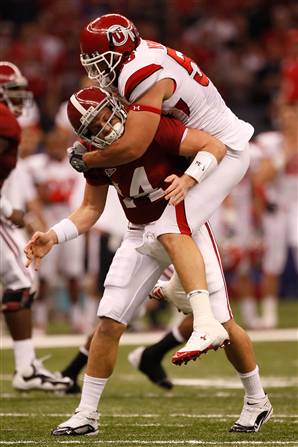
On a couple of occasions on this blog, I’ve argued in favor of an 8-team college football playoff system that uses the BCS bowls with their traditional conference tie-ins. While I still believe this would be the most viable solution to determine a national champion, I’m frankly getting completely sick of politicians trying to do anything with college football. Any sports fan that actually supports the federal government to get involved in this issue is completely insane. If there’s one system that’s guaranteed to be worse than the BCS today, it’s whatever convoluted format that Congress would come up with. Congressman Joe Barton needs to find a new issue to focus on, such as the economy, health care, or the multiple wars that our country is engaged in at this time. At the same time, the complaints from the bowl abolitionists such as the Mountain West Conference are getting as tired and worn out as Rachel Nichols’ campouts outside of Brett Favre’s Mississippi compound. The blind drumbeat that Utah was somehow disenfranchised last season has actually made me less sympathetic to the playoff issue since I wrote this post back in November largely supporting President Obama’s views on the matter. If you honestly can tell me that you would feel comfortable wagering your life savings that Utah would’ve beaten Florida, USC, Texas, and/or Oklahoma last season head-to-head, then you can go ahead and claim that the Utes deserved to be national champions. Otherwise, the fact that they went undefeated is irrelevant when compared to 1-loss teams from the much stronger SEC and Big 12. Besides, it’s incredulous to me that the Mountain West Conference and other fans are all of the sudden arguing how unfair the system is today even though the BCS expanded in 2006 to give the non-BCS conferences more opportunities to get into the top-level games and despite the fact those conferences bring very little of their own revenue (and definitely not many viewers as evidenced by the TV ratings) to the table. In the pre-BCS days, teams such as Boise State, Hawaii, and Utah would’ve never gotten a sniff of the Sugar Bowl and Fiesta Bowl, yet there were hardly any calls for a college football playoff prior to 1998 even though all bowls were completely about conference tie-ins and backroom deals.

Regardless, the college football playoff issue keeps coming back up like the Chinese water torture drip of baseball player names coming out from the 2003 steroid testing. The more that I investigate the issue, the more that I become convinced that even an 8-team playoff will never come to fruition (much less the extremely bad idea of a 16-team playoff). When the BCS bowls expanded to add a separate national championship game, thereby having 5 bowls with 10 participants, several things occurred.

First, it gave the non-BCS conferences a lot less incentive to push for a playoff. As stated before, those conferences were now getting access to revenue and bowls that they never did in the pre-BCS days, and that’s why all of those conferences opposed a playoff proposal in front of the BCS last week (except for the Mountain West, who submitted that proposal).  (Apparently, Senator Orrin Hatch didn’t realize that this automatic qualification existed for the non-BCS conferences in the Senate hearing on college football matters on Tuesday and actually openly speculated that this was some type of secret despite being published and written about everywhere.  This happens to be the Senator that called this hearing in the first place.  Once again, I don’t care how much you might hate the BCS – you don’t want these politicians anywhere near college football, particularly when you consider that Senator Hatch is relatively smart and thoughtful compared to the rest of that sorry lot.)  Therefore, those non-BCS conferences now have less incentive to mess with a system that they are now gaining revenue from (which they never would’ve had access to in the pre-BCS days).

Second, it clarified to the TV networks that the college football postseason is not like the NCAA Tournament. While the NCAA Tournament is partially about hyping Cinderellas in the first two rounds, the general public has shown year after year that it wants to sit down to watch the power teams in college football such as Florida, Texas, and Ohio State, even if they claim verbally that they want to see the Utahs and Boise States of the world. This is similar to when a lot of sports fans claimed to rejoice when neither the Red Sox nor Yankees were involved in the World Series last season, yet hardly any of those sports fans bothered to subsequently watch that World Series and drove the event to its worst ratings in history. Ever since the major conference realignments in the ACC and Big East that became effective in 2005, the only BCS bowl games other than the national championship games to have garnered over a 10.0 TV rating have all involved Big Ten schools (see historic data and this past year’s numbers). Meanwhile, the Boise State-Oklahoma 2006 Fiesta Bowl overtime classic that lots of non-BCS school proponents love to point out got trounced in the ratings that season by blowouts in the USC-Michigan Rose Bowl and LSU-Notre Dame Sugar Bowl. When ESPN, Fox, or some other network pays for sports rights, it cares about what people actually “do” as opposed to what they “say”, and what people keep doing is watch power programs in the major bowl games while ignoring the less sexy match-ups.

Third, the BCS expansion has better allowed the various bowls to retain their traditional tie-ins more often than not even if they lose a conference partner to the national championship game. The Rose Bowl has been getting its desired Big Ten-Pac-10 matchup even though Ohio State went to the national championship game 2 seasons in a row, while the Sugar Bowl has been able to always pick an SEC team despite the conference having sent its champ to the BCS title game for the past three seasons. This is an important point, particularly for the Rose Bowl, in terms of retaining the historical matchups that these bowls provide.

Finally, the Big Ten, SEC, and Big 12 have consistently established themselves as conferences that will almost always send 2 teams each to BCS bowls. Those conferences have teams from top-to-bottom with fan bases that both travel en masse to bowl games and bring in TV ratings. As a result, those conferences received even more benefits from the current BCS system since they are consistently receiving second BCS bowl game revenue shares to split among its members. Schools with horrific football histories such as Indiana, Vanderbilt, and Baylor now take in more bowl game revenue on a year-to-year basis than USC and Notre Dame. So, those 3 conferences aren’t ever going to vote for a system that would reduce their chances of sending 2 teams to the BCS.

The upshot is that even though the general perception is that a college football playoff would be a no-brainer money-maker, the fact is that the BCS conferences, TV networks, bowls, and even the non-BCS conferences actually don’t have much incentive to radically change the system that is in place today.  Team Speed Kills put together an excellent economic analysis of why it wouldn’t be financially rational for the BCS conference to alter the system (and this is coming from someone else that is on record as a playoff supporter).  This means that every sports fan out there needs to stop wasting their breath on advocating scrapping the whole system. You’ll see Sammy Sosa in the Baseball Hall of Fame before that happens.

However, we can still improve upon what we have now for everyone involved by implementing a plus-one model. For the uninitiated, the plus-one model consists of the BCS bowls all being played, having the national championship matchup being determined thereafter, and then a separate title game subsequently being played. I know that I have previously criticized the prospect of a plus-one as simply pushing off a #1 vs. #2 decision from December to January, but I’ve come around to it as a reasonable, if imperfect, alternative to today’s system. Here is how I would envision it working taking into account all of the financial and historical realities that are in place (which way too many fans either ignore or dismiss):

  1. The BCS would add the Cotton Bowl as a true 5th bowl game. As previously noted, there needs to be 10 total participants in order to maximize the opportunities for both the non-BCS conferences (to obtain single bids) and the largest power conferences (to obtain multiple bids).
  2. The BCS bowls will always have their traditional conference tie-ins. I know that this is anathema to a lot of fans that want to see straight seeding (or at least the top 4 teams seeded in a de facto 4-team playoff), but whether you agree with it or not, the Big Ten and Pac-10 aren’t going to give up the Rose Bowl. If the Cotton Bowl is added as a 5th BCS game, it would take the Big 12 champ if it’s from the Big 12 South (meaning any of the Texas or Oklahoma schools) while the Fiesta Bowl gets that conference tie-in if a Big 12 North team qualifies. This makes the most sense from both a historical (old Southwestern Conference connection with the Cotton and the Big 12 South schools) and traveling fan base perspective (Midwestern schools in the Big 12 North such as Nebraska and Missouri prefer going to Phoenix over Dallas). After that, the bowl of those two that doesn’t get the Big 12 auto bid gets the first pick of at-large teams using the same BCS ranking qualifications that are in place today (i.e. teams in the top 14 are eligible, top non-BCS conference school on top 12 must be picked by someone, a maximum of 2 teams can be picked from any one conference, etc.). After that, the bowls with open at-large spots will make selections from the BCS eligible pool in reverse order of the BCS rankings of the the teams that are already locked into those bowls. For example, the Orange Bowl had the lowest ranked team automatically committed to its game last year (#19 Virginia Tech as the ACC champ), so it would have been next in line with its selection, and so forth. This would be the mechanism to get as even of a distribution of teams across the bowls as possible (except that the Rose Bowl gets the Big Ten and Pac-10 champs no matter what). So, last year’s bowl matchups would’ve ended up like this (with BCS rankings after the regular season):Rose Bowl: #5 USC (Pac-10 champ) vs. #8 Penn State (Big Ten champ)

    Cotton Bowl: #1 Oklahoma (Big 12 champ) vs. #12 Cincinnati (Big East champ/6th at-large)

    Sugar Bowl: #2 Florida (SEC champ) vs. #6 Utah (non-BCS automatic qualifier/5th at-large)

    Fiesta Bowl: #3 Texas (1st at-large since Cotton got Big 12 champ) vs. #10 Ohio State (3rd at-large)

    Orange Bowl: #19 Virginia Tech (ACC champ) vs. #4 Alabama (2nd at-large)

  3. The day after the last BCS bowl is played, another set of BCS rankings will come out to determine the national championship matchup.  The title game will then be played on an open date thereafter (third Monday in January or one week before the Super Bowl).

Obviously, there’s still the prospect of controversy surrounding those final BCS rankings.  However, at least the outcomes of the BCS bowls provide some important information, such as whether a team such as Utah could handle Florida.  All of the catcalls about Utah last season were with the benefit of 20/20 hindsight after it beat Alabama in the Sugar Bowl.  Up to that point, reasonable college football fans wouldn’t have put Utah in the top 2 teams in the country, so it’s a bit disingenuous to state that they should’ve been in the national championship game based on the information that people had as of the final BCS rankings.  If the Utes were able to beat Florida in a plus-one system, though, then they would have had the marquee win necessary to have legitimately been in the championship discussion before the national title game (as opposed to after it).  Meanwhile, all of the BCS bowls become relevant to the national championship race as opposed to being glorified consolation prizes.  This is a throwback to the pre-BCS days when the first day of the year was one of the best sports days of the year.  The regular season also continues to have much more impact under the plus-one model.  Indeed, this is the biggest advantage of the plus-one system over any form of a playoff and why I’ve warmed up much more to the prospect of the idea.  We lose key historical moments like last year’s SEC championship game, the crazy last day of the 2007 regular season, and the 2006 Ohio State-Michigan game if all of those games become merely seeding exercises for a playoff.

So, the unseeded plus-one system is an option that the BCS conferences actually have a rational economic incentive to put into place.  Whether this could ever be put into place is obviously the continuing dilemma.

(Image from MSNBC.com)

Frank the Tank’s Slant on Twitter

I apologize for the lack of blog posts over the past month as my family and work obligations have been impeding on my ability to write pithy comments about the Bulls’ obsessive need to draft more tweener forwards.  (That being said, I haven’t really missed writing about the White Sox and the general awfulness of Chicago baseball this summer.)  The full-length posts will soon return, but in the meantime, feel free to follow Frank the Tank’s Slant on Twitter as I’m more able to squeeze in some 140 character thoughts these days with my new iPhone.  This is a public page (so you can read my musings regardless of whether you have a Twitter account or not) where the types of content will essentially mirror what’s seen on the blog (meaning that I won’t be boring you with inane details about the contents of my cat’s lunch even though I might find such Tweets personally amusing) – microblogging, as the digerati like to say.  So, check out the Tweets and have a great Fourth of July weekend!

Remembering the Worst Call in the History of Sports

Scottie Pippen Hue Hollins Hubert Davis Foul

With all of the issues with NBA officiating these days, J.A. Adande and ESPN.com just had to rip off a longtime scab with this 15th anniversary retrospective of the worst officiating call I have ever witnessed in any sport (notwithstanding the claims of Blackhawks coach Joel Quenneville) and it happened to come against one of my teams: the phantom foul call by Hue Hollins on Scottie Pippen, who as you can see from the picture above was about 80 feet away on the other side of the court from Hubert Davis.   I will go to my grave believing that the 1994 Bulls without Michael Jordan would have at least made it to the NBA Finals if not for that inexcusable call.  The fact that this loss was to the archrival Knicks made it all the more infuriating.  Psychologists believe that our brains essentially lock in the traumatic moments in our lives where we can recall every single vivid detail around them many years later, which would explain why I start immediately ranting about how far away Pippen was from Davis on that play every time that this story gets brought up (such as today).  Just don’t get me started on the 2000 Illinois-Michigan game.

(Image from NBA.com)

If the Lions Are On the Clock, It Must Be NFL Draft Day

joey-harrington-matt-millen-detroit-lions-nfl-draft

A couple of quick thoughts on today’s NFL Draft:

(1) With the Bulls and Blackhawks in the playoffs, both the White Sox and Cubs not yet knocked out of the postseason race two weeks into the baseball season, and the fact that the Bears essentially have had their draft already with the Jay Cutler trade, it’s been nice to not have to deal with several weeks of babble of who the Bears will take in the NFL Draft.  In past years, the Chicago sports media would have been in all-draft mode for days on end with supposed life or death questions of the Bears’ future.  Sure, the Bears still need an arsenal of wide receivers for Jay Cutler to actually throw to and I’m very interested to see where various Illini players such as Vontae Davis will end up, yet these concerns pale in comparison to everything else that’s happening on the Chicago sports scene.  Don’t get me wrong – I enjoy draft talk as much as anyone, but I really love watching my favorite NBA team being competitive in the playoffs (notwithstanding this past Thursday evening) a whole lot more.  It’s great to have actual games on the field dominate the sports discussion in Chicago in April as opposed to the war room at Halas Hall.

(2) The NFL has compounded its mistake of moving the draft start time from its long-time slot at 11:00 am CT on the first day to 2:00 pm CT last year by pushing this year’s start time back another hour to 3:00 pm CT.  I understand that this move was made to draw in more viewers in prime time.  However, it takes away a lot of the allure of the NFL Draft as a television event in the first place.  To me, it’s a perfect “have the TV on in the background event” and an excuse to get together with your buddies to hang out for a whole morning and afternoon in a low-key manner while you invent creations such as bacon tacos (as Minneapolis Red Sox and I did the year that the Vikings forgot to get their draft pick in on time).  However, it’s far from a prime time edge-of-your-seat event (particularly when playoff basketball and hockey games are alternative options).  So, instead of the draft having already started in the late morning as a write this post, ESPN and ESPN News are in the midst of an 8-hour marathon of punditry (featuring the legendary hair of Mel Kiper, Jr.) on draft prospects, even though the world already knows that Matthew Stafford of Georgia is going to be picked first by the Detroit Lions.  (Let’s see if that pick works better than, well, every Lions pick since Barry Sanders.)  The NFL had a great all-day format for the draft, but its belief that this is somehow a compelling prime time event is misguided and, as a result, this will be the second year in a row where I’ll watch little, if any, of what was once one of my favorite not-on-the-field sports events of the year (next to NCAA Tournament Selection Sunday, the NBA Draft, and the NBA Draft Lottery) as someone that has always wanted to run a sports team.

(Image from The Nasty Boys)

Unclear Bandwagon Status

blackhawks-flames-2009-stanley-cup-playoffs-game-1

I’ve always considered myself to be a complete purist when it comes to my sports fandom.  As much as Bill Simmons can be insufferable these days, his column on “The Rules For Being a True Fan” from earlier this decade is a classic and still holds up today.  I grew up on the South Side of Chicago, so I’m a die-hard fan of the White Sox, Bears, and Bulls.  When I went to the University of Illinois for my undergraduate years, the Illini became my college team forever.  I’m a huge believer in steering clear of sports bigamy or shenanigans with adopting popular teams in different markets just because they happen to be dominant or have players that date supermodels and music stars (i.e. Cowboys and Yankees back in the ’90s or any of the Boston teams today).  The only acceptable exception would be some direct family connection – for instance, if I had to move to, say, New York, I would insist that my future kids be raised as Chicago sports fans.

This also means that I have very little tolerance for bandwagon fans.  While I believe that Chicago has the best sports fans in the country (only Boston, Philadelphia, and Detroit fans can be allowed to debate this), there is also an unfortunately long history of bandwagoneering in this town.  The ’85 Bears, the Bulls dynasty of the ’90s, the ’05 White Sox, and every Cubs team that has finished above .500 have all drawn out the pink hat crowd in massive numbers.  These people took a sudden interest in these teams right when they were on the ascent without having had to endure the blood, sweat, and tears of missed expectations and painful losses.  Maybe that’s acceptable in places such as Los Angeles and Miami, but it’s infuriating to witness this happening in the legit sports towns like Chicago and Boston.

Having said that, I wonder if I’m being a complete hypocrite on this issue with respect to the Blackhawks.  For reasons that I’ve stated elsewhere, I never became anything more than a casual hockey fan.  While I absolutely love seeing the game live (making it a point to go to at least a game or two per year) and own a Blackhawks hockey sweater (which is my favorite sports jersey since it’s the only one that I can wear that doesn’t make me look like a complete tool), the combination of the half century of ineptitude of the Bill Wirtz regime and the fact that I have the ice skating skills of a Brachiosaurus means that I never cared about the Hawks in the same way as the teams that I listed in the first paragraph of this post.

The number of hockey games that I watched this past regular season is one-and-a-half: about half of the Blackhawks-Red Wings Winter Classic game at Wrigley Field (as I flipped between that game and the college football bowls going on at the same time) and then a Hawks-Kings game that I attended in person.  I know a handful of guys that are on the team: budding young stars in Patrick Kane and Jonathan Toews, Martin Havlat, and Nikolai Khabibulin (who, as the “Bulin Wall”,  was my lockdown goalie with the Phoenix Coyotes in marathon sessions of EA Sports NHL ’98 back in college).  The last time that I watched a hockey game that didn’t involve the Hawks was the 1999 Stanley Cup Finals when the Stars beat the Sabres on the controversial Brett Hull goal (where he may or may not have been in the crease) in overtime.

Yet, I’ve been juggling my schedule to watch the Blackhawks’ playoff games, as hockey this late in the year has been a rare occurrence over the past decade.  Thursday’s win over Calgary with Havlat scoring the game winner with 16 seconds into overtime was thrilling in terms of action and spurred me to look forward Saturday’s game (which turned out to be another win against the Flames to go up 2-0 in the series).

What I’m trying to figure out is if I actually start following the Hawks with some semblance of regularity, particularly if the team has a successful run in this year’s playoffs, would I be one of those bandwagon-jumpers that I despise?  Granted, I think that a lot of my contemporaries in Chicago are in a similar position as me since the late Bill Wirtz did everything possible to destroy the franchise’s fan base with bass-ackwards TV and marketing policies along with a reputation of throwing nickels like manhole covers (as Mike Ditka once said of George Halas) in terms of payroll.  With son Rocky in charge, it’s as if though Chicago received a completely new NHL franchise with a fresh start.  Still, I don’t want to be one of those guys that just hops onto a shooting star when it’s the easy thing to do.  That would be an injustice to the Hawks fans that still bought season tickets even when the United Center was barely half full (such as a mere 2 years ago, when I went to a Hawks-Red Wings game with Danny M and it was at about 2/3 capacity, with 3/4 of those people being Detroit fans).

Realistically, the Blackhawks will likely always be a team that I want to win (similar to my attitude toward the basketball team at my law school alma mater of DePaul), but never reach a level in my heart where I would be a die hard fan.  In contrast, earlier in the day on Saturday, I was screaming at the television for a solid three hours during the Bulls-Celtics game.  (It should be no surprise to you that my continuing man crush on Derrick Rose has been sent into the stratosphere.)  That type of emotional investment didn’t occur overnight or even over the course of a year or two – it was built up over nearly three decades of watching and growing up with the Bulls.  By the time the Blackhawks could catch up to that timeframe, I’ll be starting to take withdrawls from my 401(k) and hopefully be spending my winters in a place with a beach and palm trees.  (As a side note, I’m not foolish enough to believe that anyone in my generation will ever actually be able cash a  Social Security check.)  Plus, I’m not sure how much longer my wife would want to be around me if I started watching hockey on top of all of the basketball and football that I follow during the fall and winter months.  Thus, I envision myself being the hockey equivalent of the people that I wrote about a couple of weeks ago that don’t watch college basketball all year but then rabidly follow the NCAA Tournament, where my interest in the sport is pretty much limited to the Stanley Cup Playoffs.  My promise is that I will cheer for the Blackhawks, but do everything in my power to not fall into the traps of the typical bandwagon fan (i.e. using the royal “we” when talking about the team’s performance).  If I still get called a bandwagon jumper in this instance, I’ll just have to suffer the consequences when I get judged by the sports gods.

(Image from Chicago Tribune)

Frank the Tank’s Super Bowl XLIII Parlay

71465420MS005_Arizona_Cardi

As much as I’d love to pick the Cardinals in Super Bowl XLIII solely because they feature the long snapper/placekicker combo from my college days (which goes to show you how little performance in college really matters in terms of predicting success at the pro level –  my undergraduate time in Champaign coincided with the worst four year stretch in Illini football history, including a one win season that was followed up by a winless season, yet the special teams tandem from that team are playing together for a chance at the world championship), I simply have to believe that Mike Tomlin is going to do what the Eagles should have done two weeks ago and make sure that Larry Fitgerald is covered by at least two men at all times without exception.  If Philly had used its second half zone defense for the entire length of the NFC Championship (instead of allowing three first half touchdowns by Fitzgerald), we would be looking at an all-Pennsylvania Super Bowl.  The bottom line is that Pittsburgh has proven from the the beginning of the season until now that it is one of the best defenses ever to play in the Super Bowl, particularly considering how much scoring is up this season.  I have faith that they will find a way to shut down Fitzgerald and, ergo, the Arizona offense in general.  At the same time, I have noticed that most of Vegas has dropped the line on the game from the Steelers being a 7-point favorite to only 6.5, which must mean that way too much money is flowing in Arizona’s direction right now.  I’ll take my chances betting against the rest of America here (and in favor of the house).  Since a single pick does not make a parlay, here’s a whole slew of sports predictions for Super Bowl Sunday (home teams in CAPS, if applicable, and all prop bets are actually offered in Vegas):

  • Pittsburgh Steelers (-6.5) over Arizona Cardinals
  • Under 46.5 combined points for the Super Bowl
  • ILLINOIS FIGHTING ILLINI (-11.5) over Iowa Hawkeyes
  • LeBron James rebounds and assists (+5.5) over Arizona Cardinals points (-5.5)
  • Anquan Boldin receiving yards (+14.5) over Michigan State Spartans points (-14.5)
  • Highest scoring quarter by Steelers and Cardinals (+1.5) over Paul Pierce points (-1.5)
  • Under 38.5 for the jersey number of player to score the first touchdown

If I were anywhere near the Strip this weekend, I would be hammering those Super Bowl/basketball combo prop bets.  The long-promised Bulls midseason rant is forthcoming (it’s just going to end up being an extremely long piece).  In the meantime, enjoy the Super Bowl!

Frank the Tank’s NFL Football Parlay Record
Conference Championship Games: 1-1
Playoffs Overall: 6-3
Bears Games for the Season: 3-10-1
Overall Season: 27-25-3

(Image from Daylife)

Illinois and Northwestern at Wrigley? A Discussion of Illini Football Scheduling

wrigley-field-chicago-bears-football

Believe it or not (because I’m a dork), I had been thinking over the past few weeks that a neutral site game at Soldier Field between Illinois and Northwestern would be a very positive option for the U of I football program when the Big Ten moves its final regular season games to Thanksgiving weekend starting next season (as opposed to the traditional slot of the week prior to Thanksgiving).  The main issue is that Illinois hosts the state high school football championships every year on Thanksgiving weekend at Memorial Stadium, which is an event that the athletic department doesn’t want to give up since it amounts to a campus visit to Champaign for many top in-state recruits without having to count against NCAA recruiting limits.  As a result, a great way to solve this problem is to move the Illinois-Northwestern game to a neutral site in Chicago.  The majority of Illinois students live in the Chicago area and are more likely to be home than down on campus in the first place, while also providing the school’s Chicagoland alumni an opportunity to watch the team close by every year.

Lo and behold, the front page of Saturday’s Chicago Tribune sports section splashed an article of Northwestern’s investigation of moving a game against Illinois to Wrigley Field on the heels of the success of the NHL Winter Classic.  Wrigley Field actually has a whole lot more football history than hockey as the long-time former home of the Bears from the franchise’s first season in Chicago in 1921 until 1970.  (On a side note, an oft-forgotten part of Chicago sports history was on prominent display this past weekend with the Arizona Cardinals reaching the Super Bowl, which brought up a multitude of references to the franchise’s last NFL championship in 1947 as a Chicago-based team that played at old Comiskey Park.  With the Bears having been the clear #1 team in Chicago in terms of year-in year-out fan support for quite awhile, as alluded to in this great commercial, it’s easy to forget that the old-time football fans in town lived through a time when the Bears-Cardinals rivalry mirrored the Cubs-White Sox split between the North and South Sides of the city.)

It turns out that this is purely a proposal by Northwestern to move a home game from Ryan Field at this point and it has been confirmed that the Evanston school doesn’t need the permission of Illinois to move forward.  Seeing that Illinois wouldn’t be giving up a home game in Champaign, there would likely be an incredible amount of national press coverage by playing at Wrigley, and this would likely turn what is already a “mild” road game (since the Illini usually bring a large contingent of fans to Evanston when they play there) into a neutral site game or even a real home field advantage (considering that I felt like I was back on Green Street with the number of people I ran into in Wrigleyville every weekend for the first couple of years that I was out of college), this is a fantastic opportunity for the program without having any risk.

There are a few items that would need to be cleared if Illinois were ever to agree to a permanent annual neutral site game in Chicago as opposed to just a one-time deal, though.  First and foremost, above all else, and most importantly (I can’t throw in enough emphasis on this point), the Illinois football program MUST have seven home games in Champaign every year before it should consider any type of neutral site game.  Seven home games is now the standard for any BCS program that wants to maximize its revenue and even more imperative for Illinois, which has just finished a massive renovation of Memorial Stadium.  Of course, Ron Guenther appeared to forget about this when he agreed to the series against Missouri at the Edward Jones Dome in St. Louis while at the same time scheduling home-and-home series against non-BCS teams.  The St. Louis games have been fine to get the border rivalry on the radar on the football side, but after a few years into the series, the neutral location is best left to the basketball side alone with the Braggin’ Rights Game.  (From a financial perspective, giving up a home basketball game has nowhere near the same impact as moving a home football game, while the Illinois-Mizzou basketball tilt is engrained as a St. Louis holiday tradition in a way that the football game probably never will be.)  Missouri would be great to keep on the schedule, yet it should be home-and-home.  The non-conference schedule after that should be filled out with three body bag home games against an assortment of MAC and Division I-AA opponents.  This is the modus operandi of essentially every power program in the country (one marquee non-conference game and then three home games against non-BCS opponents), so it would be in the best interests of Illinois to follow suit to keep up with its peers (or, more to the point, the programs that we aspire to be considered peers with).

Now, it could be argued that the Mizzou game could be kept in St. Louis with three non-conference body bag home games while the Northwestern series would continue home-and-home as it has for a century.  However, it would seem to me that it would be much more important for Illinois to have an annual presence in the Chicago market over St. Louis for numerous reasons.  I’ve already noted that the majority of U of I students and alums live in Chicagoland and even more significant is the fact that securing a place as the virtual home team in the nation’s third largest media market for marketing and recruiting purposes ought to be a no-brainer priority over the much smaller St. Louis market if it comes down to a choice between one or the other.

Finally, a one-time game at Wrigley Field is perfectly fine as a novelty for press coverage.  However, in order for an annual game in Chicago to be financially viable for Illinois, it must be played at Soldier Field.  For Northwestern, moving a game from Ryan Field (47,130 capacity), where the Wildcats almost never sell-out, to Wrigley Field (41,118 capacity), which would be a guaranteed sell-out and a premium could be charged for tickets, would likely be a net economic gain for that program.  Illinois, on the other hand, sold out Memorial Stadium (62,870 capacity) for all four of its Big Ten games last season, which means that the amount that we would get from splitting the gate at Wrigley (i.e. the equivalent of revenue from only around 20,000 seats) would not make any economic sense.  At least Soldier Field (61,500 capacity) would provide enough seats to make a neutral site move financially feasible from the Illini perspective.

Let me be clear once again – I absolutely DO NOT advocate Illinois having less than seven home games in Champaign.  As long as there’s seven home games, though, then playing neutral site games in Chicago on top of that makes a lot of sense.

(Image from Stadiums of the NFL)

A Defense of Big Ten Football

ohio-state-buckeyes-texas-longhorns-fiesta-bowl

When I wrote this post on the “Conference Pride Paradox” a little over two years ago, Big Ten football was at its zenith with 2 BCS bowl victories during the prior season and its premier rivalry (which, in my opinion, is also the best rivalry in all of sports) of Ohio State vs. Michigan was being hyped for weeks as the Game of the Millennium with a #1 vs. #2 matchup for the first time.  After the Ohio State won that classic game, the national debate was centered around how Michigan deserved another shot at the Buckeyes in the National Championship Game.  Thinking back about those days that really weren’t very long ago at all, it’s amazing how far the national reputation of Big Ten football has fallen.  With Ohio State’s loss last night to Texas (albeit one that could have been prevented had the Buckeyes just kept a safety or two back in the secondary to make a tackle), the Big Ten has now lost 6 straight BCS bowl games (2 in each of the last 3 seasons).

There’s no doubt that the nation has a right to be skeptical about the prospects of the next Big Ten invitee to a National Championship Game (and frankly, no one should be surprised if Ohio State is right back in that mix next year with the players that they have coming back).  However, with Big Ten bashing becoming so fashionable among college football fans, I believe that the performances of the conference over the past 3 seasons need to be into context.  Please note that the following comments aren’t excuses – if you want to be the best, you have to beat the best at anytime anywhere, and the Big Ten teams that have gone to BCS bowls have failed miserably on that front.  It’s just that when one looks at who and where the Big Ten has played in its recent BCS matchups, it becomes apparent that the only ones that have the right to say anything are USC and the top tier of the SEC (as much as I loathe them).  Everyone else that is piling on the Big Ten (i.e. Big East, ACC, and Big 12 fans, Pac-10 schools that aren’t USC, Mountain West Conference bandwagoners riding a hot Utah team, etc.), though, need to STFU since they all likely would be in the exact same position of the power Midwestern conference if they had to play the same games.

Here are the Big Ten’s BCS opponents over the past 3 seasons:

  • USC in the last 3 Rose Bowls in Pasadena
  • Florida in the 2006 National Championship Game in Arizona
  • LSU in the 2007 National Championship Game in New Orleans
  • Texas in the 2008 Fiesta Bowl in Arizona

Look at that list of teams – it’s complete murder’s row of marquee national programs without a single breather.  The Big Ten didn’t get to play the likes of Wake Forest, Louisville, Cincinnati, or Hawaii, who were BCS participants in other bowls during this period.  Unlike the conferences that are participating in Thursday night’s National Championship Game, the Big Ten didn’t lose to non-BCS conference teams in the manner of the Big 12 (the Boise State-Oklahoma gem in the 2006 Fiesta Bowl) or the SEC (last week’s stunning Utah beat-down of Alabama in the Sugar Bowl – there was nothing fluky about the Utes in that game).  Yet, those conferences haven’t been indicted in their entirety even though their marquee teams failed to beat smaller schools whose stadiums have fewer amenities than the average SEC weight room.

The one true horrible loss for the Big Ten was Florida’s thrashing of Ohio State in the 2006 National Championship Game, where the Buckeyes had been ranked #1 nearly the entire season and were strongly favored to win the game.  After that, though, note that two 2nd place Big Ten teams (Michigan in 2006 and my alma mater Illinois in 2007) along with this year’s Penn State team got to play USC in de facto Trojan home games right outside of Los Angeles.  How many champions from any conference, much less 2nd place teams like the Big Ten has sent, are going to beat USC head-to-head in Los Angeles?  Anyone that has even a smidgen of knowledge about college football knows that this is a monster task in a sport where home field advantage is a huge deal and nowhere near the same as playing Wake Forest in the Orange Bowl or Hawaii in the Sugar Bowl.  The Big Ten doesn’t have a Rose Bowl problem or a Pac-10 problem – it has a USC problem.  Of course, every other conference would also be “exposed” as having a USC problem if its champion or 2nd place team had to play the Trojans in LA every year.  (Please note that I wouldn’t trade the Big Ten’s relationship with the Rose Bowl for anything in world since it’s the one BCS bowl outside of the National Championship Game that people actually care about.  My trip to Pasadena following the Illini last year was one of the greatest sports experiences of my life, with the exception of that game thingy.)  If USC didn’t crush its Pac-10 competition every season (outside of the annual obligatory game where they don’t show up against a ridiculously inferior team, which ruins their national championship chances) where some other team from that conference would get to the Rose Bowl, then there likely wouldn’t be a Big Ten drought in that game.

Similar to the USC situation, LSU arguably received an even greater home field advantage with last year’s National Championship Game being played in New Orleans.  Once again, would any team from any other conference have won essentially a road game at LSU in that situation?  SEC fans have earned the right to crow here, but any other conference that throws stones at the Big Ten has to realize that if they had sent a representative to that game, they also would have been crushed.  West Virginia would have received the honors to get thrashed if they had taken care of business against a pathetic Dave Wannstedt-led Pitt team while Missouri would have been the victims if they had beaten Oklahoma in the Big 12 Championship Game on the last weekend of the regular season.  None of that happened, so Ohio State, whose resume by the end of that weekend consisted of doing to the least wrong of any of the BCS conference champions that season, backed that ass up into the right to play in the title game on the road where they were guaranteed to be huge underdogs.

Finally, Texas was heavily favored to crush Ohio State in last night’s Fiesta Bowl but the Longhorns only salvaged a win because of a Buckeye defensive meltdown in the last 2 minutes of the game.  (By the way, it was fascinating to witness Jim Tressel use the reverse-Tebow technique of using Todd Boeckman to spot Terrelle Pryor at quarterback, where the intent was actually to bring in a traditional pocket passer for one or two plays at a time in order to change the pace from having a running quarterback.  The increasing reliance on spread or spread-esque offenses isn’t necessarily the greatest trend for college football overall, particularly for young QBs that want to reach the NFL, but that’s a discussion for another day.)

Once again, I’m not saying that the Big Ten’s performances in BCS bowls have been anywhere near satisfactory.  The Big Ten receives a ton of perks for having teams that draw huge television ratings (the only BCS bowls that have had over a 10.0 rating outside of the National Championship Games since the ACC-spurned conference realignment in 2003 are all of the games that have featured a Big Ten team) and the most national and wealthiest fan base of the BCS, which includes placement in the Rose Bowl (the highest profile bowl) and the other BCS bowls salivating over taking one of the conference’s other teams for an at-large bid.  With that elevated position, the Big Ten is justifiably going to receive more scrutiny when compared to USC or teams from the SEC and the conference’s teams will need to start performing.  I have faith that the Big Ten will bounce back soon enough since conference performance is cyclical, which is often hard to remember in a “What have you done for me lately?” world.  Earlier this decade, the SEC and Big 12 were the conferences being criticized as being weak and without depth.  The Big East was hailed as being back as a power conference two years ago but now is facing calls of not deserving an automatic BCS bid.  The old cliche of “what goes around comes around” is very true in college sports, so the haters out there won’t have the Big Ten to kick around much longer.

(Image from Arizona Republic)