I Love the Reverse Jinx

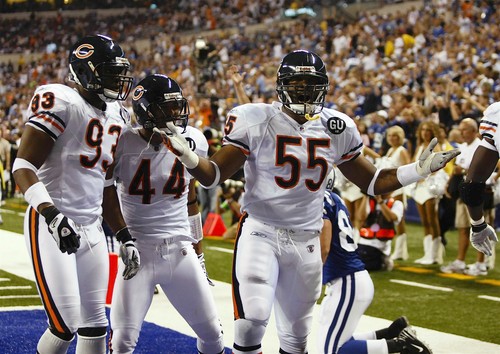
If getting picks like this wrong every week means that the Bears take it personally and come out as fired up as they did tonight in a dominant 29-13 victory over the Colts, I’ll gladly get smashed in my parlay picks all year.  Between the resuscitation of the Bears defense, the emergence of Matt Forte, the Illini putting the hammer down on Eastern Illinois after a shaky first quarter, the White Sox taking two out of three from arguably the best team in baseball in the Angels (while the Carlos Quentin situation is a bit scary right now, let’s try to take a positive outlook), and the Twins finally relenting to give the Sox some breathing room in the AL Central, this is one of the best sports weekends in the Frank the Tank household in a very long time.  Let’s just keep this up!

(Image from Chicago Tribune)

Bearly Excited and Frank the Tank’s NFL Football Parlay – 9/5/2008

What a difference a year makes – at this point last September, I had visions of a Bears team on the ascent to another Super Bowl run while hoping for a Motor City Bowl appearance for Illinois.  It turned out that I got a listless Bears team but an Illini trip to the Rose Bowl.  For the 30th season out of my 30 years on this Earth, the football gods refused to allow me to enjoy both my Saturdays and Sundays in a single year.  With the expectations for my respective football teams suddenly reversed along with a stellar baseball pennant race on both sides of Chicago, it has honestly been tough for me to get geared up for the Bears.  Kyle Orton is the starting quarterback by default, the running back situation is a complete unknown and the offensive line probably can’t open up holes anyway, the defense could be still solid yet Tommie Harris and other starters are either banged up or aging quickly, I’m horrified that Ron Turner is going to have Devin Hester run a slant pattern in the middle of the field that results in our one true scoring threat getting his legs crushed by some random safety looking to make a name for himself… these are issues that are just off the top of my head at this point.  Like the Chicago sucker that I always am, though, I’ll put on my Walter Payton jersey on Sunday and watch every moment of what will likely be a mashing at the hands of the Colts.  Well, at least I’m running three separate fantasy teams this season (yes, I have a gambling problem).  Following the form of the college football parlay, here are my three picks (including the Bears game) on the NFL side this week (home teams in CAPS):

(1) GREEN BAY PACKERS (-2 1/2) over Minnesota Vikings – I saw this line and quite honestly was perplexed with the love that the Vikings seem to be receiving from the football pundit class.  Granted, Adrian Peterson could have a breakout session on Monday Night Football at Lambeau Field the same way Randy Moss did many moons ago (no pun intended).  Still, the Vikings have Tavaris Jackson at quarterback – ’nuff said.  I’ll take the potential suckitude that I don’t know in Aaron Rodgers than the absolute suckitude that I do know on the purple side of the ball, especially when the game is in Green Bay.

(2) PITTSBURGH STEELERS (-6 1/2) over Houston Texans – The Rashard Mendenhall Era begins in the Steel City.  I don’t really care that the Texans are the sexy turnaround pick of the year (I seem to recall that the recent trendy picks of the ’06 Cardinals and ’07 49ers didn’t make anyone forget ’85 Bears).  The Steelers have one of the best home field advantages in the NFL, so my rule is if they are anything less than a touchdown favorite at home (unless they’re playing New England), I’ll give the points all day.

(3) INDIANAPOLIS COLTS (-9 1/2) over Chicago Bears – I hate this, but what can I reasonably do?  Even if Peyton Manning comes out there with a cast set in concrete, the sheer emotion of the Colts opening up a new stadium combined with the general ineptitude of the Bears in nearly all facets of the game of football leads me to no other choice.  I hope that I’m very wrong here, but this feels like a two touchdown loss for the Bears to me.

So, it looks like I’m taking all the points for college football on Saturday and giving all the points for the NFL on Sunday.  Be sure to enjoy a plethora of sports this weekend and especially all of the football.  Go White Sox! Go Illini! Go Bears!

(Image from Chicago Tribune)

Arch Rivalry Rundown and Frank the Tank’s College Football Parlay – 9/4/2008

With week one of the college football season in the books, there are a few conference-wide trends: the Big East looks bad, the ACC looks worse, and the jury is still out on how the Big Ten is going to look at the top.  Illinois lost to a simply better Missouri team, which wasn’t a surprise, but at least hung in well enough to justify the Illini staying in the top 25 in both polls, which was personally a pleasant surprise (and in the end, fair considering that Illinois was playing a team over 10 spots ahead of them in the polls going into the game).  The two main concerns coming out of the game for Illinois were the horrendous lack of tackling, which resulted in roughly 8,000 YAC for Mizzou (and Chase Daniel shred the defense overall) and the completely dead running game in the wake of the loss of Rashard Mendenhall to the NFL.  At least the running situation was mitigated by the fact that Juice Williams had a banner day stats-wise and nailed more accurate passes than ever before.  Mizzou practically stacked eight guys in the box the entire game to take away the Illini running “attack”, which allowed Juice to find some mind-boggling wide-open receivers downfield on a number of occasions.  Hopefully, the fact that Juice burned a pretty solid Missouri defense with his arm will make future opponents think twice in terms of stacking the line, which would open back up the Illini running game.  There really isn’t an excuse for the sloppy tackling, though.  The one bright spot on defense was the coverage ability of Vontae Davis – if he continues playing like he did this past week, he’s going to be taken very high in the first round by an NFL team in the near future.

There aren’t any odds available on the Illinois – Eastern Illinois since it involves a Division 1-AA team (I will continue to refuse to use the FBS/FCS monikers), so that game won’t be part of the parlay this week.  However, I’ll throw out a prediction that Illinois will win by at least 24 points.  On to this week’s college football picks from the worst slate of games of the year that features a dangerous number of spreads of 20 points or more (home teams in CAPS):

(1) Miami (+21 1/2) over FLORIDA – When the marquee game of the weekend features a 21 1/2 point spread, that means it’s a pretty bad football Saturday.  (It will all be made up next week, though, with Ohio State – USC.) I know that the Hurricanes were brutal last season, they have a bunch of freshmen playing, and Tim Tebow has a Zen-like hold on Erin Andrews.  However, have the mighty Canes fallen so far that they would be over three touchdown underdogs to the Gators in the revival of a once-heated rivalry?  I think not – I’m taking Miami with the points.

(2) CENTRAL FLORIDA (+14) over South Florida – Staying in the Sunshine State, I’m selling off USF stock after a couple of seasons of outsized returns.  This is one of those games that means a whole lot more to UCF (who believes they were just as worthy of a Big East invitation as USF) and it’s on their home field, so I’m taking the points again.

(3) EAST CAROLINA (+8) over West Virginia – Here’s a true home game for East Carolina against a top ten team one week after upsetting Virginia Tech in Charlotte.  At the same time, one of the few items that I have been consistently correct on through the years is knowing that West Virginia finds a way to stumble every season even though there is always a contingent of pundits that believes the Mountaineers will back into the national championship game since they always have a schedule where they could theoretically run the table on paper.  I’m not calling a straight-up upset here for ECU (and I’m sure WVU is on notice after VT stumbled last weekend), but it looks like I’m taking the points across the board on this week’s parlay.

The NFL parlay picks come tomorrow.

Frank the Tank’s College Football Parlay Record
Last Week: 2-1

Illini Games for the Season: 0-1
Overall Season: 2-1

(Image from Chicago Tribune)

Frank the Tank’s Football Parlay – 8/29/2008

College football season began in earnest last night, which means that it’s time for me to start making foolish predictions again that you all will make fun of by Monday.  This year, we’re kicking the predictions up to another level with a weekly parlay, which is essentially an experiment to show how much money I would lose if I went to Vegas every weekend.  I’ll pick 3 college games (always including the Illinois game) and, once the pro season starts, 3 NFL games (always including the Bears game) each week against the Friday morning spread shown on Yahoo! Sports.  The level of analysis every week will solely depend upon how much time I have to write that particular post (and in the case of this week, with little to go on other than gut feelings with the first games of the season, this blog’s credo to be “entirely logical” will go out the window).  So, as we concurrently celebrate Chicago’s exorcism of Jay Mariotti, let the season of gratuitous pictures of Ron Zook begin (home teams in CAPS):

(1) CALIFORNIA (-5) over Michigan State – This pick is less about any confidence in Cal and more that I will never trust Michigan State any farther than I can throw Sparty’s costume.  Taking Utah with 3 points over Michigan was enticing, but despite last year’s Appalachian State debacle, you bet against the Wolverines in the Big House at your own peril.

(2) Alabama (+4 1/2) over Clemson (neutral site game at Atlanta) – The money has obviously been going toward ‘Bama since the line is rolling in the Tide’s direction (no pun intended) and I think it makes sense.  The Georgia Dome crowd is probably going to tilt to the Alabama side and Clemson can’t help but screwing itself over within the first couple weeks of the season (particularly when you consider the ridiculously high expectations this season for a program that has largely done jackshit).  Therefore, I like Alabama with the points.  The most powerful coach in sports has to earn his keep somehow.

(3) Illinois (+9) over Missouri (neutral site game at St. Louis) – Alright, so all of you think this is a homer pick, particularly when Mizzou is coming back with its team from last year largely intact and Chase Daniel is leading an offensive attack with a physique that rivals our favorite neckbearded quarterback.  But seriously – a 9-point spread for a matchup that a year ago resulted in Mizzou squeaking out a 40-34 win with Juice Williams getting knocked out of the game in the first quarter?  (I’ll just ignore the fact that I have no clue what our running game will look like without Rashard Mendenhall, but Juice himself can run like he’s avoiding the wrath of Amy Winehouse.  Right?  Right???)  I’m not arguing that Illinois is better than Missouri this year or that the Illini will win (even though I very much hope that will be the case), but this high of a point spread for two ranked teams at a neutral site is suspect to me.  So, take the points and GO ILLINI!

(On a side note, please pour out some Cris for the passing of the Metra bar car today.  The long commute that I once had when I lived in Libertyville felt a lot shorter in the bar car – I was hoping this concept would expand to the Burlington Northern line to Naperville as opposed to being entirely eradicated.  R.I.P. to the “train friends” that were easily made during rush hour.)

(Image from Deadspin)

The Neckbeard is Our Quarterback

The interweb is aflutter with the buzz of Lovie Smith officially naming Kyle Orton as the Bears starting quarterback. I’m not sure whether it’s more amazing that the Bears didn’t bother looking at any other viable options at the QB position during the offseason or that the sports blogging community now follows the travails of such a mediocre player with a Rachel Nichols-on-Brett Favre-like zeal. This is in direct contrast to the Chicago media, where the general attitude is “Caleb Hanie: Why the fuck not?”

It’s interesting to look back on this post from this blog’s infancy, written at a time when the respective places of Rex Grossman and Kyle Orton in Bears fans’ hearts were completely reversed from where they are today. Of course, it’s maddening that I wrote that post nearly three years ago and barely a thing has changed with the Bears offense. I sent this message to Minneapolis Red Sox a couple of weeks ago: “I’m about 90% sure that I am going to end up writing a rant about the Bears offense after week one and then could copy and paste it for all of the other games for the rest of the season (which would cause me to drive full speed into Lake Michigan by the end of December).” Thinking about this further, the fact of the matter is that I’ve been writing the same rant about the Bears offense for three straight seasons.

As bad as the Bears offense might be with either the Neckbeard or Sexy Rexy, I’ll give Jerry Angelo credit for not heeding to the misguided calls to bring in the recently released Chad Pennington. Any Bears fan that advocated going down that path has obviously not seen him play. I had the unfortunate circumstance of following Pennington as a member of one of my fantasy teams a couple of years ago, where he achieved the dubious feat of scoring fewer points than both my kicker and tight end combined. It would have been more financially prudent for me to take a couple of Benjamins and use them as kindling to make some S’mores than to have paid my league entry fee that year. Essentially, Pennington is a higher rent and more fragile version of Orton, which is to say that Chad is nothing more than Brian Griese’s redneck twin.

So, it’s back to the Neckbeard again. With the Bears offensive line suffering from more pockmarks than Edward James Olmos and Orton having looked a bit more polished at the end of last season compared to his rookie year (which is kind of like saying that Ford just put some airbags into a Pinto to make it safer – that’s nice and all, but airbags don’t do much to prevent you from burning to death), the Jack Daniels-guzzling game manager might not be much of a quarterback, but he’s definitely our quarterback.

(Image from Deadspin)

How to Kill a Newspaper

Even though I’ve only just hit 30 years old, in the media world I’m considered to be a dinosaur. You see, I’m part of the increasingly rare tribe that actually reads newspapers – and I don’t mean just online (although I have the New York Times and Washington Post websites open pretty much all day), but physical newspapers that come to my doorstep every morning. Part of this is a function of riding the train into work, so I have time to pore through the Wall Street Journal and the Chicago Tribune on a daily basis. However, there are also benefits that you get with a physical newspaper in contrast to browsing online – you’re more likely to encounter stories that are outside of your normal reading agenda and I’m perfectly content spending an entire Sunday with the fat weekend edition of the paper.

That being said, while most of the world has been focused on Sam Zell’s quest to sell the Chicago Cubs at the maximum price (and nearly tax-free, no less) with Mark Cuban in the mix, his new plan for changing the newspapers at Tribune Company is particularly disconcerting and may have a more lasting impact on life in Chicago. (The Cubs have long been a marquee baseball franchise with deep pockets and a high payroll, which will continue no matter who the next owner might be.) The plan is reduce staff and close bureaus to slash costs and redesign the Chicago Tribune, Los Angeles Times, and other Tribune Company newspapers to make them more in tune with what focus groups supposedly say they want, which are more charts, colorful graphics, and shorter stories. This essentially means that Zell is looking to make the Tribune and its sister papers look like USA Today.

The problem, though, is that he is advocating what we call in the legal world “form over substance” – that is, switching things around on a page but not really changing anything meaningful. There are really only three newspapers in the United States that have been able to weather the erosion of paper circulation in this country over the past three decades: the Wall Street Journal, New York Times, and USA Today. The Journal and Times have made their mark by taking the high road of in-depth investigative reporting and a commitment to resources both here and abroad. On the other hand, USA Today has famously gone after the lowest common denominator as the “McPaper” with lots of charts and graphics. One would think that more newspapers that try to make turnarounds would try to emulate the Journal and the Times, not just because of some amorphous ideal of high journalistic standards, but rather that they are able to charge a premium to advertisers because they draw readers with exceptionally high levels of income and education. This means longer-term revenue streams that are less susceptible to economic downturns.

Certainly, the Tribune has long positioned itself as one of the elite metropolitan papers in the country. (Let’s contrast this with the Chicago Sun-Times, which has lately been putting out lots of hard-hitting stories, including this one referenced on the front page a couple of weeks ago. On a related note, I think all red-blooded American males can agree with this viewpoint.) Yet, every single story that I have ever seen about newspapers getting overhauled show owners going the USA Today route of slimming the paper down for the supposed masses. This occurs even though I have never met anyone that actually has a subscription to USA Today – it’s a paper that’s largely provided for free to travelers staying in hotels. So, Sam Zell and a whole lot of other newspaper owners appear to believe that the path to success for local papers that depend on hometown buyers and subscribers is to emulate a model that has proven profitable for a publication that is passed out free to people while they are away from their home markets. I have worked with Zell’s old REITs before and believe that he is as shrewd of a businessman as anyone, but his approach to the Tribune Company is showing that real estate investment skills aren’t necessarily transferable to the media world.

Here’s the mistake that nearly every newspaper owner in the country is making when they are trying to attract the elusive Generations Y and Z: they equate short attention spans with smaller papers containing fewer stories about substantive national and international issues and more blurbs about Hollywood. This is a ridiculous notion since when you take a look at the top 100 websites in the United States by numbers of visitors, you won’t see USA Today, Entertainment Weekly, TMZ.com, People, or any site focused on celebrity news on the list. However, the New York Times, BBC, and Washington Post websites are all on there. People over 30 fail to understand that people under 30 are the most media-savvy consumers anywhere and can instantly identify fluff versus well-written stories. While young people certainly like their junk food stories about the latest travails of Brittany Spears and Lindsay Lohan along with snarky commentary from a slew of blogs and other media sources, they also crave substance and they will turn to media sources that provide them with that. Even if you grant that physical newspapers are eventually going to go extinct and media companies should focus on the web, the success of the Times and the Post websites ought to be an indicator that going for the high-end of journalistic scale is a lot more successful in drawing readers (and the advertisers that pay for such readers) either online or offline than a bunch of cost-cutting measures and flashy graphics.

So, as a Generation Y guy whose main complaint about today’s Tribune is that it has introduced too many empty journalistic calories (the What’s Your Problem? feature is more suited to a community flyer as opposed to the top paper in the nation’s third-largest media market that features multiple Pulitzer Prize winners, while the Trib’s Starbucks fetish has been well-documented), the path to long-term survival in the newspaper industry, whether it’s with ink and paper or on the web, is all about substance over form as opposed to the other way around.

(Note: The Online NewsHour has some excellent analysis of the Tribune Company’s proposed moves that largely reiterates what I have stated above. For an alternate viewpoint, the Recovering Journalist takes the Tribune Company employees that are protesting Sam Zell’s moves to task in this post. This is an interesting take, particularly for a former journalist. I agree with the notion that the newspaper industry needs to undergo drastic changes, but Zell’s proposed moves aren’t necessarily the right moves to make.)

(Image from the Kellogg School of Management at Northwestern University)

Decent BCS Conference Rankings, Hoops at the Olympics, and Helmets Galore: Land-o-Links for 8/12/2008

When John Danks throws over 6 innings of no-hit ball and the White Sox still lose to the Red Sox, it’s a day when I should avoid writing about baseball. Here are some links on other issues in the sports world today:

1. The Great Conference Debate (Sports Illustrated) – While these types of rankings that sports websites tend to run during the dog days of summer often carry many flaws (please see last month’s ESPN.com rankings of the nation’s college basketball programs), the methodology used here by SI to compare the BCS football conferences is on the better end. I do believe that national title game appearances should be distinguished from other BCS games (and the lack of such distinction partially explains the Big Ten’s drop from first to fourth), but it is a relatively fair assessment overall. As SEC fans continue to bloviate about how even the worst of their teams could dominate the Big Ten (other than what happened in that pesky game last New Year’s Day where Michigan beat Florida in the Gator territory of Orlando, which has been conveniently forgotten by everyone south of the Mason-Dixon Line), it’s important to note that the SI rankings themselves show that the Big Ten was considered to be by far the strongest league during the first part of this decade. College football goes in cycles and the Big Ten is going to be a much tougher conference this year with Ohio State returning almost its entire team and improved squads at Wisconsin and Penn State (and hopefully Illinois). It’s also refreshing to see a balanced assessment of the performance of the ACC (as opposed to a lot of writers that have been very quick to pile on the conference for taking teams from the Big East five years ago while proclaiming that Rutgers is all of the sudden some type of powerhouse after its first two winning seasons since the school gave birth to college football over a century ago) – Florida State and Miami have simultaneously performed about as badly as possible over the past few years, which has masked the increased depth of the conference (while also providing the ACC much more upside if and when those schools get back on track).

2. So far, so good for NBA at Olympics (Sports Media Watch) – For those of us real Americans that don’t live in the Pacific and Mountain time zones and are able to watch many Olympics events live, we know that the most important development from NBC’s Olympic coverage is the resuscitation of John Tesh’s NBA on NBC theme song for basketball games. (If there’s one thing that you should know about me, it’s that I will find every opportunity possible to post old NBA on NBC intros from the 1990s Bulls dynasty. This golden classic from 1991, where Marv Albert speculates whether Michael Jordan would go down as one of the greatest athletes to never win a championship, with footage of Ernie Banks and, of course, O.J. Simpson in the days when he was simply a high-profile Hertz salesman, is the sole reason why YouTube was established.) At the same time, with over one billion people watching the U.S.-China basketball game on Sunday, there’s empirical evidence that Asians love basketball almost as much as they love gambling. Being half-Chinese, I can attest to that fact since every time I see a pop-a-shot machine, my hands start to tremble uncontrollably until I’m able to spend twenty bucks on the game to win 5,000 tickets (which I subsequently redeem for a couple of Tootsie Rolls or, if I’m lucky, a plastic dreidel).

The interesting thing that Sports Media Watch points out is the irony that interest in Olympic hoops in the United States has probably increased because of Team USA’s losses to other countries over the past few years. This is right on the mark – I’m truly going out of my way to watch the basketball games this year for the first time since the original 1992 Dream Team and this is speaking as someone that’s a monster hoops fan. For all of the issues that David Stern has had to deal with over the past few seasons (the Tim Donaghy scandal, the Pistons-Pacers brawl, etc.), the one thing that he’s got going for him is that the NBA is the only American professional sports league that has made legitimate inroads on the international landscape in a broad sense. Baseball has been very popular in a few Latin American countries and Japan for a number of years yet has struggled to break out of those regions, while basketball is being more widely adopted as the second major team sport after soccer on all of the continents (as shown by the fact that five countries, including Yao Ming for the host nation of China and not including the United States, chose current or former NBA players to carry in their flags in the opening ceremonies). The other sports leagues talk a lot about international expansion and may play a game here or there overseas, but the NBA is really the only one that is positioned to become a truly global league as opposed to a curiosity in other countries.

And finally…

3. The Helmet Project – This site has supposedly been in existence for quite awhile, but I just stumbled onto it today (which resulted in me canceling all of my meetings during the afternoon). The comprehensiveness of this site is astounding, as it covers the helmets from all of the various professional sports leagues since 1960 (i.e. USFL, CFL, XFL, etc.) as well as all levels of college football. (Even Minneapolis Red Sox can check out his favorite St. Norbert helmets through the years). As much as I love the Illini, the helmet designs throughout our history have been pretty lackluster – our current helmet, which has been around since 1989 with some minor color adjustments, is essentially an orange version of the New York Giants helmet from the 1980s (which they wisely scrapped a few years ago). The old “Illini” written on the side used through much of the 1970s and 1980s was never really impressive, either. An orange helmet with a blue Block I would be simple, clean-looking, and an exponential improvement, in my opinion.

(Image from New York Times)

Rare Acknowledgment of Sports Blogs (and Commenters) in the Mainstream Media

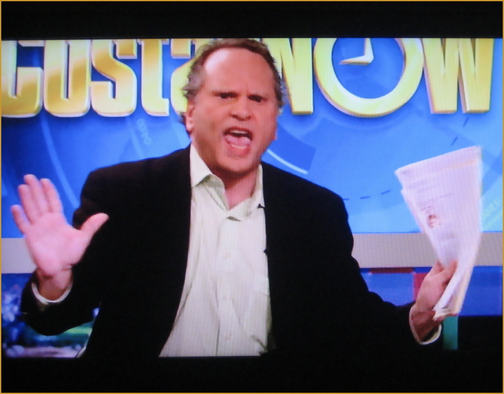
I never really got to throw in my two cents on the Buzz Bissinger – Will Leitch tiff in front of Costas Now a couple of months ago, but suffice to say that I find it incredulous that the political side of the mainstream media accepted the relevance of blogs years ago in politics, where people discuss the war, economy, social issues, and other items that actually have a direct impact on people’s lives, yet the sports side of the MSM seems to believe that stories such as the around-the-clock Favre watch and the linguistic artistry of Ozzie Guillen are so serious that blogs add nothing to the national discourse. While Wolf Blitzer and George Stephanopolous have no problem dropping tidbits from political blogs with respect to the election of the next leader of the most powerful nation on Earth, mainstream sportswriters and talk show hosts largely foam at the mouth when they are asked about Deadspin, Kissing Suzy Kolber, and other prominent sports blogs. Not only is this ridiculous, but it turns the whole notion of sports on its head – the reason why I love sports is that it’s a world where we can have so much passion about something that, at the end of the day, isn’t really going to effect whether we are going to be able to find jobs, take care of our kids, or the other things that matter in life. There are certainly serious sides to sports and I have long appreciated in-depth sportswriting, such as Bissinger’s own Friday Night Lights, yet that doesn’t detract from the fact that sports also has a side that’s primed to be ridiculed. Just as plenty of people equally enjoy spending their Sunday afternoons poring through the New York Times and The Economist while enjoying The Daily Show and The Colbert Report during the week, sports fans are savvy enough to read hard-hitting journalism that takes a look at the disproportionate weight of attention that athletics receive in Texas high schools as well as checking out the photos from the latest Kyle Orton weekend bender.

With all of this as a background, it was refreshing to hear Terry Boers and Dan Bernstein from WSCR The Score in Chicago (one of the few sports radio shows that I still listen to on a regular basis – they are the antithesis of the Mike North/Jim Rome-style bloviating that sports radio stations push all too often) not only argued that blogs such as Deadspin provide value to the sports media world since they are truly independent from the powers that be, but also gave praise the commenters on Deadspin in saying that they are just as funny, if not more so, than the blog posts themselves!

Here’s a link to the relevant segment of the show (the first few minutes of the stream). They start out with a discussion on the journalistic independence of the NFL Network, segue into talking about Buzz Bissinger’s rant, and then make their remarks about Deadspin and its commenters. As someone that remembers the days when it would take about 20 minutes to log in a comment on the punch card-based Gawker servers, it was heartening to see a couple of radio hosts that I truly respect actually say that they enjoy the comments, which in my opinion really drive Deadspin. I doubt that anything to this effect will ever be uttered on the air on SportsCenter any time soon, but it’s nice to know that there are a few rational people in the mainstream media out there.

(Image from The Sports Hernia)

Junior Griffey on the South Side and Land-o-Links for 8/1/2008

Minneapolis Red Sox has my quick take on the arrival of Ken Griffey Jr. to the White Sox organization here, although I seem to be in the minority of fans of seeing this as a generally positive move. I’m planning an expanded special take on Griffey and the White Sox over the next week, but until then, here are some links to tide you over for the weekend:

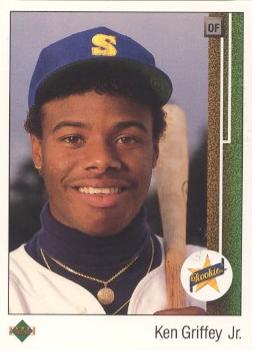
(1) Junior Mint (Slate.com) – If there’s one thing that people my age (yes, I turned 30 earlier this year) will remember about Ken Griffey Jr., it’s that 1989 Upper Deck No. 1 is the iconic baseball card of our generation. This great piece from Darren Rovell is a couple of months old (I’ve been meaning to comment on it for awhile and this Griffey trade provided a perfect opening), but it brings up some interesting questions of how a baseball card that could very well be the most widely held of all-time can still command $275 in the open market. The arrival of Upper Deck was a seismic change in the sports memorabilia market, where “premium” cards became all the rage. Of course, so many of these premium cards flooded the market (and fewer mothers, who heard the horror stories from their husbands of housecleanings from yesteryear where 1952 Topps Mickey Mantle cards were thrown in the trash, got rid of them) that the boxes of baseball cards that I have stored in my basement have lost value in non-inflation-adjusted dollars over the past 15 years (much less looking at real dollars taking into account inflation). (Mental Floss recently had a nice quiz about what some prominent baseball and basketball cards are now worth according to Beckett – it turns out I would have been better off sinking everything that I had into Enron stock.) Nonetheless, buying up Upper Deck packs in the hopes of finding the Griffey rookie card back in 1989 was my childhood version of playing craps way too long at the Bellagio – I probably spent every extra penny I had on baseball cards at the time, yet I never found Upper Deck No. 1. However, if you’re interested in a stack of Todd Van Poppel rookie cards, feel free to give me a call.

(2) Illinois’ Jamar Smith Violates Probation By Drinking Again (NCAA Basketball FanHouse) – The horrific saga of Jamar Smith and the Illini has come to the end. Bruce Weber did what he had to do in kicking Smith off of the team – the fact that Smith even had a chance to come back to the team in the first place after the Brian Carlwell incident was considered to be suspect. Unfortunately, this guarantees that there’s going to be some more ugly on-the-court play for Illini basketball until Alex Legion is able to come into the mix in January. More and more, we look like an NIT-bubble team as opposed to even having a reasonable shot at the NCAA Tournament this season.

(3) Breaking Down the Preseason Top 25 (USA Today) – We are a little less than a month away from the start of college football season, but the first impression roses are already being handed out by the coaches. Illinois starts out at #19, which seems about right considering that our running game is probably going to take a step back with the loss of Zook kryptonite Rashard Mendenhall to the NFL but the defense brining back a more seasoned Martez Wilson (there’s a flash of him mowing down Chase Daniel in the EA Sports NCAA Football ’09 commercial). The Big Ten is getting the “Ohio State and everybody else” treatment again, with the Buckeyes at #3 and the next conference members being Wisconsin at #12, us at #19, Penn State at #22 and Michigan at #24. My initial feeling is that Ohio State is going to make the national title game once again with so many starters coming back again (Georgia is going down at some point), but I’ll put together a more in-depth preview in a couple of weeks.

And finally…

(4) All Favre, All The Time (Windy City Gridiron) – Normally, I’d be all over the news coming out of Bears training camp at this time of year, but I’ve been avoiding it because of stories such as this. That being said, someone did bring up this comparison to the Brett Favre situation that hit some items for me personally: what if the Bulls had told Michael Jordan that they didn’t want him back in 1995 because they were committed to Steve Kerr as their long-term solution at shooting guard? Could you have imagined the hysteria in Chicago if the Bulls organization had used that logic? Granted, I find a number of flaws in this analogy, since MJ had a lot more productive years ahead of him at that time (as shown by three more championship rings) than Favre does now and, most importantly, MJ retired the first time around in the aftermath of his father being murdered as opposed to being a d-bag for five years straight of holding an organization hostage every offseason about his retirement plans. However, the point is well-taken with respect to any reactions that might come from Packers fans (as misguided as they might be in general).

Have a great weekend and go Sox!

(Image from Mental Floss)

Race and Class (and Starbucks) in Chicago

A few articles that I have come across over the past few days have brought up a number of loaded issues regarding race and class in the Chicago area. The New Republic looks at the Chicago area’s transformation to a Paris-style inverted geographic class structure, where the wealthy are increasingly living in or near the center of town and the poor are pushed to the outer suburbs of the metropolitan area. Meanwhile, the Freakonomics blog had an open-ended discussion on America’s most racist city, with Chicago appearing to come right behind Boston with the dubious distinction in the opinion of most commenters. Finally, even the decision by Starbucks to close stores across the country is interpreted by some to have a racial tint when such closings happen to be in areas with larger black populations (most notably, Chicago’s South Suburbs). Although the diversity of the racial, ethnic, religious and other groups within the Chicago area is as high as any place in the United States, the perception remains that city and its surrounding suburbs are extremely segregated.

There are significant arguments that most of Chicago’s racial segregation is rooted more in class differences over anything else. The urban core of Chicago has been rapidly gentrifying over the past decade, with neighborhoods that used to be considered ghettos turning into affluent enclaves for yuppies and hipsters. (Certain people really like gentrification.) The author of the New Republic article, who grew up in what would now be called the West Loop, referenced the incredible changes in the area around UIC, which is something that I can personally attest to. My father worked the bulk of his career at UIC and up until the late-1990s, the thought of walking around the fringes of campus after it got dark out was considered to be a death wish. My family always joked that we could buy back the hubcaps from my father’s car at the Maxwell Street market every week since they were stolen so frequently. Now, the housing projects have almost entirely been eradicated from the area while condos and townhomes that run into the upper six and seven figures line the streets. It’s not quite a West Side version of Lincoln Park as of yet, but it looks a whole lot more like the wealthy North Side neighborhood than the areas immediately adjacent to University Village to the south and west. While there has been plenty of negative press about how people have been pushed out of their old neighborhoods, at end of the day, I believe that gentrification is better as a whole than “managed growth” (which essentially means restrictions on new investment). Certainly, Chicago is a whole lot better off than its Midwestern brethren of Detroit, St. Louis, Milwaukee and Cleveland as a result of gentrification with businesses and residents correspondingly moving into the area as opposed to out. The utopian vision would be that neighborhoods could improve on a linear basis where a blighted neighborhood can gradually become “middle class” in a neat and predictable fashion, but the reality is that urban development in Chicago (and other strong cities such as New York, San Francisco and Boston) is coupled with a Tipping Point phenomenon – the change in a neighborhood is very slow until it hits a certain critical mass of affluence and trendiness, where it then transforms rapidly from one extreme on the income scale to another. This could also be a reflection of society as a whole where there is a greater bifurcation between the upper and lower classes with a smaller middle class. Despite the significant rise in cost of living expenses in the city, on the whole, when the choice is to be more like Manhattan or Detroit, most reasonable people would choose Manhattan.

However, is what is happening in Chicago, Boston, New York and other cities with rapidly gentrifying urban cores really just about class? I grew up in Chicago’s South Suburbs, which have long been considered the forgotten stepchild of the region. Even while being Polese (half-Polish and half-Chinese), I was always pretty well aware that even the more affluent South Suburban areas of Homewood and Flossmoor were treated with different standards by businesses and even government agencies than the North and West Suburbs and had long theorized that it was because of race. For example, when I took the Metra on the Illinois Central line to the city from downtown Homewood as a kid, every rider had to purchase a ticket prior to getting on board and then put it through a turnstile in order to get onto the train platform. This doesn’t sound like a big deal, but when I took the Milwaukee North line to visit my then-girlfriend now-wife when she lived by Libertyville, I was perplexed that I could get on the train itself, much less the platform, without a ticket and could even purchase it on board. I came to find out this was indeed the case on every single Metra line in the Chicago area – except, of course, for the Illinois Central line that runs through the South Side of Chicago and the South Suburbs. This was rectified in 2003 (not exactly ancient history) where the Illinois Central line is now treated in the same manner as all of the other lines, but this shows where the South Side was treated on the area’s totem pole where its residents couldn’t be trusted to even get onto a train. Plenty of other train lines went through (and continue to go through) high crime areas such as Joliet and Waukegan, yet it’s hard not to notice that the Illinois Central is the one line that cuts through more predominantly African-American neighborhoods and suburbs compared to the others.

After spending my years since graduating from college and law school living at certain points in Chinatown (more like the gentrified South Loop economically than the rest of the South Side), Roscoe Village, Libertyville and now Naperville (all the while either going to school or working in the Loop), it was easy for me to forget that there are places in this world that are begging for places such as Starbucks (and for that matter, any type of retail and restaurants other than fast food) instead of attending the latest NIMBY protest. The news of the Starbucks exit from Country Club Hills brought back those old feelings that the South Side is still being neglected in the region. There are three Starbucks shops within a two block radius in downtown Naperville – yes, in downtown Naperville, not downtown Chicago – while there is a Starbucks on the first floor of the Store Formerly Known as Marshall Field’s on State Street, another one on the bottom floor of the store and yet another across the street. All the while, a middle class suburb such as Country Club Hills supposedly can’t support just one Starbucks even though suburbs to the north and west still have free-flowing coffee with similar economic demographics (but significantly different racial compositions).

I would be the first to tell you that I’m essentially an Ayn Rand objectivist when it comes to economic policy and business decisions and have absolutely no qualms about any entity leaving an area for financial reasons. At the same time, I don’t think that Starbucks has made any type of nefarious racially-tinged decision with respect to closing the Country Club Hills location or any of its other stores. Yet, it would be blind to state that race isn’t a major factor in where people move to, which in turn businesses will follow. My childhood hometown of Glenwood was over 90% white back in 1980. The average income of its residents hasn’t substantively changed since then, yet whites have increasingly moved out of the town (mostly to Southwest Suburbs west of I-57 such as Tinley Park and Orland Park) to the point where it is now a majority black town. This isn’t a comment as to whether this is good or bad, but rather an observation that this relatively fast and very drastic racial change had little relation to changes in income or class demographics (as is often argued about racial changes in gentrifying areas). Does Glenwood have a classic case of white flight that occurred in neighboring Harvey and Chicago Heights long ago? Was it perceptions about crime (whether or not they are true) that spurred people to move? As much as I have tried to use this blog to present possible solutions to issues ranging from sports to politics, I’m at a loss as how to address these issues when we have been looking at the exact same pattern repeat itself over and over.

(Image from uic.edu)