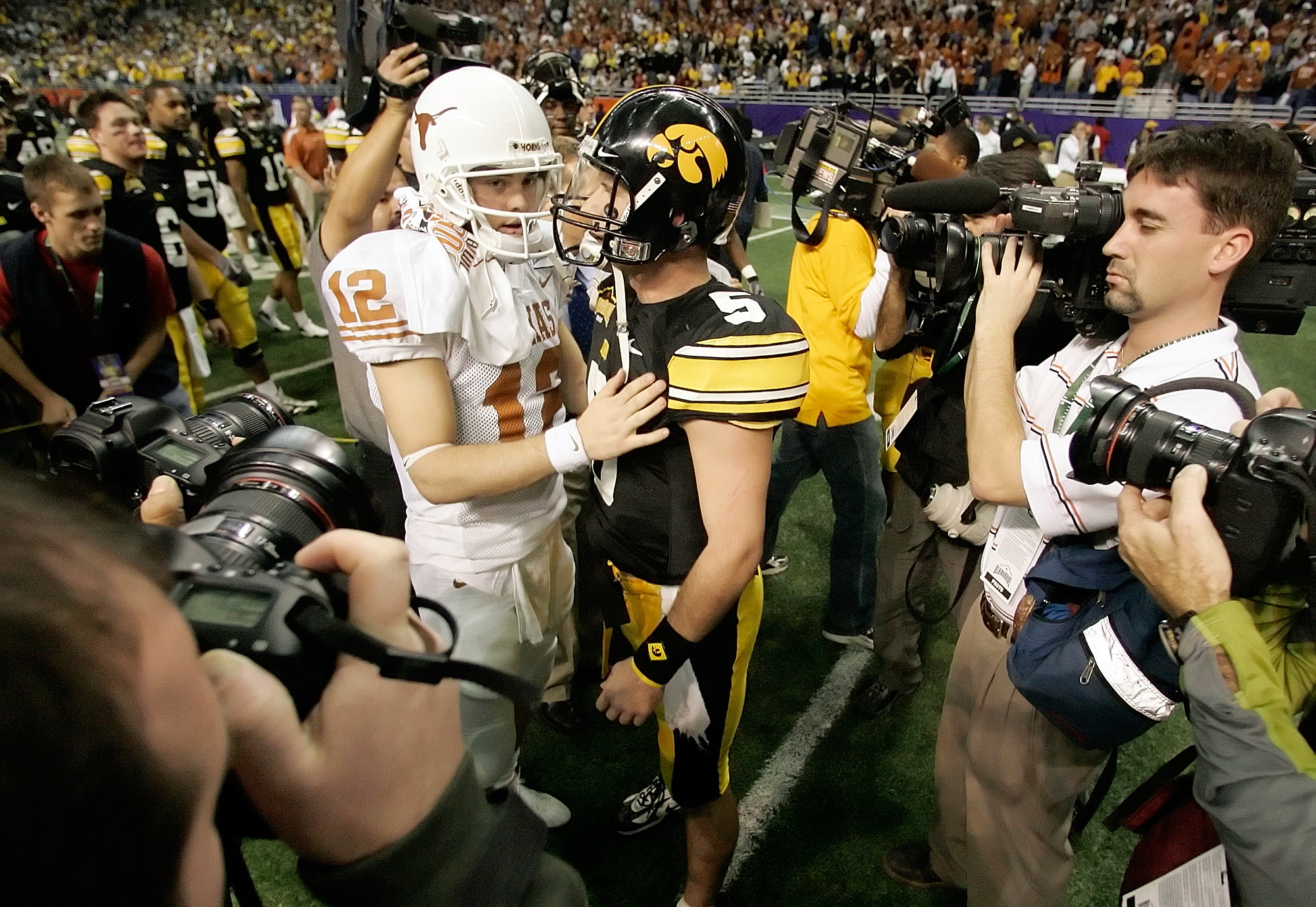
List of 15 Big Ten “Candidates” is Who May Come With Texas or Notre Dame (not Instead of Them)

Lots of people have been discussing in the comments section on the “Template for Shooting Down Any Argument Against Texas Going to the Big Ten” post a story from the Milwaukee Journal-Sentinel stating that the Big Ten has hired a research firm to evaluate an “initial list” of 15 schools, with a quote from Wisconsin AD Barry Alvarez saying that Texas isn’t on that initial list.  (H/T to WolverinePhD, among others, for sending in the link.)  I don’t interpret this study as Texas not being a target.  As Dennis Dodd stated on CBS Sportsline (who has voiced skepticism about Texas joining the Big Ten):

[I]f Notre Dame and/or Texas showed a willingness to join the Big Ten, there wouldn’t be much research to do.  The two schools are seen as the only slam-dunk candidates in an otherwise muddied expansion picture.

Exactly.  The Big Ten doesn’t need to pay presumably tens of thousands of dollars (if not more) to hire a research firm to say that “Adding Texas and Notre Dame would be sweeeeeeeeeet!!!”.  The conference knows that already and its university presidents don’t need to be convinced of the attributes of those schools.  Instead, you hire a research firm to evaluate the schools that you AREN’T sure of and look at the positives and negatives of them.  A research firm that’s providing value is going to look at issues that aren’t obvious, such as whether Syracuse or Rutgers can really deliver the New York City market or Nebraska’s national brand name can compensate for its small home market.  It’s a waste of money to have someone come in and state that “Texas would really add a lot of eyeballs to the Big Ten Network while being awesome in sports and academics.”  No shit, Sherlock.  Tell me something that I don’t know.

The fact that the Big Ten has a list of 15 schools that it’s looking at is an indication that the conference is looking at numerous schools that are significantly outside of its conference geographic footprint.  To me, this exercise looks a lot more like an evaluation of “Who do we add on top of Texas and/or Notre Dame if we’re willing to go to 14 schools?”  From a realistic standpoint, schools from the SEC aren’t going to ever move while the 2 schools that the Big Ten would want from the Pac-10 (USC and UCLA) are no-brainers in the same category as Texas and Notre Dame where there’s no point in even examining them because they’re in if they want to join.  Here is my semi-educated guess as to who is on that list of 15 schools as well as the key questions that the Big Ten ought to be asking about them:

1.  Syracuse – Does it really bring in the NYC market?  Can it bring in the NYC market when it’s combined with Penn State?  If yes, does Syracuse or Rutgers do this better?

2.  Rutgers – See comment for Syracuse.

3.  UCONN – Can it make inroads into both the NYC and Boston markets?  It’s not an AAU member but its overall rankings are pretty solid, so is that good enough academically?  Is the youth of the football program at the Division 1-A level a complete non-starter?

4.  Pitt – Great for both academics and athletics, but can they really add much in terms of TV viewers with Penn State already delivering the Pittsburgh market, especially when there are other candidates that are similar but can bring in new markets?

5.  Maryland – Is it more trustworthy in its ability to deliver the DC and Baltimore markets than the other East Coast candidates with respect to their own markets?  What does a Maryland/Penn State combo do for the conference in terms of delivering the Mid-Atlantic region?  Is there enough commitment to the football program in terms of long-term competitiveness?

6.  Virginia – An unequivocal academic superstar, but are its athletic programs good enough to add more value?  Can it really deliver the DC market any better than Maryland?

7.  Virginia Tech – Rising in terms of academics but not an AAU member, so is that satisfactory?  Can it really deliver the DC market any better than Maryland or UVA?

8.  Boston College – Can it really deliver the Boston market?  Is the fan base large enough to justify inclusion?  Very strong undergrad program but isn’t an AAU member, so will it fit academically?

9.  Miami – Can it deliver the Florida market by itself?  It’s not an AAU member and doesn’t have great graduate programs, but it’s a top 50 undergrad school.  Is that enough in terms of academics?  Is the poor attendance and traveling fan base for the football program trumped by its extremely strong national TV drawing power?

10.  Missouri – Has the ability to draw in the St. Louis and Kansas City markets, but is that enough considering that there are options in more populous regions like the Northeast, Florida and Texas?  Many assume that it’s an academic fit as an AAU member, but it’s actually lower in the US News rankings than Nebraska, so does it really meet the Big Ten’s academic requirements?

11.  Nebraska – Is the national drawing power of its football program enough to compensate for its tiny home TV market?  Lots of questions as to whether it would be an academic fit even though it’s an AAU member already.  Does it meet the Big Ten’s academic standards?

12.  Colorado – Long assumed to be a top Pac-10 target, but could it be a viable Big Ten candidate since it’s actually a better academic and cultural fit with the Big Ten than anyone in the Big XII besides Texas?  Is the population growth trend in the Denver area more attractive than adding presently larger markets like the state of Missouri when looking at this decision 20 or 30 years down the road?

13.  Oklahoma – Obvious national football power, but without AAU membership (unlike Missouri or Nebraska) or high academic rankings (unlike UConn), can it fit in academically?

14.  Kansas – 99% of these decisions are about football, but Kansas isn’t any ordinary basketball school (where only Duke, UNC and Kentucky can compare nationally).  Is the elite status of its basketball program enough to compensate for a historically weak football program that no longer has the services of Baby Mangino?

15.  Texas A&M – Is the Big Ten truly fine with the thought of Texas A&M coming along with Texas in a package deal?  Are the Aggies really a threat to go to the SEC if the Big Ten doesn’t invite them?  What do they bring to the table that Texas doesn’t bring alone?

The Big Ten will NOT expand unless it adds Texas and/or Notre Dame.  The conference is in a financial position where it doesn’t make any sense to settle for anything less.  This “initial list” is examining who might come along for the ride on top of the main targets.

(Follow Frank the Tank’s Slant on Twitter @frankthetank111)

(Image from Scout.com)

Template for Shooting Down Any Argument Against Texas Going to the Big Ten

It appears that the Earth is now 70% covered by water, 25% covered by schlocky Black Eyed Peas TV appearances and 5% covered by Big Ten expansion Internet ramblings.  I really didn’t think that I could cover too many more angles regarding the positives and negatives of Texas moving to the Big Ten, but the general ignorance of much of American public on the issues at hand that I’ve seen in various newspaper columns, blogs and message boards has brought up a number of additional thoughts.  I guess this should’ve been as predictable as the NFL ignoring all musical acts from the past half century for the Super Bowl Halftime Show.  Regardless, many Texas alums themselves have debunked a lot of the popular misconceptions themselves (such as well-informed posters like Ice Man on Orangebloods, who went over a lot of the points I’m going to be making in this post), which should serve any non-Texas Big XII fans notice that Texas is NOT joking here.  (By the way, multiple Facebook groups supporting Texas joining the Big Ten have popped up here and here.)  The feedback that I’ve been receiving is that Texas is looking at every possible scenario, ranging from joining the Big Ten or Pac-10 to even becoming an independent.  Let’s reiterate some of the arguments that I’ve seen from Texas alums along with a few more tidbits of my own that ought to blow every common objection to this out of the water.  I’ll warn you ahead of time that this blog post will be almost as long as Greg Oden’s third leg.

1.  More reasons why travel costs are a “penny wise, pound foolish” concern – It’s still the most common financial argument against Texas making a move to the Big Ten, even though I began to address travel costs in this post.  As people continue to bring it up as an issue, I actually went to the Texas Longhorns athletics site to see exactly which sports need to travel for conference games or matches.  Contrary to popular belief, Texas isn’t going to have to send the vast majority of its teams traveling any more in the Big Ten than they do today in the Big XII.  Out of the 16 non-revenue varsity teams that Texas supports, only 5 of them involve substantive conference schedules: baseball, softball, women’s basketball, women’s volleyball and women’s soccer.  Remember that these teams still have to get onto a plane for every place they travel to in the Big XII other than College Station and Waco, so it’s not as if though they are really losing many bus trips (where the costs savings are really accrued).  As I’ve stated before, once you have to get onto a plane, the actual distance that you have to travel is irrelevant in terms of costs since commercial flights are dependent upon supply and demand on that particular route (where a plane flight from Austin to Oklahoma City could easily cost much more than a plane ticket from Austin to Chicago), while the largest cost for chartering a jet is the fixed expense of having to charter it in the first place.

Meanwhile, the following 11 teams travel to regional non-conference meets for the bulk of their schedules: cross country (men and women), golf (men and women), swimming and diving (men and women), tennis (men and women), track and field (men and women) and rowing (women).  Just take a look at their schedules for yourself.  In almost all cases, the only time that any of those teams face inter-conference competition is for the weekend of the conference championships, which would be the same whether Texas was in the Big Ten or Big XII.  So, Texas moving from the Big XII to the Big Ten would only have a material impact on 5 non-revenue sports with the other 11 non-revenue varsity teams experiencing no real change in travel.

When it comes to the revenue sports of football and men’s basketball, let’s not forget the obvious example of why travel costs are certainly irrelevant to a wealthy athletic department: Notre Dame.  I believe that we all can agree that Notre Dame isn’t hurting for revenue, even though we’ve established that Notre Dame’s NBC contract ($9 million per year) is actually only worth less than half as much as the TV revenue that each Big Ten school receives ($22 million per year).  What’s interesting is that part of the reason why Notre Dame wants to keep its NBC contract and avoid joining the Big Ten or another conference is exactly the opposite reason why a lot of travel-obsessed people think that Texas shouldn’t join the Big Ten: the Irish play a true national football schedule with games that literally stretch from coast-to-coast annually.  In fact, Notre Dame is even scheduling “home” games in locations far from South Bend, particularly in… wait for it… the state of Texas.  A number of Notre Dame alumni have stated to me that the NBC contract is just a means to an end, where the point is that it’s more than enough revenue to allow Notre Dame to remain independent and keep its national schedule.

At the same time, Notre Dame’s non-football teams play in the incredibly dispersed Big East, which ranges from Milwaukee over to Providence and down to Tampa.  As a result, Notre Dame has to get onto a plane for every conference opponent except for DePaul and Marquette.  For all of this trouble, Notre Dame receives about $1.25 million per year from the Big East in TV revenue.

Let’s put this all together: Notre Dame makes about $10.25 million per year total from its NBC contract and the Big East basketball TV contract.  It plays a completely national football schedule each year where they have games in California, Texas and the Northeast corridor.  As part of the Big East for other sports, the Irish are required to get onto a plane for 13 out of its 15 conference opponents.  Through all of this travel, Notre Dame has leveraged itself into becoming one of the most profitable athletic departments in the entire country.  That shows you how much more powerful television revenue is compared to travel costs.

Seeing that Texas would be making, at a minimum, $22 million in TV revenue per year in the Big Ten (and it will probably be closer to around $30 million) compared to Notre Dame’s $10.25 million per year, yet Notre Dame endures a travel schedule in all sports that would be more than comparable to Texas in the Big Ten, there is absolutely no rational way to think that the Longhorns’ increased travel costs would come even close to approaching the increased revenue or be of the slightest financial concern.

2.  When did at least an extra $10 million per year become “not a big deal”? – It is amazing to me when I see comments, especially from the mainstream media that ought to have the cursory ability to do some research on Google, stating that at least $10 million extra payout per year isn’t a big deal or, even better, that Texas supposedly has “enough money already”.  One Omaha columnist that epitomizes the “N stands for Nowledge” stereotype went so far as to call the extra money “measly”.  Well, I think guys ranging from Omaha native Warren Buffett to Jerry Jones have more than enough money, too, but you don’t see them standing around not trying to make more.  In fact, I don’t know too many high achievers that are satisfied with the status quo – they’re always looking to add to the coffers.  It’s also incredulous to me that the myth that Notre Dame wouldn’t join the Big Ten because it supposedly makes too much from its NBC deal is often advanced yet again.

So, the general argument that we’ve been seeing a lot in the mainstream media is that an extra $10 million per year supposedly isn’t enough of an incentive for Texas to join the Big Ten, yet the approximately $10 million total that Notre Dame is receiving from NBC and the Big East is “too much to give up” to join the Big Ten.  These are completely contradictory statements that any random person (such as a lawyer that writes a blog in his spare time) could instantly debunk by performing a couple of searches on the Internet.  There’s little wonder why I previously wrote about how the newspaper industry was being run into the ground.

Suffice to say, an extra $10 million per year (and I have to emphasize again that this is the MINIMUM that Texas would enjoy because it would likely by closer to an extra $15-20 million based on projections) is the equivalent of a school adding more than the entire value of the Notre Dame NBC contract that allows the Irish to be independent and that people seem to think gives them great power.  That’s definitely a big deal for any school, even one that’s as financially flush as Texas.

3.  The largest slice of the pie in the Big XII is still smaller than an equal slice of the pie in the Big Ten – Further to point #2, it continues to perplex me that a lot of people still advance the argument that Texas won’t leave because the revenue sharing in the Big XII favors them.  This is the equivalent of saying that you don’t want to move to a mansion in Beverly Hills because you own the largest house in Compton.  Once again, every Big Ten school in its equal revenue distribution model, from Ohio State down to Indiana, made $22 million in TV money last season.  In contrast, Texas, in an unequal distribution model that completely favors them in the Big XII, with the most national TV appearances and a BCS bowl berth, only made $12 million.  You don’t need to have been a math major to understand that $22 million > $12 million.  I’m not sure why Texas cares about getting the largest slice of the pie in the Big XII when an equal slice of the pie in the Big Ten is so much bigger.

4.  Texas has the nation’s wealthiest athletic department IN SPITE of the Big XII (not because of it) – Following up on points #2 and #3, the notion that Texas won’t move because it already has the nation’s richest athletic department is the same thing as arguing that a minimum of $10 million extra per year isn’t a big deal and the Longhorns should pass that up so that they can preserve road trips to Lubbock.  Texas isn’t competing with Texas Tech and Baylor in order to win the Texas state college championship.  On the national scene, it’s competing with Florida, Alabama, Ohio State and Penn State, all of whom will each take in about $100 million more than Texas over the next decade just for showing up to play if the Longhorns stand pat.  That’s going to have a material long-term impact on Texas competing at a national level.  Texas might be the wealthiest athletic department in the nation today, but that’s IN SPITE of the Big XII and its poor prospects for television revenue as opposed to because of it.

5.  The Pac-10, with its own expansion plans, is REALLY helping the Big Ten out – Out of all of the BCS conferences, the Big Ten and Pac-10 arguably have the closest relationship with very similar academic institutions and, of course, the connection through the Rose Bowl.  Whether intentional or not, the rumors that the Pac-10 is considering to add Colorado and Utah has started to really make the Big XII look incredibly unstable and ripe for the picking by the Big Ten.  I explained in the Big Ten Expansion Index post that Missouri was essentially a “stalking horse” in this expansion process, where the threat of Mizzou leaving for the Big Ten (which would take away the most populated state in the Big XII other than Texas) would cause Texas to engage in CYA measures of its own and consider bolting the conference instead.  The practical issue, though, was that the Missouri-to-the Big Ten rumors never really seemed legitimate other than to some sportswriters and fans that still see conferences as purely geographic exercises and the pining has almost been completely coming from Mizzou as opposed to the Big Ten.

Colorado going to the Pac-10, on the other hand, is a different story.  Check out this interview of CU’s Phil DiStefano chancellor in the Denver Post, where he is already talking about weighing the exit penalties for leaving the Big XII and the school’s better alumni base in the Pac-10 region.  Remember my mantra that you need to think like a university president instead of a sports fan when talking about expansion?  Well, CU’s chancellor, who is the actual person who will be making the decision to switch conferences, has come out talking publicly about the machinations of moving to the Pac-10 when the normal answer to a newspaper reporter at this point in time would be “No comment.”  That’s about as clear of a sign that Colorado is ready to bolt to the Pac-10 ASAP without actually saying, “Smell ya later!” and there are a lot of indications that the interest is mutual.

Losing Colorado is just as damaging to the Big XII as losing Missouri (and from the Longhorns’ perspective, CU is the closest cultural and academic match that Texas has in the conference).  Colorado represents the second largest population base in the conference in the Big XII outside of the Texas along with the largest single TV market (Denver) in the conference other than Dallas and Houston.  This sets up the scenario that Texas blog Barking Carnival has brilliantly described in this post examining what should be the thought process of University of Texas president William Powers.  Here’s a great quote:

Even though the Big 10 began expansion discussions first and needs to add just one school, expect the PAC 10 to move first. Importantly, the PAC 10 will be useful to Texas when it breaks the seal of the Big 12 with the recruitment of Colorado.

While inside the mind of Powers, take note of how important it will be for Texas not to make the first move. Powers’ job description involves managing a complex brew of relationships, not the least of which is big-P Political (versus small-p political, which is a rich tradition in universities of all sizes and reputations). Were Texas to initiate the move that drops the value of Texas Tech’s share of a TV deal in half, the talk in the capitol building will be about Texas’ greed and complete disdain for other parts of the state. The West Texas lobby may not be strong enough to keep the deal from going forward, but a university president can die from a thousand papercuts.

You want more control over tuition? You want relief from the top-10% rule? Cry me a river, Mr. Ivory Tower. We’ll show you who runs the show in this state. Sorry that we can’t afford to fund your building maintenance requests. Better luck next year.

Some historians will note that Texas had a hand in leaving TCU, SMU, Houston and Rice in limbo when the Big 12 was formed. The way former K-State president Jon Wefald has told the story, the Big 8 made an initial overture to form the Big 16, and that it was Texas president Robert Berdahl who indicated his preference to split the pie twelve ways rather than sixteen. But it is also important to note that UT already had very poor relations with the Legislature at that time, something Larry Faulkner and now Bill Powers have worked effectively to improve.

On the other hand, if Colorado or Missouri make the first move (and both could make a move without directly impacting another university in their respective states), then Powers will have the moral authority to make the move that best serves Texas. Adding TCU to replace a defector will result in a net loss to Texas. While Powers may be politically prohibited from initiating a move, he will be held blameless for reacting to one.

While I’m personally not a fan of the 16-school conference proposal described at the end, everything else in that post is spot-on.  In fact, it elevates the “think like a university president” rule to the maximum degree.  Colorado, Missouri and now even Nebraska are beginning to look like the first actors here, which can give Texas the political cover to make a move first.  The Pac-10 making overtures to Colorado has now given even more incentive for Texas to move and the Big Ten gets a lot of leverage from it.

6.  Texas isn’t doing this for leverage because the Big XII can’t give anymore – Another common argument that I’m seeing is that Texas is only talking to the Big Ten and Pac-10 in order to get more concessions from the rest of the Big XII.  The problem with this argument is that it only works if the other Big XII members can actually give anything more to Texas.  The Longhorns already receive the most TV money in the entire conference.  The football conference championship game is likely to be played at Jerry World in Arlington more often than not.  The Big XII headquarters are already in Dallas.  There’s virtually nothing else that Texas can extract from the Big XII, yet as reiterated in point #3 above, it still pales in comparison to what it could receive in the equal revenue sharing model in the Big Ten.

Kansas State blog Bring on the Cats, using an apt poker analogy, brought up a well-written argument that Texas might be doing this in order to scare Missouri and other schools back into line so that the Big XII status quo and the unequal revenue sharing that favors the Longhorns isn’t disturbed.  Indeed, as I mentioned in the comments to that blog post, Missouri badly misinterpreted its bargaining position in the expansion process.  Mizzou likely thought that it was in a “no lose” situation where it could either extract more revenue concessions from Texas and other Big XII members in order to stay in that conference or bolt to the Big Ten.  Instead, Mizzou has spurred Texas to make a move first (just as the Barking Carnival discussion that I linked to in the Big Ten Expansion Index post predicted), which wind up leaving Mizzou in a much weaker Big XII without any chance of moving to the Big Ten.

However, the issue with the poker analogy in Bring on the Cats is that I don’t believe that Texas is bluffing at all: they have the nuts in this scenario and all of the other Big XII schools are going to lose one way or another (either through not getting any type of better revenue sharing in the conference or Texas actually leaving).  At the same time, while Missouri might be scared back into its place since a Big Ten invitation really isn’t imminent, Colorado could leave for the Pac-10 anyway and take down the proverbial house of cards itself.  In that case, Texas would bolt anyway.

7.  The Big XII won’t magically sign a new TV contract that is anywhere close to what the Big Ten and SEC are receiving today – Another popular argument from non-Texas Big XII fans is that the Big XII will supposedly sign a much better TV contract over the next few years that will be competitive with the Big Ten and SEC.  While I’m not a television executive, let me point out exactly why this is not a reasonable proposition whatsoever.

First, let’s take a look at the population bases of the states comprising the 5 BCS conferences other than the Big East (which I’m only excluding because they have large states on paper but don’t really deliver the key ones that well for football), with the numbers coming from the always reliable Wikipedia:

Big Ten 67,379,505
ACC 59,697,664
SEC 58,581,019
Pac-10 54,047,294
Big XII 44,097,046

The Big XII, as of today, has over 23 million less people than in its footprint compared to the Big Ten.  What’s worse is that it’s not even diversified, where around 24 million of those people reside in the state of Texas.  The reason why the Big Ten and SEC have such massive TV revenue is that they are able to combine intense passion for their schools with fairly large population bases.  There might be some intense passion within the Big XII, but it has nowhere near the population base to even come within the vicinity of the deals of the other conferences.  Not only that, but Texas has to compare any prospective Big XII revenue to what the Big Ten revenue will look like with the Longhorns included, where the Big Ten’s population base would catapult to over 90 million people.  On a financial level, the Big XII simply will not be able to compete with the Big Ten.

Second, there aren’t networks out there that would pony up that type of money.  The main entity that can afford to pay the most in rights fees, ESPN, already has its best time slots locked in with – guess who – the Big Ten and SEC.  The Big Ten dominates the 11:00 am CT time slot on both ESPN and ESPN2.  At the 2:30 CT time slot, the Big Ten is guaranteed nationwide reverse mirror coverage on ABC/ESPN, where if a Big Ten game isn’t shown in a particular region on ABC, it is guaranteed to be shown on ESPN or ESPN2 in that region (which effectively gives the Big Ten nationwide coverage for all games in that time slot just like the SEC on CBS).  Meanwhile, the SEC is guaranteed to have a prime time game on ESPN or ESPN2 every single week.  As a result, ABC/ESPN simply doesn’t have any more room and, as a result, doesn’t have much incentive to pay much more than it does now for Big XII games.

With respect to the other networks, NBC is satisfied with Notre Dame football and, frankly, is the cheapest network out there when it comes to paying for sports rights.  (Please note that the NHL is actually paying NBC for airtime as opposed to the other way around.)  CBS has its own massive deal with the SEC for 2:30 CT national games, so it’s definitely not looking for any more college football games.  Fox is committed to Major League Baseball for most of the college football season, so it doesn’t have any time slots on Saturday for college football along with having much less incentive to broadcast the sport after giving up the rights to the BCS bowls.

So, unless the Big XII thinks that Fox Sports Net or Versus is going to come through with a massive new offer, there’s literally not much upside to look forward to in the next conference TV contract.

8.  The Longhorn Sports Network (which is why there isn’t a Big XII network today) is an open question mark – Further to point #7, lots of non-Texas Big XII fans have suggested building a Big XII network modeled after the Big Ten Network.  Of course, that was an idea that was proposed several years ago but was vetoed by – guess who – the University of Texas.  Texas has looked into starting the Longhorn Sports Network where it would build its own TV network and keep all of the revenue itself.  This is actually probably the only financial argument that could possibly support Texas staying in the Big XII as opposed to moving to the Big Ten.  However, let’s take a reasonable look at how viable this network could be.

Starting up a new cable network, while it looks like easy money on paper, is not for the faint-of-heart.  Here’s a list of major sports organizations that have endured one year or more involved in nasty carriage disputes:  the NFL with the NFL Network, the New York Yankees with the YES Network and the Big Ten with the Big Ten Network.  These only happen to respectively be (1) the most powerful and highest-rated professional sports league in the nation, (2) the wealthiest Major League Baseball franchise and most popular sports team in the nation’s largest media market and (3) the most powerful college sports conference that has the largest population base.  If you could pick any 3 organizations in the country that would have the most leverage in cable negotiations, those would likely be at the top of the list.  Even with all of that leverage and, more importantly, a whole lot of high value programming to offer in the form of exclusive coverage of live sporting events that a critical mass of fans deem important, it took an extremely long time for all of them to get the desired cable carriage and they all ended up having to accept lower subscriber rates to get their deals completed.

The University of Texas has leverage in the state of Texas in theory, but the issue would be whether a potential Longhorn Sports Network would have much (if any) high value programming that would make it into a must-have for basic cable systems.  It took over a year for the Big Ten to get basic cable carriage and that was with a full slate of high value football and men’s basketball games from across the conference to offer viewers.  Texas might not have control to televise any live football games or men’s basketball games, which would likely result in the network not (a) getting full basic cable carriage in the state of Texas and/or (b) receiving a desirable subscriber fee.  On top of that, Texas would need to lay out a large amount of capital expenditures in order to get the network off the ground.  This is in contrast to the Big Ten Network, which Texas could enter into with no risk or capital expenditures and have an important stake in a true national sports network (as opposed to one that’s just confined to the Lone Star State).

There will be smarter people than me looking further into this issue.  Honestly, this is really the critical question for Texas other than politics (and definitely more than emotionally-based thoughts like rivalries): does starting up the Longhorn Sports Network trump the revenue that would be received from the Big Ten Network?  If the answer is no, then I think Texas moving to the Big Ten becomes even more likely.

9.  You think that Texas recruiting would be hurt by moving to the Big Ten because players would supposedly rather travel to Waco and Lubbock?  Seriously?!  Have you heard of the power of “national TV” in recruiting? – One of the more ridiculous arguments out there is that Texas would supposedly be hurt in recruiting by making a move to the Big Ten.  Deciding which college to attend, whether you’re an elite athlete or average student, depends upon a whole host of factors and is a highly personal decision.  That being said, the typical top football recruit isn’t going to attend the University of Texas just because it’s close to home.  If that were the case, top kids from the Dallas-Fort Worth and Houston areas would end up attending places like SMU, TCU, the University of Houston and Rice instead.  Top recruits go to Texas because they want to play big-time games and big-time environments that are beamed across the country on national TV so that they can watch themselves on SportsCenter late at night.  I have a hard time believing that Mack Brown sold Colt McCoy on coming to Texas based upon trips to Texas Tech and Baylor instead of, well, the home-and-home series against Ohio State back in 2005 and 2006.  While there might be a handful of kids that will only go to where their families could theoretically drive to all of the games (which, by the way, doesn’t happen in the Big XII with the widely dispersed Big XII North states), it’s the games in the Big House, Horseshoe and Happy Valley that get the blood pumping for the vast majority of elite athletes.  These are guys that are going to prioritize getting maximum exposure in terms of getting to the NFL way more than worrying about how far the road games might be.  If top recruits cared that much about family road trips, USC would always have terrible recruiting classes since they have to travel by plane for every road game except for the UCLA game.  We obviously know that’s not the case.

Meanwhile, it’s not as if though the University of Texas at Austin campus would be physically moving to the Great White North.  If you reasonably assume that all 4 non-conference games would be played in the state of Texas (Oklahoma in the Red River Rivalry in Dallas, home-and-home against Texas A&M, and 2 patsies to play at home in Austin) plus 4 conference home games, that means that UT would still be playing 8 games in the state of Texas every season.  The road games that aren’t in the state of Texas are in some of the largest and greatest venues in all of college football that would get maximum coast-to-coast coverage.  Anyone that attempts to compare the road trip desirability of Waco and Lubbock to even the least picturesque Big Ten college towns (much less all-world places like Chicago, Madison and Ann Arbor) has literally no fucking clue about what he’s talking about.

At the same time, if I hadn’t made this clear before, every single Big Ten football game is available across the country via ABC, ESPN, ESPN2 or the Big Ten Network in high-definition.  It seems to me that this is a much more important selling point to elite athletes, especially when you consider how many recruits the school might lose by making them pay $39.95 just to watch a third-tier blood money game in Austin itself against Louisiana-Monroe.  It doesn’t matter whether you’re playing your state rivals and they’re close by if the games aren’t available on television – last year’s Texas A&M-Texas Tech game wasn’t even televised!!!

For all of the consternation about the relative handful of athletes and families along with the few thousand fans that might be inconvenienced by the longer travel involved in the Big Ten, people have completely missed out on how appalling it is that Texas still has to have millions of its fans fork over nearly $40 just to watch a third-tier home game on pay-per-view.  That will absolutely never be a concern for recruits, families and fans in the Big Ten.

10.  The weather is actually pretty nice in Big Ten country during football season – This is another ignorant argument that I’ve seen in dozens of places: “Why the heck would Texas want to play in the snow in the Big Ten?”  Any person that writes this obviously hasn’t gotten out of his or her bunker to realize exactly what the weather is like in the Midwest from September through November.  The first two months of the season actually provides spectacular football weather for the most part – it’s not agonizingly hot like Texas can be in September while October normally provides great fall weather.  It can get colder in November, but you’ll virtually never see snow during that time.  Does the weather suck royally hard in the middle of February as I’m writing this blog post?  Absolutely.  However, football season is a completely different story.  Even if we grant that it can get chilly in the Midwest in November, Texas would likely only have one road game in that environment anyway every year (since you can presume the Texas A&M game will always be played Thanksgiving weekend).  This isn’t any different than Texas having to take a trip to a Big XII North school during that time of year.  The weather issue is both a red herring AND completely wrong.

11.  Texas A&M or no Texas A&M?  That is the question – I vacillate back-and-forth about whether I’d want Texas A&M in a hypothetical 14-school Big Ten if the Aggies are politically required to tag along with Texas.  Texas A&M is kind of like a girl that isn’t that terrible looking from certain angles, yet she seems a little bit off where you wouldn’t be surprised if she engaged in things like ritual animal sacrifices.  The Aggies don’t fit in with the Big Ten at a cultural level in the same manner that Texas does, although the main things that A&M has going for it is an excellent academic research reputation (much more so than other Big XII candidates like Missouri and Nebraska) and the combo of Texas and Texas A&M would truly lock down the state of Texas as completely Big Ten territory (which does carry a lot of long-term value).

In this post, I voiced my original skepticism as to the desirability to build a 14-school conference from a financial standpoint.  Frankly, I’ve been surprised by how many people out there like the prospect of 14 or even 16-school super-conferences.  In my opinion, there are just significant diminishing returns as you move past the 12-school conference model, not the least of which is that it doesn’t do much good to have Texas, Ohio State, Michigan and Penn State in the same conference if they’re only playing each other a couple of times per decade because the conference is too large.  (This matters to both university presidents AND sports fans.)  Personally, I think that adding Texas alone for a 12-school conference would be the best thing from a competitive and cultural fit standpoint as well as being the per school revenue maximization point.

That being said, the prospect of the Big Ten adding Texas is just too great to pass up and I’m resigned to the fact that if it means Texas A&M has to come along, then the conference needs to pull the trigger. At that point, the Big Ten can give one last shot for spot #14 to Notre Dame (and I think that they’re probably going to be much more open to taking it than people generally believe with the knowledge that the Big Ten would truly close off membership forever) and if the Irish turn it down, then virtually every school in the country outside of the SEC will be gunning for that slot and the Big Ten can have its pick.

Once again, I’d much prefer just adding Texas alone for a 12-school Big Ten.  However, if A&M needs to come along, then the Big Ten has to take heed the words of the great Joel Goodson: “Sometimes you’ve got to say, ‘What the fuck, make your move’.”  Only instead of “Looks like the University of Illinois!”, it’s now “Looks like Agricultural & Mechanical!”

12.  How to sell this to the Texas Legislature: Better Academics + More Research Funding = More Jobs – Out of all the arguments against Texas moving the Big Ten, the one that truly has real validity is that Texas state politicians would block the move.  One major way to alleviate this concern has already been addressed, which is to take Texas A&M, too.  The other way is to make sure that it’s emphasized that a move to the Big Ten doesn’t just affect some football games in Austin.  The CIC, which as discussed before is the academic arm of the Big Ten (plus the University of Chicago), would likely invite the University of Texas Medical Branches located in Dallas, Houston, Galveston and San Antonio to participate as guest members, which is similar to how the University of Illinois at Chicago (which performs a large amount of biomedical research as the home of the U of I Medical School) is able to take advantage of the consortium.  The UT Medical Branches actually perform $1.4 billion of research annually, which is nearly three times as much as the Austin campus itself.  This means that the major medical centers in all of the largest cities in the state of Texas would have access to more research funding, which in turn translates into more jobs in those cities (and high value jobs, at that).

In this economic environment, Texas state legislators will be put on the defensive if the frame of the debate is that they are trying to protect a football conference at the expense of more research funding and jobs for the top hospitals in the state’s major cities.  As much as football might be a matter of the highest political importance in the state of Texas, there are concrete medical research and economic incentives that would apply to places outside of Austin with UT making a move to the Big Ten.

So, when you get into an argument about Texas joining the Big Ten at your local bar, I’ve provided you with a template to refute every knee-jerk response out there.  I’m getting a little more optimistic each day that this is the massive move that the Big Ten is going to make.

(NOTE:  The long-promised Big East analysis is forthcoming.  Until then, feel free to follow me on Twitter @frankthetank111.)

(Image from Doc’s Office)

Big Ten Expansion Index Follow-Up #2 – Nationwide and Longhorns Fan Responses on Texas to the Big Ten

Leading up the National Championship Game (which Texas sadly lost despite about as good of an effort that you could’ve expected from redshirt freshman quarterback Garrett Gilbert having to replace injured starter Colt McCoy in the first quarter), the original Big Ten Expansion Index post and its first follow-up somehow exploded over message boards and blogs over the past few days.  So, I’d like to address a few overarching issues that particular fan bases have brought up and, most importantly, what Texas alums and fans actually think about this (and if those Longhorns supporters are indicative of what that school’s fan base overall believes, then fans of other Big 12 schools are VERY far off on how Texas is approaching this expansion cycle and they better hope their schools are engaging in some CYA of their own).  Obviously, you can only take so much from blogs and message boards since you’ll get a lot of extreme comments, but it’s been fascinating to review the general views and themes that I’ve been seeing from various fan bases.  Once again, I’ll need to put off the additional analysis of other expansion candidates since there’s a whole lot to chew on already.

There’s one issue that I wanted to clear up immediately – a lot of people have questioned my statement that there isn’t any rule that all Big Ten states must be contiguous.  Here is confirmation from an official Big Ten spokesman that there is absolutely no such geographic rule and he also confirms that AAU membership isn’t an outright requirement.  While I believe as a practical matter that the lack of AAU membership is really geared toward allowing an exception for the non-AAU member of Notre Dame (and no one else), I really hope that it gets hammered home that there is no rule whatsoever in the Big Ten charter about geography and conference states having to touch each other.  As I originally stated, that rule is purely an Internet urban legend.  Now that we’ve put that to bed, let’s get to my observations on how the sports message board community is responding to the Big Ten Expansion Index:

1.  Big Ten fans love it – I haven’t come across a single overall fan base that wouldn’t be absolutely ecstatic to see Texas in the conference.  The geographic issues seem to be irrelevant when it comes to a school of the stature of Texas.  In particular, Penn State fans have generally been extremely supportive of the prospect of the move (see Blue White Illustrated, Penn Live and Penn State Hoops as some examples) which was the main fan base that I was interested in feedback from since there has long been the perception that they want an Eastern travel partner like Syracuse or Rutgers.  That perception has turned out the be erroneous – while they might wonder what a school like Missouri would do for them, they are extremely knowledgeable about what Texas would bring to the Big Ten and would be gung-ho about it.  Please also see thoughts from Ohio State (edit: lots of Buckeye fans have jumped on this – here’s another example that includes conversations with Texas alums), Iowa, Michigan State, Wisconsin and Michigan fans.  Simply put, the Big Ten fan bases generally have little concern about where Texas is located.  Of course, there is healthy skepticism as to whether it could ever be pulled off.

2.  Rutgers fans don’t like it and think that I overrated Syracuse – This Rutgers message board was really the one that started the avalanche of visitors.  I started to engage a number of the posters on that board, yet with all of the new comments on my blog post itself coming through, I had to stop the discussion on my end.  The main thrust of the Rutgers supporter argument is that Syracuse doesn’t really deliver the New York City market and even if Rutgers can’t deliver the entire New York DMA, it can at least provide the New Jersey portion, which is valuable in and of itself.  That’s a compelling argument, yet I’m still skeptical that Rutgers can deliver even just New Jersey, much less the entire Tri-State area.  I might be wrong on this and I’m sure this is an issue that the Big Ten will examine closely over the next 12-18 months.  Regardless, I believe my skepticism is valid and it’s why I gave Rutgers a relatively low TV Market Value score despite its great location on paper.  Until there is proof that Rutgers can truly deliver its home market (and not just be located in it), that school is an open question mark.

4.  Missouri fans don’t like it and think that I overrated Nebraska – The general public has long talked about Missouri as one of the front-runners to join the Big Ten, so they certainly didn’t like being ranked below two of their conference-mates, especially Nebraska.  Mizzou fans have a valid point that Nebraska may not meet the academic qualifications, which is something that I acknowledged when I stated in the original post that I was giving the Cornhuskers “the benefit of the doubt” on that front.  I would not be surprised at all if Nebraska got nixed automatically by the Big Ten on academic grounds, yet it’s arguable that the school’s AAU membership will still carry some weight.  The Missouri fans also expressed something in common among Big 12 fans outside of Longhorns fans…

5.  Non-Texas Big 12 fans are convinced that Texas won’t ever want to leave the Big 12 – Please see the message boards from Missouri, Nebraska, Colorado and, of course, Texas A&M virtually all expressing the same strain of thought.  To them, Texas wouldn’t want to (a) go “play in the snow” in Big Ten country, (b) leave their rivals of Texas A&M and Oklahoma, (c) incur massive backlash from the Longhorns fan base and major donors, (d) deal with the political heat in the state of Texas if they were to leave, and, most importantly and by far the biggest reason, (e) ever give up the “control” of the Big 12 that they now have.  As we’ll see from the general feedback from Longhorns fans, only one of the thoughts has really crossed their minds at all on this issue, but we’ll get to that in a moment,

6.  Other fans think that I’ve been ingesting some strong peyote for even suggesting this – Taking a look at boards from LSU, Virginia, the Rivals national college football site and, as we’ll always have to deal with regarding Big Ten expansion, Notre Dame, the thought of Texas going to the Big Ten is so foreign and ridiculous that no financial and academic reasons could rationally support it.  From their perspective, I should’ve just thrown out that the Big Ten should invite USC and Florida, too, with such a low likelihood.  To be fair, the original posters on these threads typically enjoyed my blog post or at least acknowledged that it was an interesting take, where it was then shot down by others like Sonny Corleone at a toll booth.

So, let’s take a look at the people that actually matter in this discussion, which are the Texas alums and fans…

7.  Texas fans are more open to this than I could’ve ever possibly imagined – When I wrote the original Big Ten Expansion Index post, I had a feeling that it would appeal to the financially and academically-minded people that understood the massive differences in revenue between the Big Ten and Big 12, the inherent instability within the Big 12 and the academic benefits of the CIC.  What I didn’t know, however, was how the “average sports fan” at Texas that I referred to so much in that post would take this suggestion.  I could list out all of the financial and academic advantages to Notre Dame fans, yet I was certain they would be steadfast in having an immediate rejection of any thought of joining the Big Ten.  Would Texas fans be the same way?

Well, the feedback that I’ve received from Texas alums and fans has been absolutely astounding, especially when so many have taken the time to review my blog posts when what I would’ve been doing if I was in their position was to look at national championship game stories for days on end.  Please take a look at the following Texas message boards discussing my blog posts at HornsFans and OrangeBloods (subscription required), the comments from my previous two posts, and as these two Barking Carnival posts here and here about the prospect of Texas switching conferences that were written before I had created the Big Ten Expansion Index (so those were organically and separately discussed by Texas fans without my index being a catalyst).  As you’ll see, there was certainly a good number of people opposed to the idea.  There were concerns about the effect on non-revenue sports, particularly baseball, where Texas has a power program.  Some people expressed a preference for going to the Pac-10 or even becoming an independent like Notre Dame.  Recruiting could possibly a factor if there are more road games played outside of Texas.  Finally, there was the important topic about whether it would be politically feasible in the state of Texas for the school to make the move to the Big Ten.

However, the overarching message was very clear to me: Texas fans have virtually no emotional attachment whatsoever to the Big 12 and the alumni are more than willing to seriously listen to the Big Ten.  There was nary a mention about supposed Texas control of the Big 12 nor was there much of a concern of having to play their rivals of Texas A&M and Oklahoma in the non-conference schedule.  Having been through the Southwestern Conference implosion of the 1990s, they are very aware that there are inherent problems in the Big 12, such as the poor TV contract, that will be almost impossible to rectify because of the small TV markets that conference has outside of Texas and they are determined not to be in that situation again.  In fact, it is almost the antithesis of the Notre Dame situation.  Whereas the general public seems to think Notre Dame should join a conference, the Notre Dame alums reflexively reject that notion.  In contrast, the general public appears convinced that Texas would never leave the Big 12, yet a strong contingent of Texas alums have stated upfront that they have no qualms about leaving that conference.

Note that these views didn’t come from a SharePoint-hosted discussion forum from the McCombs MBA program.  These are comments from sports fans on general purpose and widely read Texas Longhorns message boards who you would think would be the very first ones to say, “NFW R WE GONNA LEAVE THE BIG XII CUZ BIG TELEVEN FOOTBALL IS SLOOOW AND SUX AZZ!!!”  So, if fans like these who are more likely to make comments based on emotion are willing to consider moving to the Big Ten, then you cannot discount the accountants in the athletic department that know that they would receive nearly twice the TV money in the worst case scenario, the faculty that would relish access to CIC research funding, and the administrators at the university that need to balance the financial budget and the interests between sports and academics being extremely interested in a conference move, as well.

The intertwined issues of Texas state politics and what happens to Texas A&M were cited as the single greatest obstacles for Texas in joining the Big Ten.  It would be interesting if what Longhorn Lawyer noted in his comment on my initial index post about making sure that “Texas A&M is taken” care of would mean that, perhaps, the Aggies could head over to the Pac-10 along with that conference’s long-time rumored target of Colorado and turn the West Coast league into its own extremely strong 12-school offering.  I’ll have to amend my 99.99999% probability figure that the Big Ten would not go past 12 schools down to about 95% to allow for the possibility that even if the conference’s revenue needs to be split among 14 schools, getting Texas might be so valuable that if it means that the conference also needs to take A&M (which is a pretty valuable school in and of itself), then it’s more than worth it (as Trashtalk Superstar noted in his own comment).  Add on, say, Syracuse to the Big Ten to kick it up to 14 schools and now you’ve added both the states of Texas and New York to the Big Ten footprint and pretty much as close to a national conference as you can get.  I still think that the Big Ten would much prefer simply adding Texas to keep the conference tight-knit at 12 schools (since most of the gains in that 14-team conference could be achieved by adding only Texas only), so that’s really only a very last resort.

Regardless, here are the real takeaways that I want you to have from these discussions are the following:

A.  Remember the Methodology – The way I assigned values to various schools can be endlessly debated, which is more than understandable.  However, the use of the methodology itself is really what I’m aiming for people to internalize.  When you talk about Big Ten expansion, remember to think like a university president and not like a sports fan, 11 + 1 = 13, and put academics, new TV markets and football brand value at the very top of the list in terms of criteria.

B.  Texas is Legitimately Willing to Leave the Big 12 – Maybe the whole Texas to the Big Ten scenario isn’t likely and political obstacles will get in the way.  However, this whole discussion has proven to me that, at the very least, Texas is definitely willing to leave the Big 12 and, as such, would consider a Big Ten invitation extremely seriously.  This means that I’m not setting forth a completely pie-in-the-sky dream scenario for the Big Ten, as a whole lot of people that aren’t associated with Texas have suggested.  Instead, this is a potential move that is certainly a possibility that would radically alter the college sports landscape.  As a result, it behoove the Big Ten to put effectively all of its efforts into luring the people in Austin (meaning both the university officials and, more importantly, the people in the state capitol).  Maybe Texas can take a whole lot more trips to Pasadena in the future.

(Image from USA Today)

The Big Ten Expansion Index: A Different Shade of Orange

The Big Ten has sent college conferences across America into a tizzy with its announcement that it will examine the possibility of expanding. Of course, the announcement was really a non-announcement – the conference has always looked at expansion issues every few years. However, this feels a little bit different this time around where it feels as if though the conference is finally starting to think about options outside of the Irish-born elephant located in the middle of the conference footprint in South Bend that always seems so stubborn (or what they would call “independent”).

A few years ago, I wrote that if the Big Ten ever wanted to expand with a school other than Notre Dame, then it ought to invite Syracuse for a variety of reasons. A lot of the same analysis still applies today, although I wanted to do a comprehensive review of the various candidates using a 100-point index (as I’ll expand upon in a moment). The conclusion is that the best available Big Ten candidate certainly wears orange, but it’s not who most of the general public is discussing (even though it makes incredible sense considering that a new school has to have a massive impact in order to make it worth it for the conference, which is the nation’s oldest and wealthiest, to split the pot 12 ways instead of 11). We’ll get to that in a bit.

I. GENERAL RULES

There are two overarching rules to examining potential Big Ten expansion candidates:

RULE #1: Think like a university president and NOT like a sports fan.

RULE #2: 11 + 1 = 13

The first rule is something that over 90% of the pundits (whether it’s in the “traditional” media or on blogs and message boards) violate with impunity on this subject. A massive number of sports fans see Team A vs. Team B as being a good matchup in this particular season and think that the Big Ten ought to expand solely based on that reasoning yet not even bother to address any academic requirements. Others put a high value on strict geography without even thinking about financial matters such as whether a school will add any new TV markets. Contrary to an Internet-fueled urban legend, there isn’t any rule that says that all Big Ten states much touch each other. Even if such rule existed, finding the right school completely trumps any geographic issues for a conference that looks at itself as an exclusive club. I’m going to hammer on this geography issue A LOT because too many sports fans are hung up on this when the university presidents really don’t care about it as much as being aligned with peer institutions for BOTH academics and athletics wherever they might be located.

As for the second rule, that isn’t just fuzzy math for a conference with 11 members that still calls itself the Big Ten. The reason why the Big Ten has stood at 11 members for so long is that Penn State, which has been an unqualified success in bringing an enormous amount of resources to the conference, is now the baseline standard for any type of expansion candidate. That is, a new school must bring financial, academic and fan base value to the conference that is way above and beyond what an average school would bring to the table. The Big Ten DOESN’T need 11 + 1 = 12, where all that does is add another mouth to feed without materially changing the fortunes of the current conference members. At the same time, the Big Ten absolutely positively will not even consider 11 + 1 = 11.5, where the revenue split per school would actually go down by adding a 12th member. Instead, a viable expansion candidate has to show that by becoming the 12th school in the conference that it would be the equivalent of bringing value that is above and beyond simply adding a conference championship game – essentially, the Big Ten needs 1 marquee school that is worth 2 average schools. Hence, the proper math for the Big Ten is 11 + 1 = 13.

(Note that the excellent Big Ten lawyer blog The Rivalry, Esq. borrowed a modified version of the 11 + 1 = 13 concept in its own analysis of Big Ten expansion candidates and gave a shout out my way in the process.)

So, when some columnist, blogger or message board poster starts talking about Big Ten expansion, remember those two overarching rules at a bare minimum when considering whether the writer has a financially and academically astute brain built for running conferences or a sports stereotype “What have you done for me lately?” brain. Only the former type of brain has any type of credibility.

II. EXPLANATION OF THE BIG TEN EXPANSION INDEX

As I alluded to earlier, I’ve built a 100-point Big Ten Expansion Index that evaluates the viability of each particular school’s Big Ten candidacy. There are 6 categories (Academics, TV Brand Value, Football Brand Value, Basketball Brand Value, Historic Rivalries/Cultural Fit, and Mutual Interest) that receive different weights depending upon how important they are in the decision-making process. If a school were to receive a perfect score in each category, then it would have 100 points. Here are detailed explanations of the categories and how they are weighted:

Academics (25 points) – This is a zero-sum category: either a school meets the academic requirements and receives the full 25 points or it doesn’t. Casual sports fans tend to ignore this component since they just see conferences for how they perform on the field or hardwood. However, academics are heavily weighted in this analysis because membership in the Big Ten also means membership in the Committee for Institutional Cooperation (CIC). That’s not a small consideration as the Big Ten universities plus former conference member University of Chicago share research and resources among each other for academic purposes. Therefore, any expansion candidate needs to fit in with academic discussions among U of C and Northwestern faculty just as much as they need to bring prowess to the football field against Ohio State and Michigan. Membership in the American Association of Universities is preferred but not required if a school is in the upper echelon of the U.S. News & World Report rankings. Tier 3 schools, however, are going to be eliminated right off the bat no matter how much they might bring to the athletic side of the equation.

TV Value (25 points) – An expansion candidate needs to either bring new major TV markets to the conference or be such a massive national name that it would overshadow a small market. Outside of the obvious school in South Bend, any school that overlaps a market that the Big Ten already has today without bringing new markets on top of that will receive 0 points – the most important point that people need to understand is that being within the current Big Ten footprint is a massive negative to the conference. Too many sports fans mistakenly think the opposite way, where they think that because School X is in the same state as Ohio State or School Y used to have a long rivalry with fellow in-state school Penn State means that they are good fits for the conference, when in reality those types of schools bring little or no value to the Big Ten because they don’t add any more TV households to the table. I’ll repeat the mantra here: think like a university president instead of a sports fan.

Another important consideration here is that the Big Ten’s future media revenues are going to be heavily dependent on the performance of the Big Ten Network. As with any basic cable channel, whether it’s ESPN or the Food Network, the Big Ten Network’s revenues and profitability are largely based upon getting into as many basic cable households as possible – pure and simple. The TV ratings for a particular school in a market don’t mean as much as whether such school has enough leverage and drawing power in a region or market to get the Big Ten Network onto basic cable there. What this means is that there’s going to be a heavy premium (if not outright requirement) that a new school delivers the largest number of cable TV households possible on top of what the Big Ten has now. On the flip side, if a school doesn’t add any new Big Ten Network subscribers, then that school is a non-starter.

Football Brand Value (30 points) – This is the most heavily weighted category as a reflection of the reality of the college sports landscape. The revenue generated from football is so massive in comparison to the other sports (including basketball) that no expansion is likely to happen in the Big Ten unless the new school is a bona fide gridiron power. It’s why the ACC was willing to water down its basketball conference with football schools like Miami and Virginia Tech a few years ago and the root of the massive unilateral pushback from the major conferences about any type of NCAA Tournament-esque college football playoff proposal – there’s so much money involved with football that there’s no rational economic reason for the BCS conferences to share it.

It must be emphasized that Football Brand Value puts much more weight on the long-term history and financial underpinnings of a program over short-term or recent success. Thus, Team A that has sold out 80,000-seat or even 100,000-seat stadiums for decades whether it wins or loses is much more valuable than Team B that only sells out a 40,000-seat stadium when it’s in the national championship race, even if Team A has had a mediocre seasons recently and Team B happens to rank in the top 3 of the BCS rankings this year. The “What have you done for me lately?” attitude of most sports fans doesn’t apply here. Instead, the proper question is the opposite: Even if the target school goes 0-12 in a season, will it still attract TV viewers and attendance? In other words, the true value of a football program is really measured by how much attention it still receives when it’s down as opposed to how much attention it gets when it’s up. The Big Ten will only consider programs that have large and real hardcore fan bases that will stick them in good times and bad as opposed to programs that have bandwagon fans that will bolt when there’s a 7-5 season.

Basketball Brand Value (10 points) – Personally, there’s nothing that would make me more delirious as a sports fan than Illinois winning the national championship in basketball. However, when it comes to conference expansion discussions, basketball simply won’t be much of a consideration, which is why the Football Brand Value category is weighted three times as much as the Basketball Brand Value category. A common argument that you’ll see on blogs and message boards is that “Team A won’t leave Conference X because Team A is a basketball school and Conference X is so much better in basketball than the Big Ten.” Once again, this is a sports fan view as opposed to a university president view. As I alluded to before, the financial value of football outweighs basketball interests by such a massive margin that every single all-sports athletic director in America will take a bad football program in a top drawing football conference over a championship caliber basketball program in the best basketball conference without hesitation.

That being said, if all things are relatively equal in the other categories, then basketball considerations could be the tipping point. In that event, this index assigns 10 points to a school that would be a legitimate marquee basketball program in the Big Ten, 5 points to a middle-to-upper middle class basketball school that isn’t quite a top program but would at least provide some depth and 0 points to a school that doesn’t bring anything to the basketball side of the equation whatsoever. There might also be a specific case where the conventional financial argument between football and basketball could be turned on its head (which will be addressed in examining how Big Ten Network distribution could work with a certain school located in Upstate New York).

Historic Rivalries/Cultural Fit (5) – This is more of a “smell test” category. Does a school have existing or historic rivalries with any Big Ten schools? Is the atmosphere balancing academics and athletics at the expansion target in line with the rest of the conference? When the average sports fan looks at the conference alignment, does it seem to make sense? 5 points are given to a perfect fit across the board, 3 points are given to a good fit in some respects but maybe less so in others, while 0 points are given to anyone that simply would stick out like a complete sore thumb (with much more emphasis on the character of the school as opposed to geography).

Mutual Interest (5) – The basic question is the likelihood of whether an expansion candidate would actually accept an invitation from the Big Ten. This is relevant because Notre Dame publicly declined an official Big Ten invitation in the late-1990s, which was a drawn-out process and left a lot of sour feelings among the conference members. As a result, the conference has no desire to invite anyone unless that school has confirmed with its university president and board of trustees that it will say “Yes” without a public debate or discussion. 5 points are given to a school whose university president will be on the next plane to O’Hare and start popping champagne the moment that the Big Ten extends an offer, 3 points to a school that will give an invitation heavy consideration but could go either way and 1 point to a school that will hear the Big Ten out yet will almost certainly reject any offer.

III. EVALUATION OF THE BIG TEN EXPANSION CANDIDATES

The candidates are listed in reverse order from least desirable to most desirable. For the purposes of this evaluation, I’m assuming that the only viable expansion candidates are currently independent or members of the Big East and Big 12. For various reasons, the Big East and Big 12 have the most unstable conference situations where a move to an extremely stable Big Ten would be attractive on paper, while there is little reason for any school to leave the SEC, ACC or Pac-10 at this time (meaning suggestions that I’ve seen elsewhere that the Big Ten should add the likes of Maryland, Vanderbilt and/or Kentucky aren’t going to be examined here). I’ve placed the candidates into tiers of Pretenders, Contenders and The Only Real Choices.

A. Pretenders

CINCINNATI
Academics: 0
TV Value: 0
Football Brand Value: 10
Basketball Brand Value: 5
Historic Rivalries/Cultural Fit: 0

Mutual Interest: 5
Total: 20
Overview
: This is the ultimate example of the short-sighted sports fan “What have you done for me lately?” choice based upon this particular year’s results as opposed to thinking like a university president. Cincinnati is in the third tier of the U.S. News rankings, doesn’t add any new Big Ten Network subscribers since Ohio State already has the city of Cincinnati covered for the conference (and then some) and it would be an urban commuter school in a conference that is largely composed of large flagship universities where nearly all of the students live on campus. For those that think that the Football Brand Value is too low at 10, remember that the criteria is a long history of football success as opposed to recent gains. At the end of the day, Cincinnati couldn’t sellout 40,000 seats until it was in the national championship race (which indicates a high level of bandwagon fandom), its coach couldn’t take the Notre Dame job fast enough despite being the #3 team in the country, and the school doesn’t even have a football practice facility. In contrast, Ohio State has practice facilities that put almost every NFL team to shame. Here’s my personal litmus test for expansion discussions: anyone that mentions Cincinnati as a viable Big Ten candidate loses all credibility whatsoever with me on the issue.

LOUISVILLE
Academics: 0
TV Value: 10
Football Brand Value: 15
Basketball Brand Value: 10
Historic Rivalries/Cultural Fit: 0
Mutual Interest: 5

Total: 40
Overview: Similar to Cincinnati, Louisville is a tier 3 school, which eliminates them off-the-bat. Elite basketball program and excellent fan base overall (even with the football team being in the doldrums lately), yet there rightfully isn’t much buzz about Louisville as a candidate.

IOWA STATE
Academics: 25
TV Value: 0
Football Brand Value: 10
Basketball Brand Value: 0
Historic Rivalries/Cultural Fit: 3
Mutual Interest: 5

Total: 43
Overview: The only expansion name that gets thrown out by the pundits more idiotically than Cincinnati might very well be Iowa State. I’m not exactly sure why the Big Ten would want to take one of the least valuable schools in the BCS that is located in a small state which is already covered by the conference with a much more popular flagship. If it wasn’t for Iowa State having a halfway-decent engineering school, it would be the worst possible Big Ten expansion candidate out there. Yet, Iowa State’s name gets tossed around merely because it’s within the Big Ten footprint, which I’ve already explained is actually a massive negative mark as it doesn’t open up any new markets. Therefore, I’ll amend my original litmus test for expansion discussions: anyone that mentions Cincinnati or Iowa State as a viable Big Ten candidate loses all credibility whatsoever with me on the issue.

WEST VIRGINIA
Academics: 0
TV Value: 10
Football Brand Value: 25
Basketball Brand Value: 5
Historic Rivalries/Cultural Fit: 3
Mutual Interest: 5

Total: 43
Overview: On the field, West Virginia is a solid school across-the-board: excellent football program with a great traveling fan base, an upper tier basketball program and a dormant rivalry with Penn State. However, the off-the-field considerations will kill any talk about the Mountaineers – it’s a third tier school academically and the school brings very few new TV households.

B. Contenders

PITTSBURGH
Academics: 25
TV Value: 0
Football Brand Value: 20
Basketball Brand Value: 10
Historic Rivalries/Cultural Fit: 3
Mutual Interest: 5

Total: 63
Overview: Pitt is mentioned by a lot of pundits as a top candidate for Big Ten expansion or maybe even the very best candidate outside of Notre Dame. Certainly, there is a lot to base this upon: excellent academic research reputation, long history in football, elite basketball program, a great-but-dormant rivalry with Penn State and there’s no doubt that Pitt would accept a Big Ten offer. However, WAY WAY WAY too many people have completely forgotten about the obvious problem with Pitt: just like Iowa State and Cincinnati, Pitt wouldn’t add a single new Big Ten Network subscriber. Penn State already delivers the Pittsburgh market and much more (Philadelphia and the rest of Pennsylvania), so Pitt’s TV value to the Big Ten is zero. It’s unfortunate that Pitt couldn’t trade locations with Rutgers – if that were the case, then Pitt would be an excellent candidate. Alas, the one thing that Pitt can’t change is its location, which means that it won’t ever receive an invite from the Big Ten.

RUTGERS
Academics: 25
TV Value: 15
Football Brand Value: 15
Basketball Brand Value: 0
Historic Rivalries/Cultural Fit: 3
Mutual Interest: 5

Total: 63
Overview: Another popular name that’s being discussed in the general public and it’s almost solely based on the location of Rutgers in the New York DMA. The problem is that it’s highly debatable as to whether Rutgers has the leverage to get the Big Ten Network onto basic cable in the New York City area overall or even in just New Jersey. In fact, a lot of neutral observers would say that the Big Ten already has the most popular school in that market in the form of Penn State, so adding Rutgers wouldn’t even do much on that front. Therefore, the market of Rutgers is fantastic on paper, but its ability to deliver that market is questionable at best, which results in it only having a TV Value of 15. Without guaranteeing the NYC market, Rutgers isn’t really very attractive.

MISSOURI
Academics: 25
TV Value: 15
Football Brand Value: 15
Basketball Brand Value: 5
Historic Rivalries/Cultural Fit: 3
Mutual Interest: 3

Total: 66
Overview: As an Illinois fan, it would be fun to see the Braggin’ Rights games for both football and basketball be taken in-house. However, as someone that always wants the best for the Big Ten overall, Mizzou is more of a “meh” move. There’s some decent value on all of the fronts in terms of academics, TV markets (the portion of the St. Louis market that the Illini don’t deliver and Kansas City), football, basketball and cultural fit, so it’s not as if though there’s anything particularly bad about the school. Yet, nothing screams out that adding Mizzou is a spectacular game changing move by the Big Ten, either. As I stated earlier, Penn State is the standard for Big Ten expansion, and on that front, no one can reasonably put Missouri anywhere near that level. If the Big Ten just wants to expand just for the sake of expanding, then Missouri is a decent choice, but I don’t think that’s the Big Ten’s modus operandi. Therefore, I think that the heavy talk about Missouri going to the Big Ten is mostly coming from the Mizzou side as opposed to the Big Ten side. (Please see this interview with the Missouri athletic director, who seemed to be saying, “Please invite us to the Big Ten!” in the most diplomatic way possible.) Plus, as I’ll get to later, it’s possible that all of the Big 12 schools are up for grabs, in which case there truly is a non-Notre Dame game changer available.

NEBRASKA
Academics: 25
TV Value: 15
Football Brand Value: 30
Basketball Brand Value: 0
Historic Rivalries/Cultural Fit: 3
Mutual Interest: 3

Total: 76
Overview
: I’m giving Nebraska the benefit of the doubt on the academics front here – its undergraduate admissions standards are significantly below anyone else in the Big Ten, but it’s an AAU member with solid graduate programs. Still, Nebraska brings maximum points in the most important category of Football Brand Value. Hypothetically, is Average Joe Sports Fan in Anytown, USA going to be that interested in watching Missouri vs. Ohio State/Michigan/Penn State or Rutgers vs. Ohio State/Michigan/Penn State? Probably not. However, Nebraska vs. Ohio State/Michigan/Penn State will get marked on the calendar by ABC for national distribution immediately an draw massive ratings year-in and year-out. Nebraska’s issue, though, is that while its national reputation is great for traditional TV contracts with ABC/ESPN, its tiny home state doesn’t help much with the Big Ten Network since the school probably won’t spur many cable providers outside of its home markets to add the channel. As a pure football move, Nebraska would be a fantastic addition, but I think the TV market issue is significant enough to keep the Cornhuskers from receiving an invite.

SYRACUSE
Academics: 25
TV Value: 20
Football Brand Value: 20
Basketball Brand Value: 10
Historic Rivalries/Cultural Fit: 3
Mutual Interest: 5
Total: 83
Overview
: As I noted earlier, Syracuse was my favorite Big Ten expansion candidate outside of Notre Dame for a long time. The analysis from my original post still largely stands. If the goal of the Big Ten is to gain entry into the New York market and effectively dominate the East Coast in the same way that it dominates the Midwest, then I believe Syracuse is a much smarter addition than Rutgers. While Syracuse football probably doesn’t have the leverage to get the Big Ten Network into New York DMA households just as Rutgers, the difference-maker here could be Syracuse basketball. New York is a terrible college football town, but it’s a pretty good college basketball city, and on that front, Syracuse is at or near the top in that market. So, NYC residents may not care to get the Big Ten Network for a handful of Rutgers or Syracuse football games per year, but they may very well have enough interest in 10-15 Syracuse basketball games per year to launch the BTN into basic cable distribution there. In essence, the “football means everything in college sports” mantra could be turned on its head here with respect to New York where basketball is the driving revenue factor. I’m not saying that this logic will hold in practicality, yet at least it seems more likely to me than the thought of either football programs at Rutgers and Syracuse really having an impact for the Big Ten in the NYC market.

C. The Only Real Choices

NOTRE DAME
Academics: 25
TV Value: 25
Football Brand Value: 30
Basketball Brand Value: 5
Historic Rivalries/Cultural Fit: 5
Mutual Interest: 1

Total: 91
Overview
: It’s pretty simple as of today – if Notre Dame wants to join the Big Ten, then it’s in. The national fan base of its football program is unparalleled and, frankly, it would propel the conference into East Coast markets such as New York better than pretty much any school that’s actually located on the East Coast.

Of course, it’s easy to see what’s in it for the Big Ten. However, the issue has always been about what’s in it for Notre Dame. While I personally believe that Notre Dame will continue with its current stance in favor of independence, the college sports financial landscape has drastically changed since the Fighting Irish rejected a Big Ten invite in the late-1990s. What the average sports fan doesn’t realize is that Notre Dame’s NBC contract, which is what the uninformed pundits point to as the major reason why the Irish wouldn’t join the conference, pales in comparison to what every single Big Ten and SEC school makes from their respective conference TV contracts. Notre Dame reportedly makes around $9 million per year from NBC, which was a level that made it the top TV revenue school back in 1999. In contrast, ESPN’s Outside the Lines reported last week that the Big Ten is currently making $242 million per year in TV revenue which is split equally among the 11 schools, meaning that everyone from Michigan to Northwestern is taking in $22 million per year. Think about that for a second: the vaunted Notre Dame was the #1 TV revenue maker in the entire country up until just a few years ago, yet it’s now only #3 in its own home state behind Purdue and Indiana (and less than half as much of each, at that).

How did this happen? It’s the fact that the TV landscape has tipped completely in favor of cable over the past decade. Cable channels have a dual revenue stream, where they make a certain amount of money for each subscriber it has every month plus advertising on top of that. In contrast, over-the-air networks can only rely on advertising. For instance, about $3 of your monthly cable bill goes to ESPN whether or not you watch it. ESPN is in over 100 million households, which means that it’s making $300 million per month and $3.6 billion per year in subscriber fee revenue… and that’s before the network sells a single ad… and that’s not counting its revenue from ESPN2, ESPNEWS, ESPNU and ESPN Classic. As a result, ESPN is the single most profitable entity in the entire Disney empire, which is why the network can afford to pay much more for high profile sports events such as Monday Night Football (note that ESPN is paying almost twice as much for MNF as NBC is for a better flex option slate of Sunday Night Football) and the BCS bowls than the traditional TV networks. When Comcast bought NBC Universal last month, the main prize was the stable of profitable cable channels such as CNBC, MSNBC and Bravo. In contrast, NBC itself is bleeding over several hundred million dollars per year in losses and is the main reason why General Electric wanted to sell the entertainment unit in the first place.

While the Big Ten has ensured that its top tier games continue to be shown on ABC for football and CBS for basketball, it has taken advantage of the sports landscape by securing massive cable revenue for its second tier games on ESPN and its own Big Ten Network. The SEC has done the same via its own wide-ranging media rights deal with ESPN. Notre Dame’s issue is that it’s almost impossible for it to take advantage of these financial changes by being outside of a conference unless it moves all or most of its games to cable (i.e. Versus, which is now a sister company to NBC in the new Comcast conglomerate), which defeats the main advantage of having an independent TV contract in the first place (nationwide over-the-air NBC coverage whether you have cable or just rabbit ears). As a result, independence has turned from Notre Dame’s greatest financial asset into possibly its greatest long-term financial liability.

Therefore, the “Notre Dame makes way too much money as an independent with the NBC contract to ever join a conference” argument is simply not true anymore. For the first time in a century, it may very well be in the rational economic interest of Notre Dame to join the Big Ten. The academics and faculty in South Bend already strongly supported a move to the Big Ten in the 1990s because of the CIC research opportunities and now the financial people might be on board. Of course, this type of logic doesn’t necessarily apply to Notre Dame alums (no offense intended for the Irish fan readers of this blog – I sincerely mean it in a positive way that describes the special passion that alums have for the school) – it’s “independence or die” for them. As I’ve thought about this issue more, this longstanding mentality might actually be as much of a roadblock for the Big Ten as it is for Notre Dame. On one side of the ledger, you have school that has spent most of its history protecting itself and profiting from independence. On the other side, you have the nation’s oldest collegiate conference where most of its members have dealt with each other for over 100 years, share everything equally and have a legitimate “all for one and one for all” mentality. Ohio State truly understands that what’s best for the Big Ten overall is best for Ohio State individually. Could Notre Dame ever adopt that type of worldview? It might be impossible, which could lead to a lot of heartburn down the road.

As a result, it would behoove the Big Ten to look toward another powerhouse university where there appears to be much more mutual interest than the pundits are generally acknowledging. This is a school that the Big Ten could add as a 12th member and unequivocally never think about Notre Dame again…

TEXAS
Academics: 25
TV Value: 25
Football Brand Value: 30
Basketball Brand Value: 10
Historic Rivalries/Cultural Fit: 3
Mutual Interest: 3
Total: 96
Overview
: You’re not seeing a misprint – the University of Texas-Austin is the single best possible addition for the Big Ten and the Longhorns are a whole lot more open to it than what the public seems to realize. The average sports fan that has been raised to view college conferences in a regional geographic context probably believes the notion of Texas going to the Big Ten is weird, crazy, upsetting and will never happen. However, as I stated under the Notre Dame overview, the college sports landscape has completely changed from a decade ago where national TV contracts and cable channel distribution now rule the day.

Putting aside any geographic concerns for the moment, Texas is a perfect fit in almost every possible way from the Big Ten’s perspective. The academics are top notch where Texas is one of the nation’s top 15 public universities in the latest U.S. News rankings and its graduate programs are right alongside Michigan, Illinois and Wisconsin as among the elite for public flagships. The football program in Austin was just ranked as the most valuable in all of college football by Forbes magazine (#2 is… Notre Dame) and, unlike Nebraska, the Texas basketball program is playing at an elite level, as well. As I’m writing this blog post, both the Texas football and basketball teams are ranked #2 in the country. At the non-revenue sport level, Texas would completely put Big Ten baseball back on the map. Finally, the value of the Big Ten’s traditional TV deals and Big Ten Network revenue would skyrocket with the addition of the #5 (Dallas-Fort Worth) and #10 (Houston) TV markets in the nation plus the entire state of Texas (the country’s 2nd most populous after California). While it’s questionable whether Syracuse or Rutgers could really break the Big Ten into the New York area, there’s absolutely no doubt that Texas would deliver the Big Ten Network to every single cable household in the Lone Star State. The market impact is incredible – the Big Ten, which already has the largest population base of any conference, would further increase such base by over 1/3 with Texas to over 90 million people. When you start thinking about Texas as a possible Big Ten candidate, the thought of inviting Missouri, Syracuse or Rutgers feels like a inconsequential move.

It’s clear why the Big Ten would want Texas. So, why on Earth would Texas want to join the Big Ten? Well, the financial implications are massive. As I stated earlier, the Big Ten receives $242 million per year in TV revenue to split evenly among its 11 members, which comes out to $22 million per year for every single school. In contrast, the Big 12 receives $78 million per year in TV revenue that is split unevenly among its 12 members based on national TV appearances. That comes out to $6.5 million per year for the average Big 12 school. Even Texas, which is a beneficiary of the Big 12’s unequal revenue distribution model since it receives a large number of TV appearances, received only about $12 million in TV revenue last season according the interview with Missouri’s AD that I linked to earlier. In other words, every single Big Ten school makes $10 million per year more than Texas does on TV revenue whether such school is on ABC 12 times or the Big Ten Network 12 times. Remember that the $10 million difference is more than what Notre Dame receives from its vaunted NBC contract. If Texas were to simply bring enough to the Big Ten to maintain the status quo of per school revenue, that would be an 83% jump in TV revenue for the Longhorns immediately off the bat. Considering that the addition of Lone Star households to the Big Ten Network’s distribution would yield an even greater increase in revenue, Texas would easily see in excess of a two-fold increase and maybe even close to a three-fold increase in TV revenue whether it wins or loses.

The average sports fan will look at those numbers and retort, “It’s not all about the money. It’s about rivalries and the passion.” That’s a fair enough point. However, consider that Texas has only been in the Big 12 for 15 years, compared to the original Big 8 members like Nebraska and Oklahoma that have been together for nearly a century. Texas cares about playing Oklahoma (which was a non-conference rivalry for decades up until the formation of the Big 12 in 1994) and Texas A&M. After those two schools, the general consensus among Texas fans is that they could care less about Texas Tech, Baylor and virtually everyone from the Big 12 North (who are all old Big 8 members). Similar to how most of the schools in the East (particularly Big East schools) consider Penn State to be a rival yet the Nittany Lions don’t reciprocate that feeling, all of the Southwestern schools think of Texas as their main rival while the Longhorns simply don’t care about them. Also note that outside of the states of Texas and Colorado, the Big 12 is a decidedly Midwestern conference, only those Midwestern states pale in population size compared to the Big Ten’s Midwestern base. What this means is that the Texas ties to the Big 12 are fairly loose and not ironclad at all in terms of history while the geographic factor really isn’t that important considering how many Big 12 schools are in the Midwest. If Texas maintains its rivalries with Oklahoma and Texas A&M in the non-conference schedule, the Longhorns keep their two most important regional rivalries alive while opening themselves up to the entire nation during the conference schedule.

Speaking in terms that the average sports fan in Texas ought to understand, think of the Dallas Cowboys. When the NFL realigned its divisions in the 1990s, it strongly considered moving the Cowboys to the NFC West. It made geographic sense and, at the time, the Cowboys were in the middle of its run of great games against the San Francisco 49ers, so there was some emotional juice that could’ve been taken to a higher level with those teams in the same division. However, Jerry Jones completely insisted that the Cowboys stay in the geographically-challenged NFC East. Why? Because the Cowboys wouldn’t be able to continue being “America’s Team” by playing teams in the South and West Coast. In order to obtain a national fan base, you need to play in the major markets in the East. If Texas were to move to the Big Ten, it would break out from being a school with a strong regional fan base into one that could be the equivalent of the NFL Cowboys with a national fan base by playing in a disproportionate share of the largest markets in the country located East of the Mississippi River.

Academics are also an extremely important selling point for Texas. The issue with the academic standards in the Big 12 is that there are no academic standards in the Big 12. Texas is the highest ranked Big 12 school in the U.S. News rankings tied at #47 (the Big Ten schools ahead or tied are #12 Northwestern, #27 Michigan, #39 Illinois, #39 Wisconsin and #47 Penn State) while every single other school in the Big 12 except for #61 Texas A&M is ranked lower than every other Big Ten school (the lowest ranked are Indiana, Michigan State and Iowa tied at #71). No one else in the Big 12 comes even close to the academic research abilities of Texas. The potential entry of Texas into the Big Ten would include membership in the CIC, which opens up a whole new level of academic research opportunities for the school that simply doesn’t exist in the Big 12. The first general rule that I mentioned about discussing Big Ten expansion was that people need to think like a university president as opposed to a sports fan. If moving to another conference would (1) make more money for the athletic department AND (2) improve the academic standing of the university, you’ve made quite a powerful argument to the Texas university president.

Finally, there’s a CYA aspect to all of this for Texas. Please take a look at this discussion about expansion options on Barking Carnival, which is my favorite Texas blog. I was shocked to find very few “BIG TEN FOOTBALL SUX”-type comments and instead saw a whole lot of consternation about the long-term viability of the Big 12 overall. Here’s something that I didn’t think about before: if Missouri were to hypothetically leave the Big 12 for the Big Ten, then the Big 12 could end up imploding (i.e. Colorado would bolt for the Pac-10) or at least be severely weakened. The reason is the subpar Big 12 TV contract that I mentioned earlier. St. Louis and Kansas City are decent markets and Missouri is a decent state for a conference like the Big Ten, but none of them have much of an impact when the conference already has Chicago, Philadelphia, Minneapolis and the entire states of Ohio and Michigan. In contrast, St. Louis and Kansas City are respectively the 4th and 5th largest markets for the Big 12 (and more importantly, respectively the 2nd and 3rd largest markets outside of Texas) and Missouri is by far the largest state in the conference other than Texas. Therefore, the loss of Missouri would cause the currently bad Big 12 TV contract to get even worse since no possible replacement school from, say, the Mountain West (i.e. BYU, Utah, etc.) would come close to replacing those markets and households. In turn, all of the Big 12 schools might be sent scrambling for new homes. While that might be a doomsday scenario, Mizzou leaving for the Big Ten would severely damage the Big 12 at the very least.

So, if all of the Big 12 schools could be theoretically up for grabs, why the heck would the Big Ten go after a minnow (Missouri) when it could get a whale (Texas) instead? Why the heck would the Big Ten take Missouri or even Nebraska and let Texas possibly walk off to the much less financially powerful Pac-10? Why the heck would Texas just let a middle tier school like Missouri leaving for another conference put its future in limbo? Simply put, if a decent-but-not-great school like Missouri leaving could have that much of a potential impact on the Big 12, then that’s clearly evidence that the conference is unstable and maybe a powerhouse school like Texas will understand that it needs to start evaluating more stable options (if it hasn’t already). This presents a monster opportunity for the Big Ten to swoop in and solidify its place as the nation’s most powerful sports conference.

Sports-wise, the Big Ten has a reputation of being staid and conservative. In terms of overall conference management, however, the Big Ten is quite forward looking and thinks outside of the box. It’s easy to say that the Big Ten Network is an obvious cash cow for the conference as of today, but at the time of its formation, it was a massive risk considering that it could’ve easily taken a massive traditional rights deal from ESPN in the same manner as the SEC without the pain of a year of fighting for basic cable distribution in the Midwest and Pennsylvania. It now looks like the Big Ten is going to benefit from that risk. Similarly, I’m convinced that the Big Ten isn’t going to make a “meh” move simply to get to the 12 teams needed to stage a football conference championship game. The new school has to be strong enough where if Notre Dame all of the sudden decides that it wants to join a conference in 10 or 20 years, the Big Ten can comfortably say “No” and not have buyer’s remorse about the 12th member that it added. I don’t think that Missouri, Syracuse or Rutgers would come close to meeting that standard, but Texas hits the mark and even more. Therefore, there’s one task for the Big Ten over the next year or so:

Hook ’em.

(Follow Frank the Tank’s Slant on Twitter @frankthetank111)

UPDATE #1 (1/4/2010) – Tons of great feedback on this post, so I’ve addressed some additional issues in Big Ten Expansion Index Follow-Up #1: Superconferences, Conference TV Revenue and More Reasons Why Texas to the Big Ten Makes Sense.

UPDATE #2 (1/8/2010) – Confirmation that the Big Ten “contiguous state” rule is a myth, responses to blogs and message boards from across the country and, most importantly, the views of Texas fans in Big Ten Expansion Follow-Up #2: Nationwide and Longhorns Fan Responses on Texas to the Big Ten.

UPDATE #3 (1/20/2010) – More on the financial gap between the Big Ten and Big 12, how Notre Dame almost joined the Big Ten and thoughts on the East Coast schools and fallout in other conferences in Big Ten Expansion Follow-Up #3.

UPDATE #4 (2/1/2010) – Why the “Pitt Joining the Big Ten” Rumors are False.

UPDATE #5 (2/11/2010) – Newspaper reporting that the Big Ten has entered into preliminary discussions with the University of Texas.

UPDATE #6 (2/17/2010) – Template for Shooting Down Every Argument Against Texas Going to the Big Ten

UPDATE #7 (2/21/2010) – Explaining why the “initial list” of 15 Big Ten candidates is an examination of who would join WITH Texas and/or Notre Dame (NOT instead of them).

UPDATE #8 (3/2/2010) – What’s the purpose of the Big Ten leaking a study of Notre Dame, Missouri, Rutgers, Syracuse and Pitt?

UPDATE #9 (3/6/2010) – How Rutgers could work in the Big Ten (as long as another national marquee name also comes along)

UPDATE #10 (3/9/2010) – Notre Dame AD Jack Swarbrick leaves an opening for the Irish to join a conference.

UPDATE #11 (3/19/2010) – Rumors that the Big Ten is looking to add Boston College, Notre Dame and Rutgers.

UPDATE #12 (3/24/2010) – How the Pac-10 could affect Big Ten expansion.

UPDATE #13 (3/29/2010) – Notre Dame’s AD runs his trap again.

UPDATE #14 (4/6/2010) – Big Ten considering a 16-school conference.

UPDATE #15 (4/12/2010) – How a multi-phase expansion could be a good idea for the Big Ten.

UPDATE #16 (4/19/2010) – The value of expansion candidates to the Big Ten Network.

UPDATE #17 (4/25/2010) – Getting krunk on expansion news (or lack thereof).

UPDATE #18 (5/2/2010) – Rumors about a 5-team expansion with Nebraska, Missouri, Pitt, Rutgers and Syracuse.


Random Observations on the World of Sports and Frank the Tank’s Football Parlay – New Year’s 2009 Edition

robbie-gould-bears-packers

A few random observations before we get to an expanded edition of this week’s football picks:

  1. The Bears Are Horrible… and the NFC is Even Worse – There was no logical reason for the Bears to have beaten the Packers this past Monday night.  They played as if though they were ready to pack it in for the season as opposed to fighting to keep alive in the playoff race.  Only the Bears have the ability to make me feel like I just drank some paint even while winning football games.  The only saving grace is that the NFC is so horrific (trading the Big 12 South straight up for the NFC West would have made for a much more competitive year) that this mediocre team could still actually host a playoff game if the right things fall into place.
  2. The Illini Basketball Team Actually Has Some Life… and So Does the Rest of the Big Ten – Hope is a dangerous drug.  As I’ve stated in some prior posts, I was more than willing to scrap this current Illinois basketball season as a complete rebuilding project with an aim toward giving Alex Legion ample playing time.  After absolutely crushing Missouri in the Braggin’ Rights Game on Tuesday night, though, the Illini seem to be looking to get back to the NCAA Tournament a year ahead of schedule.  One of these years, Illinois will beat Mizzou in football and then Mizzou will beat Illinois in basketball, upon which I will cardon myself in the basement with a plethora of perishable goods to prepare for the impending destruction of the world.
  3. Bulls Are the Ultimate .500 Team – Has there been a team in recent memory that have hung around the .500 mark with such consistency as this year’s Bulls?  I’m pretty sure they’ve attempted to get to .500 every single time that I’ve watched one of their games this season.  They’re like a baksetball version of an Escher painting.
  4. For the Love of God, Stop Fellating the Celtics – On the complete opposite side of mediocrity, I know that the ESPN criticism in the blogosophere can often be over the top at times, but how many fucking years in a row do they need to put up a fucking daily game-by-game comparison of a hot NBA team’s record versus the 1996 Bulls (and said hot NBA team flames out by the middle of January at the very latest)?  Well, the tizzy around the Celtics’ recent 19-game winning streak has been almost as ridiculous as the inclusion of the 2005 USC Trojans in the infamous “greatest college football team ever” bracket prior to that season’s national championship game (who subsequently lost to Texas).  When an NBA team only has 5 losses at the All-Star Break, then we can start talking about whether a team might beat the Bulls’ single-season record.  If it’s only a month-and-a-half into the season, though, just simmer down and shut the fuck up.  I cannot tell you how much I hate these premature crownings of teams.  Let me move on before I throw my laptop across the room…

On that happy holiday note, let’s get to a super-sized edition of the football picks (home teams in CAPS where applicable):

NFL FOOTBALL PARLAY

  • PHILADELPHIA EAGLES (-1) over Dallas Cowboys – In relatively quiet fashion, the Iggles have been as consistent as anyone in the NFC since Donovan McNabb learned about ties in the NFL.
  • Miami Dolphins (+3) over NEW YORK JETS – I’ll admit that all I want to see if Chad Pennington to come in and stuff the team that turned on him so that they could whore themselves for Brett Favre.
  • Chicago Bears (+3) over HOUSTON TEXANS – The bookmakers know that the Bears are horrible, which is how a listless Texans team could be favorites over a club that is still fighting for a legit shot at the playoffs.  Yet, I still think that the Bears will pull this out for a restless Chicago fan base.  Let’s hope that the Giants play their starters long enough (if at all) to do some damage to the Vikings at the same time.

Frank the Tank’s NFL Football Parlay Record
Last Week: 1-2

Bears Games for the Season: 3-91
Overall Season: 19-20-3

NEW YEAR’S DAY NON-BCS BOWL PARLAY

  • Outback Bowl:  South Carolina Gamecocks (+3.5) over Iowa Hawkeyes – Can I really trust an Iowa team that lost to the Illini to actually cover against a Steve Spurrier-led team in Tampa? NFW.
  • Gator Bowl:  Nebraska Cornhuskers (+3) over Clemson Tigers – The only team that I trust less than Iowa is Clemson.
  • Capital One Bowl:  Michigan State Spartans (+7.5) over Georgia Bulldogs – I truly don’t understand this Georgia team, which was bandied around as one of a handful of national championship contenders at the beginning of the year.  On paper, UGA should be crushing State, but the Big Ten has a pretty good track record against supposedly superior SEC teams in Orlando.  I’ll take the points for Sparty here.

BCS BOWL PICKS

  • Rose Bowl:  Penn State Nittany Lions (+9) over USC Trojans – Chicago has alternately seen temperatures close to zero degrees, traffic debiliating snowfall once the temperature rises into the teens, and then zero-visibility fog as the temperature creeps above freezing over the past THREE days.  This type of setting has made the dark hole of no Pasadena trip to look forward to for the Illini (and me) even more depressing.  I always have an extremely hard time watching a major sports event the year after my favorite team has played in it (i.e. 2006 NCAA Final Four, 2006 World Series, last year’s Super Bowl) and this Rose Bowl will be no exception, particularly with the Illini failing to make any type of bowl at all.  The only thing that warms my heart here is that the Big Ten has its best shot to knock off those USC bastards yet.  Unlike Ohio State earlier this year, the Illini last season, and Michigan two years ago, JoePa’s current squad is anything but a stereotypical plodding Big Ten team – Penn State has as much speed as anyone in the country.  The spread is way too large here with the Nitanny Lions at full strength.
  • Orange Bowl:  Virginia Tech (+2.5) over Cincinnati Bearcats – I’d stay the hell away from this game in the sportsbook in real life.  In theory, Cincy should be much more motivated to be here, particularly since Virginia Tech was just in the Orange Bowl last season.  I’ll go with the established power here, though, only because the Hokies still have an abundance of talent to the point that I’m fairly surprised that they are more than a 1-point underdog.
  • Sugar Bowl:  Alabama Crimson Tide (-10) over Utah Utes – As much as I’d love to see Utah draw blood against the team that was #1 for most of the season, ‘Bama is way beyond the draws that the ’04 Utes and ’06 Boise State respectively received with Pitt and Oklahoma in their Fiesta Bowl non-BCS conference upsets.
  • Fiesta Bowl:  Ohio State Buckeyes (+8.5) over Texas Longhorns – Much like the Rose Bowl spread, there are way too many points to pass up taking here.  Plus, am I the only one in America that didn’t find a single thing wrong with how the Big 12 determined its tie-breaker at the division level?  Oklahoma, Texas, and Texas Tech were all tied for first place in the Big 12 South division with 1 win and 1 loss in head-to-head competition against each other.  It seems to me that having the BCS standings is the next logical tie-breaker (with “logical” being an extremely convulated term in the world of college football) since any conference would want to elevate a team that would have the best chance of getting to the national championship game.  While Texas beat Oklahoma head-to-head, the Longhorns didn’t have any more claim to get a spot in the Big 12 Championship Game than Texas Tech, who beat Texas head-to-head.  I have no clue why there was such a national uproar over a tie-breaking procedure that seemed to actually make a lot of sense considering how the national championship match-up is determined today.  Anyway, the point is that Texas seems to be acting like the ’06 Michigan Wolverines that complained mightily that they didn’t get a re-match with their fiercest rival in Ohio State in the national championship game and then got crushed by a very talented USC team in the Rose Bowl.  I have a strong feeling that Texas is going to put up a massive dud here, too, since Ohio State is anything but a pushover when Beanie Wells is on the field.
  • BCS National Championship Game:  Florida Gators (-3) over Oklahoma Sooners – No one should forget that Florida is going to be playing a virtual home game in Miami in the same manner that LSU had the home field advantage in last year’s national championship game in New Orleans.  At the same time, for all of the national bashing of Ohio State for its high profile stumbles over the past two seasons, they have made it to BCS bowls 6 out of the last 7 seasons (including this year) with 3 victories that includes a national championship (the only two losses coming in the last 2 national championship games).  There isn’t another program other than USC that would trade places with the Buckeyes with that type of record.  Meanwhile, in the last four BCS bowls for Oklahoma, the Sooners were crushed by West Virginia (who was reeling after having just lost its head coach to Michigan) by 20 points in last year’s Fiesta Bowl, was on the wrong end of the classic upset by Boise State in the 2006 Fiesta Bowl, got blown out by USC by 36 points in the 2004 Orange Bowl for the national championship (one of the most horrific performances that I’ve ever seen considering the stakes), and was beaten by LSU in the 2003 Sugar Bowl for the national championship.  Jim Tressel looks like Mozart to Bob Stoops’ Salieri when it comes to BCS bowl performances.

Frank the Tank’s College Football Parlay Record
Last Week: 1-2

Illini Games for the Season: 5-6
Overall Season: 19-22-1

Enjoy the games and Happy New Year!

(Image from Washington Post)