No One Goes to Hooters For Wings: Crazy Like a Fox Part 2, BlogPoll Ballot, Football Parlay and Classic Music Video of the Week

It has been quite crazy in the real life of Frank the Tank over the past couple of weeks, so I apologize for the hiatus.  Let’s get right back into it:

(1) The Enemy of My Enemy is My Friend: Fox Emerging as Top Competitor to ESPN Instead of Comcast (Because That’s How ESPN Wants It) – When I wrote this post on potential challengers to ESPN back in March, I was fairly skeptical of anyone being able to step up to create a full-fledged all-sports network competitor.  Unlike Fox News Channel and MSNBC, which were able to establish audiences to compete with CNN with internal programming decisions within their full control, new sports networks are largely dependent upon winning sports rights from third parties (which aren’t guaranteed).  To its credit, though, Fox has been able to assemble a broad array of what I called “tier one” properties since that time, such as cable rights for Major League Baseball (including postseason games) and NASCAR.  When combined with the Big 12, Pac-12 and soccer (e.g. future FIFA events such as the World Cup, English Premier League, etc.) rights that Fox already has in hand, the likely-to-be-formed “Fox Sports One” looks like a legitimate counterweight to ESPN.  Rupert Murdoch and News Corp. certainly has a lot of experience building empires based on sports properties with BSkyB in the United Kingdom breaking through after the purchase of English Premier League rights and over-the-air Fox doing the same after winning NFL games here in the United States.  (If you were around in the early-1990s, there were legitimate concerns and tons of late night talk show fodder about whether enough people would be able to find the Fox network.  Within a couple of years of having NFL games, though, Fox established itself as every bit as powerful of a network as ABC, CBS and NBC.)  It looks like he’ll finally have a cable sports network in the US that will have access to top properties during the entire calendar year.

In contrast, it appears that Comcast has very few options left for its NBC Sports Network.  For all of the bluster from Comcast that it was looking to invest heavily in NBCSN, it has ended up losing out on every competitive bidding situation for sports rights over the past 2 years with the exception of retaining the NHL and Olympics rights that it already had.  The other properties that NBCSN has added during that time frame are generally low value, such as MLS soccer, Formula One racing and Atlantic 10 basketball.  Comcast may no longer have much incentive to spend significantly on NBCSN since there is literally nothing else of value available over the next few years outside of the Big East rights (which we’ll address separately in a moment).  As a result, I wouldn’t be surprised to see NBCSN go more toward the CBS Sports Network route of trying to keep costs down while providing an overflow outlet for the main over-the-air NBC Sports operation.

What’s interesting here is that ESPN effectively picked the winner between News Corp. and Comcast when it chose to work with Fox in winning the Pac-12 rights against NBC last year.  Once that occurred, it established (or maybe just reflected) a fascinating bond between Disney (ESPN) and News Corp. (Fox) along with Time Warner/Turner (TBS/TNT): no matter how much they might have hated each other, they all hated Comcast even more and showed that they would rather work together to squash NBCSN than let the fledgling network gain any traction.  ESPN and Fox have partnered on the new Big 12 TV deal, while Turner is going to pay twice as much as it does now for MLB rights for half as many games (with virtually all of the games that they’re losing heading over to Fox).  From the perspective of these media companies, it makes complete sense.  Comcast is the largest source of subscriber fees for all of the top cable networks, which means that a Comcast-owned sports network that has enough top tier properties to be used as leverage in carriage fees negotiations is much more dangerous for ESPN, Fox and Turner than any other potential competitor.  So, for ESPN, it was much better for them to allow Fox to rise up as its primary competition than Comcast/NBC.  It’s a classic “the enemy of my enemy is my friend” situation.

The Big East is sitting back seeing this dance unfold.  A few months ago, many sports media industry observers thought that it was a foregone conclusion that the Big East’s new TV contract would end up with Comcast/NBC.  Now, the view seems to have shifted to where a number of people are betting on an ESPN/Fox combo for the Big East (similar to what they have in place with the Pac-12 and Big 12).  What’s hard to tell is whether this is going to end up working out financially well for the Big East since, whether or not they ultimately sign a contract with any particular media entity, they need all three of ESPN, Fox and Comcast/NBC (plus CBS for basketball) to be legitimately interested in the conference’s rights to drive up the price.  If ESPN and Fox are working together while Comcast/NBC decides that it’s going to take a low cost approach, then the Big East may not receive the payday that many of the league’s fans are hoping for.  Therefore, the Big East had better hope that Comcast/NBC is willing to legitimately pay up to compete with ESPN and Fox and not just sell the availability of “exposure” with open Saturday time slots that ESPN can’t offer.  The fact that Comcast/NBC wasn’t willing to do that with MLB rights is a negative sign, but as always, we’ll find out whether that will be the case here soon enough.

(2) BlogPoll Ballot

I seriously don’t try to win the Jim Tressel’s Numb Existence Award every week, but I’m on top of the list again despite my love for Toledo.

(3) College Football Parlay Picks (odds from Yahoo! and home teams in CAPS)

Indiana (+1) over ILLINOIS – I don’t care how bad Indiana might be (and believe me, they’re awful) – Illinois should not be giving points to any team.  Look, I’ve had some prolonged rough stretches as an Illini fan.  During my first three years of college in Champaign, the Illinois football team amassed a 5-28 record (including a winless season in 1997).  When Illinois finally won a game in 1998, fans rushed the field even though that win was against the mighty Middle Tennessee State.  2003 through 2006 featured an 8-38 stretch, which was mitigated a little bit by some glory years for the Illini basketball team.  However, I’m not exaggerating here when I say that this is the most dejected that I’ve ever seen the Illini football fan base.  At least with Ron Zook, there was the inkling of hope that his legendary recruiting ability would eventually turn things around.  Plus, I think we’ll eventually remember the Zook years as being “funny bad”.  Between the asinine 2-point conversion attempts in the first quarter, rugby punts and water skiing without water skis, Zook at least sucked with some style.  (Other examples of “funny bad”: “Evil Dead 2”, the “Cheaters” TV show, and the Henry Burris stint as quarterback for the Bears.)

The Illini team under Tim Beckman, on the other hand, has been completely listless since the loss to Louisiana Tech in week 4.  To use a sports cliche, it’s not that the Illini are losing per se that bothers me, but rather how they are losing.  Several other top Illini boosters are bothered by it, as well, and have made it known publicly that they aren’t happy at all with Beckman or Illinois athletic director Mike Thomas.  Granted, it’s tough to fire any new head coach after only one season (compounded by the fact that the Illinois athletic department is still paying buyouts to both Ron Zook and Bruce Weber at the same time), but we’re getting dangerously close to the point where fan anger turns to fan apathy, which is the worst thing that can happen to a program that can’t count on 100,000 people showing up every week no matter what like Ohio State and Michigan.  For practical purposes, I’m resigned to the fact that Beckman will almost certainly get another year (if only because Thomas would be admitting he made a major mistake in the hiring by axing Beckman so quickly), yet Illinois might be trading a short-term contract buyout issue for a legitimately long-term setback once again.

Cincinnati (+4) over LOUISVILLE – Even though Cincinnati lost a trap road game to Toledo last week, I believe that the real fight in the Big East will eventually come down to between the Bearcats and Rutgers.  Louisville has already had multiple close escapes with a very weak schedule, so the Cardinals’ undefeated record and #16 ranking are paper thin in my eyes.  (The sharps in Las Vegas apparently agree with me since this line has been dropping with money heading towards Cincinnati all week.)

Michigan (+2.5) over NEBRASKA – This ought to be a fun atmosphere in Lincoln with Michigan coming to town, but my feeling is that the Wolverines will end up running the table for the rest of the year to get to the Rose Bowl.

(4) NFL Parlay Picks (odds from Yahoo! and home teams in CAPS)

BEARS (-8) over Panthers – An organization in a tailspin versus the NFL’s best defense isn’t a great combo for Cam Newton and Ron Rivera.  Granted, I’m concerned about Jay Cutler’s bruised ribs (as his passes were nowhere near as crisp in the 2nd half against the Lions on Monday Night as they were in the 1st half), but the Bears have definitely taken care of business against all of the teams that they were supposed to beat so far this season.  Lovie Smith has had this team completely focused game-to-game.

LIONS (-1) over Seahawks – As stifling as the Bears defense might be, the Lions were actually able to move the ball fairly well down field in the 2nd half and it took multiple disastrous red zone turnovers by Detroit for Chicago to come away with the win.  I have no idea why Matthew Stafford seems to miss on half of his throws toward Calvin Johnson with Megatron being such a massive target, but those two connecting consistently is much more likely at home against Seattle than it was on the road against Chicago.

Falcons (+2) over EAGLES – I know that Atlanta has to eventually lose, but I don’t feel that it’s going to come against an underachieving .500 squad in the middle of Philly fan calls for the scalps of Michael Vick and Andy Reid.

(5) Classic Music Video of the Week: “No Sex in the Champagne Room” by Chris Rock

In honor of Tom Fornelli starting up The Champaign Room at SBNation to cover the Fighting Illini (the logo is even better than the name), here’s a memorable ditty from Chris Rock:

Enjoy the World Series and the rest of your week!

(Follow Frank the Tank’s Slant on Twitter @frankthetank111 and Facebook)

Crazy Like a Fox: Can Anyone Compete with ESPN?

As some of you may know, I’m the father a two-year old twins (a boy and a girl).  At this age, the Walt Disney Company is constantly vacuuming funds out of my wallet.  In the past year alone, I’ve bought Lion King and Toy Story Blu-rays, movies tickets to see The Muppets, a dancing Mickey Mouse (complete with the ability to moonwalk, which is actually pretty sweet), Lion King dolls, Disney Princess books, Disney Princess clothes, Disney Princess purses, Disney Princess stage show tickets, Disney Princess toys and of course the granddaddy of all Disney wallet sucking experiences, a trip to Disney World staying in a Disney hotel complete with a Disney Princess breakfast at Cinderella’s Castle.

For all of the money that people like me spend on Disney toys, movies and theme parks and others that watch TV properties such as ABC and the Disney Channel, the Mickey Mouse-controlled  subsidiary that provides more profit to the company than any other by a massive margin is ESPN.  In fact, it’s not even close.  Currently, ESPN is in close to 100 million households clearing over $5.00 per month from every single one of them in subscriber fees.  This means that ESPN is making around $500 million in revenue per month and $6 billion in revenue per year before even selling a single advertisement.  ESPN isn’t just the most powerful sports network in America.  That would be vastly understating the network’s power.  Here’s the real bottom line: ESPN is the most powerful media and entertainment company in America.  Period.

It’s against this backdrop that we have to analyze the prospects of Fox, NBC/Comcast and, to a lesser extent, CBS becoming viable competitors to ESPN in cable sports world.  Fox has just announced that it is forming a new national cable sports network, NBC/Comcast has rebranded Versus to be the NBC Sports Network, and CBS is trying to turn what was once a college sports-focused channel into a broader sports network.  Certainly, it makes sense for all of them to try to get a piece of ESPN’s cable sports pie.  As I noted here last year, there are three key factors in television viewership today:

  1. More old people watch TV than young people*
  2. More women watch TV than men
  3. More people are using DVRs

(* For TV purposes, “old people” are defined as people older than 49 and “young people” are between 18 and 34 years old.  The only rating that matters for advertisers for a network prime time TV show is what it draws in the age 18-49 demo, while age 18-34 viewers command the greatest premiums.  It doesn’t matter that people older than 49 actually have higher incomes – this is about simple supply and demand, where younger viewers are in shorter supply.)

As a result, the most valuable property on TV on per viewer basis is the program that draws the age 18-34 male that watches it live. This is what sports does more consistently and dependably than anything else on TV, which means that advertisers and cable providers pay a significant premium for sports programs even though their overall viewership numbers (outside of the NFL) generally aren’t that large compared to the average network prime time show or even the movie of the night on TNT or USA.  As a result, ESPN is able to charge the highest monthly subscriber fee of any channel on cable by a significant margin.

The problem is that competing with ESPN is much easier said than done.  Fox and NBC might be spinning their networks as “new competitors” where they just woke up yesterday and realized that ESPN needs some competition, but the reality is that they’ve been trying to compete with ESPN for decades to no avail.  Cablevision created SportsChannel America back in the 1980s, which was a consortium of regional sports networks that bought national TV rights to NHL (in the glorious days when the Norris Division was alive) in attempt to create a competitor to ESPN.  Many of those regional sports networks got bought by Fox in the 1990s, where they tried create a similar type of ESPN competitor by buying national cable rights to properties such as the Big 12 and Pac-12 along with creating studio programs such as “The Best Damn Sports Show”.  That has been done a bit better than the old SportsChannel America, although it’s still been fairly lukewarm and the new national Fox sports network (dubbed “Fox Sports 1”) appears to be simply a vehicle to put air the national rights that it already has on a coast-to-coast network as opposed to through regional networks.  In the meantime, NBC Sports Network has been in existence for quite awhile, with it initially being called the Outdoor Life Network.  Comcast already attempted to rebrand the channel as Versus several years ago in order to try to position itself as a direct ESPN competitor, and it’s now doing a rebranding again with its recent purchase of NBC.

So, when I see sports fans that are exasperated with ESPN (for good reason)* cheering the prospects that someone is finally competing with the Worldwide Leader, the problem is that they’re falling for the spin that these companies are just starting from scratch with something brand new.  It’s simply not the case.  The core problem for any network that wants to compete with ESPN is the lack of access to what I call “Tier 1” content, which I would consider to be the NFL, Major League Baseball, NBA, SEC and Big Ten.  These are the properties that a network can use as tent poles to drive casual sports fans to flip over.  “Tier 2” content would be the other major college conferences, the NHL and the elite levels of golf, tennis and soccer, while “Tier 3” is everything else.  A network can fill airtime with Tier 2 and Tier 3 content, but can’t rely on that programming alone to break through to legitimately compete with ESPN.

(* Note that I’ll always consider this blog to be a Deadspin baby, as I was in one of the early sets of commenters on that site due to the graciousness of former editor and fellow Illinois alum Will Leitch.  That original commenter group ended up spawning a whole bunch of blogs with much wider reach than this one, such as Kissing Suzy Kolber and With Leather.  The point is that I’m well-schooled in the lampooning of ESPN, culminating in what is quite possibly the funniest story that I’ve encountered in all of the years of writing this blog: the comically insensitive ESPN college basketball commercial casting call that was real.  I still laugh my ass off at that one.  So, this post is not a defense of ESPN in terms of its editorial and promotional practices, which can be nauseating at times.  However, ESPN is absolutely the best run media organization in the country when it comes to the business side.  That side of the equation should be unquestioned.)

NBC Sports Network has been able to get Tier 2 and Tier 3 content, but nothing at the Tier 1 level (which has been the case for many years).  As a result, the ratings lately have been nothing less than horrible.  Viewership during the first quarter of 2012 for NBC Sports Network is down 22% compared to the same period last year and is actually at its worst levels since 2004, when it was still the Outdoor Life Network (meaning that the ratings this quarter right after the NBC re-branding are worse than at any point when the network was called Versus).  Even worse is the rating in the target demo.  Remember when I noted above that the whole reason why sports networks get a premium is that they are supposed to draw age 18-34 males?  NBC Sports Network’s rating in that demo was 0.4 this past quarter.  By comparison, Lifetime (yes, Lifetime) had a 0.5 in that demo.  There’s no good way to spin those figures.

Fox has a better stable of sports rights to draw from with the Pac-12, Big 12 and international soccer rights such as the English Premier League and Champions League.  However, that’s still a limited amount of content to power an all-sports network that’s aiming to draw a broad audience (not just niche fans) on par with ESPN.  Fox still doesn’t have any Tier 1 tent poles.

In theory, NBC/Comcast and Fox could overcome these disadvantages by simply bidding more for Tier 1 content than ESPN.  That sounds logical, but it’s not quite as easy in practice.  First, there’s not much Tier 1 content available.  The NFL decided to grant its own NFL Network a full season Thursday Night Football package, which means that the biggest potential tent pole of all is now off the table.  The Major League Baseball package will come up for bid likely later this year (the current deals run through 2013), while the NBA and Big Ten will have their packages opened up in about 3 years (with their respective current deals ending in 2016).  The SEC is locked up through the mid-2020s.  That’s not very much out there and even if a network can get one of those packages, that can only take it so far.  A viable ESPN competitor really needs 2 or more of those packages.

That gets to the second point, which is that the Tier 1 content leagues like being around other Tier 1 content leagues.  As much as we believe that sports leagues will simply take the most money no matter who it comes from, the Tier 1 entities aren’t very interested in being pioneers on an upstart network (unless they actually own that upstart network a la the NFL Network or the Big Ten Network).  It’s no different than really wealthy people generally preferring to buy houses in neighborhoods with other really wealthy people instead of going to a place where they’d clearly be the wealthiest people on the block.  During a panel of top sports media executives at the recent MIT Sloan Sports Analytics Conference*, this was called “optimization instead of maximization”, meaning that sports leagues aim to optimize their media audiences and not necessarily maximize revenue.  That might sound like MBA speak gobbley gook, but it’s really just a newfangled way of saying, “Don’t kill the golden goose”.   For instance, the NFL could theoretically make the most money by keeping all of its games for the NFL Network and effectively charge whatever it wants for the channel, which cable providers would almost certainly have to pay.  The Big Ten could do the same by sending all of its games to the Big Ten Network.  However, neither entity wants to do that because that’s taking short-term revenue at the expense of long-term viability.  The Tier 1 sports leagues got to that position because they are able to combine a passionate core fan base with interest from casual sports fans.  League-owned networks and lower distribution channels can still draw the passionate core fan base, but the casual fan segment won’t move over and will deteriorate over time.

(* I highly recommend watching this panel discussion that features the presidents of ESPN, Fox Sports, NBC Sports, NFL Media and MLB Media.  They go through a whole slew of issues, including rising TV sports rights fees, the impact of Internet streaming and on-demand viewing, league-owned networks and cable chord cutting.)

That’s really the toughest part of competing with ESPN: it provides the best platform by far for drawing casual fans, which is what the Tier 1 content providers need.  The interesting thing is that the only successful cable bidder for Tier 1 content outside of ESPN and the league-owned networks has been Turner with the NBA (TNT), MLB (TBS) and NCAA Tournament (TNT, TBS and truTV).  That’s notable because TNT and TBS are not sports networks and are instead positioned as broad-based general interest channels that are the cable equivalents of the Big Four (ABC/CBS/NBC/Fox) over-the-air networks.  This means that TNT and TBS are able to draw in casual TV viewers in a way that, say, NBC Sports Network can’t, meaning that they are much more palatable to Tier 1 leagues.

As a result, the most realistic competitors to ESPN aren’t other all-sports networks, but rather the broad interest cable channels that draw high ratings such as USA (owned by NBC/Comcast) and FX (owned by Fox) alongside Turner’s TBS and TNT.  At least that’s how I’d approach it if I were running NBC Sports or Fox Sports.  It would take many years for an all-sports network to get the critical mass of content on par with ESPN2, much less the ESPN mothership, and that’s assuming that such network wins every competitive bid for Tier 1 and Tier 2 content until the end of this decade.  That’s simply a losing battle.  However, TBS and TNT have shown that they can make a dent on ESPN’s chokehold over cable sports rights and have been rewarded with higher rights fees as a result.  They are able to incorporate Tier 1 sports into their other entertainment programming that draw high ratings, which means that they are getting casual fans (not just the hard core fans) to tune in.  My belief is that it would be easier to sell rate increases for USA and FX adding on premier sporting events than to try to get brand new rights fees for separate new sports networks.  I don’t blame NBC/Comcast and Fox for trying their current all-sports plans because those ESPN-type rights fees are so enticing, but I think that in a few years, they’ll end up retreating and focus on beefing up the sports content on their general interest networks instead.  That’s where they can draw out value that ESPN isn’t able to provide.

(Follow Frank the Tank’s Slant on Twitter @frankthetank111 and Facebook)

(Image from American Progress)

New Leader of the Pac

The Pac-12 is ready to announce a massive new television deal with Fox and ESPN worth $250 million annually.  (No one has been covering this story better than Jon Wilner of the San Jose Mercury News.)  I certainly have to give props to Pac-12 Commissioner Larry Scott here.  Up to this point, I’ve thought that he was smart and aggressive but more full of bluster with big ideas without necessarily the ability to implement them.  The amount of the Pac-12 deal, shows that the conference made a smart move in hiring from outside of the college administrator ranks.

Ultimately, the reasoning for a TV rights fee is akin to examining the price of a stock.  A portion of the price is going to be related to the market overall, another portion is connected to the industry sector, and there’s a final part that is based on the fundamentals of the individual company itself.  It wasn’t a surprise that the Pac-12 was able to raise its TV rights fees significantly, as the demand for sports programming in general has been skyrocketing over the past few months.  That’s a market-based factor that all sports entities negotiating new TV deals are benefiting from right now, which I examined in-depth in my last post.  What I didn’t expect was that the Pac-12 would vault itself to a position alongside the Big Ten and SEC in terms of TV revenue so quickly.  The Big Ten has the benefit of having the Big Ten Network that can take advantage of the market trends until its ABC/ESPN ends in 2016, but the SEC is locked into its CBS and ESPN deals until well into the next decade.  That doesn’t mean that the Pac-12 is inherently as valuable as either the Big Ten or SEC.  Indeed, the Big Ten and Pac-12 negotiated for the rights to their respective new conference championship games with Fox at virtually the same time.  Head-to-head, the Big Ten game garnered over $23 million per year, while the Pac-12 game received $14.5 million per year, so that gives you an idea of what the conferences are worth relative to each other when you take timing out of it.  My impression that the SEC championship game would be worth even more.  Still, it’s significant that the Pac-12 seems to have been able to pull away from the ACC and non-Texas/Oklahoma portion of the Big 12.

So, what are the fundamentals specific to the Pac-12 that led to this deal (as opposed to just the overall rising tide of sports fees)?  One important point that I’ve mentioned before but probably underestimated in the scheme of things is that the Pac-12 is the only conference with a BCS monopoly in its own footprint.  In fact, with the additions of Colorado and Utah, it’s the only BCS conference located in the entire Pacific and Rocky Mountain Time Zones.  That’s a pretty massive swath of area to effectively have all to yourself.  In contrast, all of the other BCS conferences compete with at least 2 other BCS conferences in their footprints.  For the the Big East in particular, it has to compete with all of the other BCS conferences in its footprint except for the Pac-12.

Another item to note is that Fox needed to retain the Pac-12 very badly for its owned-and-operated West Coast regional sports networks, especially FS West in the Los Angeles market.  FS West is suffering from the blow of losing its most valuable property of the Lakers next year, who are pouring salt in the wound by creating two competing networks (one English and the other Spanish) with Time Warner Cable.  Losing Pac-12 sports on top of that would have left FSN West to rely on the Clippers… and I don’t care how badass Blake Griffin might be (and he’s about as badass as one can be badass), but if I’m Rupert Murdoch, I’ll be damned if I run any organization that has to rely on the Clippers.  With ownership of FS Arizona and a minority interest Comcast SportsNet Bay Area, Fox had some heavy incentives to protect or expand its Pac-12 programming.

(Note that Fox’s owned-and-operated regional sports networks are heavily concentrated in California, Arizona, Texas, the Great Plains Midwest and the Southeast.  Looking at that lineup, it should come as no surprise why Fox paid up heavily for the Pac-12 and Big 12 TV rights and sent in a large bid for the ACC.  The Northeast markets, on the other hand, are largely the domain of Comcast RSNs with Fox largely being shut out.  This is instructive as to who might be (and not be) looking at the Big East’s TV rights down the road.)

ESPN expanding its relationship with the Pac-12 is a little more difficult to read.  Variety has indicated that the Pac-12 has agreed to provide 4 Thursday night and 4 Friday night football games per year to ESPN, so there seems to be a push from the Worldwide Leader to get more higher quality weeknight college football contests.  The Pac-12 also allows for late night games on Saturdays to compensate for the moves of Hawaii and Fresno State from the WAC to the MWC (which doesn’t show any games on ESPN).  Finally, there could be a return of a 11 pm Central Time Big Monday basketball time slot allocated to the Pac-12, which ESPN used to have for Big West or West Coast Conference games.  Overall, ESPN’s modus operandi may very well have been to ensure that neither Comcast nor Turner Sports would end up with the Pac-12, who could have been used as a cornerstone to really have beefed themselves up as legitimate college sports broadcast competitors.

It’s also a bit of a surprise that a Pac-12 network would be wholly-owned.  This is a good thing if the network can receive basic carriage, but could be a roadblock if there are any carriage disputes.  The Big Ten Network, which is 49% owned by Fox, was able to leverage its basic carriage with DirecTV (which was owned by Fox at the time of the launch of the BTN) to apply pressure on cable operators, while the MLB Network garnered one of the largest basic cable launches of any channel in history by offering minority stakes to several cable companies in exchange for carriage.  Those cable companies also provided capital start-up costs.  On the other end of the spectrum, the NFL Network (wholly-owned by the NFL) is still battling cable operators 8 years after it went on the air.  There seems to be a presumption that the Pac-12 wanted to have 100% ownership of a network, but I’m not so sure that’s the case with the amount of ramp-up costs involved and how critical basic cable carriage is for success.

Regardless, even if a conference network never even gets off the ground, I’m pretty sure the Pac-12 schools are acting like this right now.

(Follow Frank the Tank’s Slant on Twitter @frankthetank111 and Facebook)

(Image from Lehigh Valley Live)

West Coast Represent: Pac-12 TV Talks and What it Means for Other Conferences

There were a couple of separate articles today regarding Pac-12 television rights that point to some implications for other conferences.  First, Jon Wilner from the San Jose Mercury-News had a fairly in-depth article today regarding the status Pac-12 television contract negotiations.  Second, Percy Allen from the Seattle Times had an interview with Pac-12 commissioner Larry Scott that focused on the conference’s basketball TV rights.  Here are the main points from those articles:

(1) Fox is the most likely long-term TV partner for the Pac-12 with a possibility of some over-the-air football games on the mothership network, while Comcast/NBC is the second option;

(2) ESPN is not willing to pay as much for the Pac-12 as it did for the ACC for a variety of reasons (including lack of time slots and the value of the ACC’s syndicated basketball package);

(3) Larry Scott wants the Pac-12 Network to happen, but Time Warner Cable will be a large obstacle in the Los Angeles market; and

(4) Going forward, all media rights for all Pac-12 members will be controlled by the conference (as opposed to a portion being controlled by the individual schools as it is today).

Let’s examine each of these points from the perspective of the Pac-12 and how they apply to the college sports world at large.

Point #1 about Fox’s involvement isn’t a surprise considering the current relationship that it has with the Pac-12 and the media giant’s increasing focus on obtaining college sports rights over the past several months (including paying $140 million over the next six years solely for the Big Ten Championship Game).  The overarching questions going forward are (a) how serious is Fox about expanding its overall college sports presence and (b) are they willing to use Fox over-the-air for games?  Fox bid on the ACC package last year with an offer that was heavily reliant on FX as the main national platform.  Indeed, David Hill, Chairman of Fox Sports Group, sees an increase in sports programming on FX as a key in making that network competitive with the likes of TNT.  While Fox didn’t win that deal, they did procure a smaller agreement with C-USA plus rights to the Big Ten and Pac-12 championship games.  A hungry Fox can certainly bid up the price of rights for other conferences… as long as ESPN is willing to play, too.  (More on that in a moment.)

As for Comcast/NBC, call me skeptical of them ever becoming a truly major player in college sports.  Comcast-owned Versus certainly is looking for more sports programming, but that’s a fairly unattractive national cable partner compared to ESPN or FX on its face and you’re more likely to see sports move away from NBC as opposed to any events being added.  Sports programs in general are loss leaders for over-the-air networks and the last thing that NBC needs is more losses.  In fact, NBC Universal CEO Steve Burke told Wall Street analysts covering Comcast specifically yesterday that NBC’s current “sports properties lose hundreds of millions of dollars per year.”  NBC lost $220 million on the 2010 Vancouver Winter Olympics and even its gold-plated NFL Sunday Night Football package loses around $100 million per year.  So, it doesn’t exactly sound like the new Comcast ownership is going to be spending very much money on more sports on NBC.  If anything, those quotes from the head of NBCU indicate that they’re preparing to cut back heavily.  Therefore, any conference hoping for Comcast/NBC to come through with some great offer is going to be severely disappointed.

From the Big Ten’s perspective, I see Fox only as a viable option in the conference’s next TV deal if there is essentially a replication of the SEC’s agreement with CBS: the top game of the week gets coast-to-coast over-the-air coverage.  I can’t realistically see the Big Ten considering a deal with Comcast at all.  While much has been made of the Big Ten’s partnership with Fox regarding the Big Ten Network, it must be emphasized that the conference still receives substantially more money from ESPN compared to the BTN.  There are also more Big Ten events on ESPN today than there were prior to the BTN being formed.  From the very beginning, the BTN has always been intended to be a supplement to ESPN coverage as opposed to a replacement.  The Big Ten is smart enough to know that the time slots that it has secured with ABC and ESPN provide incredible exposure and the conference doesn’t want to kill the proverbial long-term golden goose for short-term financial gains.  Any new deal going forward has to provide even more exposure than today’s deal.  Thus, I could see the Big Ten pushing to a movement of the games that are regionalized on ABC right now to national over-the-air Fox coverage.  However, I highly doubt that the Big Ten would ever seriously consider moving ESPN games to FX (and definitely not to the patchwork quilt of Fox Sports Net affiliates).  It’s interesting to note, by the way, that the two conferences that make the most money outside of ESPN (Big Ten with the BTN and SEC with CBS) also make the most money from ESPN. Money certainly talks, but the Big Ten seems to be a property that ESPN will pay up to get them to stay (and the desire to stay on ESPN will be reciprocated by the conference).

That leads to Point #2, where apparently the Pac-12 is a conference that ESPN is not willing to pay up for.  More specifically, ESPN appears to believe that the Pac-12 TV package is worth less than comparable ACC rights.  This doesn’t surprise me at all.  I’ve been fairly consistent on this blog that the ACC is in much better shape than what a lot of sports fans (that have concentrated on the conference’s relative weakness on the football field over the past few years) believe. 

National marquee brand names are extremely important for determining college sports rights and the ACC has 2 big ones for football (Miami and Florida State) and arguably the 2 very biggest ones for basketball (Duke and North Carolina).  The ACC basketball package is also unique in that it draws football-level ratings in several of its markets, which is something that none of the other BCS conferences can claim (even those that might be better on the court in a given year, such as the Big East).  If and when Miami and Florida State get back on track, you’ll see a dramatic turnaround in the football perception (and TV ratings) of the ACC.  In contrast, the Pac-12 is largely reliant on the strength of USC for football and UCLA for basketball in terms of drawing national interest.  Beyond the LA schools and Oregon’s wacky uniforms, the Pac-12 continues to struggle with getting much notoriety in the Eastern 2/3rds of the country.

The Pac-12’s inability to get much of a large bid out of ESPN should be a small warning sign to the Big 12 and a large red flag to the Big East, who are both hoping to receive large TV rights increases from the Worldwide Leader.  Several conferences last summer were under the impression that ESPN paying such a large amount to the ACC meant that the network’s greenback gushers were wide open and they could switch the style up, but if they hate let ’em hate and watch the money pile up.  Instead, it looks like ESPN is going to keep all its money in a big brown bag inside a zoo.  Dan Beebe and the Big 12 members may sweat it out a bit as there were some financial assurances from ABC/ESPN this past summer that aided in keeping the conference from splitting apart.  Personally, I’m a believer that ESPN understands the big picture and seeing that they presently want to avoid the formation of superconferences, they’ll pay enough to the Big 12 so that the conference makes good on its promises to Texas, Oklahoma and Texas A&M.  With ESPN’s investment in the UT network, the Big 12 needs to stay alive and a few extra bucks on the conference contract would be money well-spent.

The Big East is a different matter.  That conference has already bore the brunt of having football games moved by ESPN to Thursday nights initially, and then when the SEC, ACC and Pac-12 saw that Thursday was a great night for exposure, the Big East has been kicked around to several Friday nights and even some Wednesday evenings.  Much of the hope of a Big East TV contract increase rested on leveraging its valuable and massive basketball package into better football exposure.  However, if ESPN isn’t willing to pay the Pac-12 TV rights in line with the ACC, then it stands to reason that they’re going to value the Big East even less.  Unless Fox or Comcast swoop in with competing bids for the Big East, the conference’s schools are going to have a difficult time coaxing the increases that they’re hoping for from ESPN.  I’m sure that you’ll see the Big East get what amounts to an inflationary increase (maybe 150% of what they receive now), but not enough to get on the same tier as the other BCS conferences.

Under Point #3, Larry Scott seems extremely determined to start a Pac-12 network.  However, Jon Wilner pointed out a large potential obstacle: Time Warner Cable.  He noted that TWC is the largest cable provided in the Los Angeles market and they’ve had a habit of getting into carriage fights regarding regional sports networks.  What Wilner neglected to mention (and I find to be even more important) is that TWC just sent a Valentine’s Day present to Jerry Buss of what’s rumored to be around $150 million per year to create two new regional sports networks in the LA market (one English language and the other Spanish language) built around the Lakers.  With 3 Fox Sports networks in that market already, that means that the LA market will be supporting 5 RSNs and making it even more crowded than the New York City market.  This crowded environment in the Pac-12’s most important market has huge implications on whether a conference network can realistically be formed.  The Big Ten Network only had to compete with 1 RSN in each of the markets within its footprint (even in its largest market of Chicago, which only has Comcast SportsNet Chicago).  Thus, it was a more palatable for the cable providers to give in when the BTN was RSN #2 on their systems… and even then, it took over a year of carriage fights for them to get to that point.  It’s a much different value proposition for the Pac-12 attempting to enter into market that already has 5 other RSNs – TWC has a whole lot more leverage to demand lower subscriber rates or refuse basic carriage entirely.  Note that a potential Big East Network would face the same issues in the NYC market with so many RSNs already clogging up cable bills.  This was a factor in the Big Ten ultimately deciding to not go after schools like Rutgers or Syracuse in this last round of expansion, as the BTN absolutely had to get basic carriage in the NYC market in order to financially justify those additions, and they didn’t see that happening anytime soon.

Finally, with respect to Point #4, Larry Scott confirmed that all media rights for all Pac-12 members would be controlled by the conference.  This is important for one massive reason: the University of Texas.  With the Pac-12 taking that position, it has effectively wiped out any reasonable possibility of Texas joining the conference in the future, as the new Longhorn Network would be unable to exist under those conditions (and I don’t see UT giving up in excess of $10 million per year for any reason).  For the fear mongerers (who are all wrong, by the way) that continue to believe that UT’s ultimate goal is to end up independent or in the Pac-12, at the very least, that Pac-12 option is gone.  (I’ve listed a multitude of reasons of why UT wants to stay in the Big 12 in perpetuity and, in fact, needs that league to live, but many people seem to believe what they want to believe on that front.)

Fans of all conferences should keep a close eye on the West Coast since how the Pac-12 proceeds will be a significant indicator of how TV networks will pay for college sports in this next round of contracts.

(Follow Frank the Tank’s Slant on Twitter @frankthetank111 and Facebook)

You Can’t Always Get What You Want, Aggies

It was as predictable as a lackadaisical road game for the Illini basketball team. When the University of Texas signed its network deal with ESPN, the drumbeats from people that aren’t looking at the big picture started: “Well, this means Texas A&M is heading to the SEC sooner rather than later.”  It’s a stance that’s become reflexive among many widely read pundits.  Unfortunately, that stance is absolutely and positively dead wrong.

If there’s one overarching takeaway that you should get from this blog post, it’s that what Texas A&M wants to do means jack.  I’m very certain Aggies all across America (especially the younger ones) would love nothing more than to move to the SEC, yet that’s irrelevant.  What really matters is what Texas A&M is allowed to do, and with a Molotov cocktail of an SEC that doesn’t really want to expand, Texas state politicians that are out to quash any move that will injure Texas Tech and Baylor, and ESPN specifically wanting the Big 12 to live, that leaves with Texas A&M with virtually no options outside of staying right where they are.

THE REACTIONARY SEC

Let’s start out with the most basic rule in conference realignment: it takes two to tango.  In order for Texas A&M to even consider to move, the SEC has to want to add them in the first place.  There’s a widely misguided belief in the blog and message board world that since the SEC reportedly invited Texas A&M and Oklahoma over this past summer, that means there’s an “open invite” for the Aggies and Sooners.  Nothing could be further from the truth.  Everyone is forgetting the circumstances under which the SEC invited those two schools.  OU president David Boren stated that the Pac-16 proposal was researched and planned, while the SEC invitations were “a reaction to the situation”.  The SEC was never proactive in last year’s conference realignment because they didn’t (and still don’t) have any type of vehicle to justify expanding beyond 12 schools.  This is in contrast to the Big Ten, whose Big Ten Network can garner additional revenue from adding more basic cable households, and the Pac-10, who was so far behind in revenue that it was worth it for them to take a huge leap in order to add UT and friends.

The fact of the matter is that the SEC loves the status quo.  They are Wal-Mart to the Big Ten’s Target in college football’s financial hierarchy, with everyone else way behind.  The last thing that the SEC wanted was to see major changes to the conference landscape where a third equal competitor would rise up or, even worse, being sent to a permanent third place position.  So, the only reason why the SEC offered A&M and OU those invites was because they were looking at a world where 2 superconferences were about to be formed – the Pac-16 with UT as the centerpiece and a 16-school Big Ten with Nebraska and Notre Dame as the main additions – and they had to draw a little blood in order to not completely get left behind.

We need to make this clear: the SEC invites to A&M and OU were completely reactionary.  Once the Big 12 was saved and superconferences weren’t formed, the reasoning for the SEC to expand evaporated.  There is only one way that the SEC can lose its dominant position next to the Big Ten at this point: if UT moves from the Big 12 to another conference (because as we’ve explained here before, they’re never going to the SEC themselves).  That’s something the SEC absolutely doesn’t want to see happen.  As a result, the SEC isn’t going to make a proactive move on the Big 12 because it’s not going to risk giving UT a reason to explore the Pac-16 proposal again.  If some other conference makes a move on the Big 12, then the SEC will react in order to pick up the pieces, but they’re not going to attack first.  The only realistic way A&M gets an SEC invite is if someone else raids the Big 12.

ALL CONFERENCE POLITICS ARE LOCAL

Now, let’s say that I’m completely wrong about all that I just said about the SEC and they extend invites to A&M and OU, anyway.  That doesn’t mean that the Aggies (or OU, for that matter) can just move willingly.  Here’s a quick recap of the major conference realignments since the collapse of the Southwestern Conference:

1994 – UT and A&M attempt to move to the Big 8 by themselves to create a 10-team conference.  Texas legislators catch wind of the plan and use political pressure on those 2 schools to force Texas Tech and Baylor into the league, too.

2003 – The ACC invites Miami, Boston College and Syracuse.  Virginia legislators catch wind of the plan and use political pressure on UVA to force Virginia Tech to get an invite in lieu of BC and Syracuse.  BC eventually gets an invite later on, while Syracuse is still in the Big East.

2010 – The Pac-10 invites the entire Big 12 South except for Baylor.  The deal falls apart and Pac-10 commissioner Larry Scott attributes it to the political heat from Texas legislators with Baylor getting left out.

See a pattern here?  State legislators have played a central role in all three major conference realignments in the past 20 years, including Texas legislators specifically in two of them.  Public universities are controlled by a ton of different interest groups, including people whose loyalties lie with competing universities.  Notre Dame, as a private university, can simply listen to its own rabid alumni base in making decisions.  Texas A&M (and other public universities) can’t do the same.  Despite this fact along with recent conference realignment history, virtually every single column that I’ve read suggesting that Texas A&M will eventually head to the SEC either (a) completely ignores Texas politicians altogether or (b) makes unsubstantiated comments that the politicians aren’t obligated protect Tech and Baylor anymore.

What?!  It’s incredulous to me how anyone that observed what occurred this past summer could think for two seconds that Texas politicians won’t get involved.  If anything, it proves that Tech and Baylor have more pull than previously anticipated.  As I’ve admitted previously, I certainly made the grave mistake a year ago in my conference realignment analysis of underestimating how much Texans believe that football matters are of the utmost political importance.  I haven’t seen a single person articulate a legitimate reason why a single thing has changed in the political environment in Texas since this past summer or even 1994.  The Texas legislature has literally done more to shape college conferences over the past 20 years than any other entity.  Besides, even if you assume that Tech and Baylor don’t have a Bob Bullock-type figure to hammer through their interests, UT is going to be right alongside the supporters of the little brothers on this issue.  UT wants nothing to do with A&M in the SEC (for good reason) and the Longhorns know how to play the political game as well as anyone.  I really hope people aren’t naive enough to think that Texas politicians are just going to sit on the sidelines if A&M attempts to move to the SEC by itself. 

IF TEXAS TECH AND BAYLOR AREN’T BETTER OFF WITHOUT A&M THAN WITH THEM, THEN DO NOT PASS GO

The main argument that I see from those that believe that A&M is heading to the SEC is that Texas Tech and Baylor can be “taken care of” in order to placate the politicians.  There is a prevailing belief that as long as the Big 12 survives with UT staying there, then A&M can move alone.  The problem with this line of thinking is that Texas politicians have consistently placed a MUCH higher standard of what it means for Tech and Baylor to be “taken care of”.  Having those schools “taken care of” really means two options:

(1) UT and A&M are in the same conference as Tech and Baylor.  Period.

OR

(2) Tech and Baylor are financially stronger without one of the big brothers in the same conference than with them.

Think of it this way: if I come and take a wrecking ball to your kitchen, you’re probably not going to think you’re “taken care of” if I point out the fact that I left your bedroom intact, so at least you’re not homeless.  Well, Texas A&M can’t just leave the Big 12 and make more money in the SEC while simultaneously reduce the conference revenues for Texas Tech and Baylor (and for that matter, UT) and claim that they’re “taken care of”.  That’s a proactive move by A&M that hurts those in-state little brothers.  So, simply saying that Tech and Baylor are still in an AQ home isn’t good enough for the Texas politicians.  A&M has to find a way to ensure that Tech and Baylor somehow make more money with the Aggies leaving the Big 12, which most reasonable people would conclude simply isn’t realistic.  As noted earlier, the SEC doesn’t really have a financial vehicle to justify expanding in the first place, so every expansion candidate has to pull more than its own weight.  A&M is a very good catch for any conference by itself, but that school isn’t worth SEC having to add any type of financial dead weight (Tech or Baylor) in order to get them.

As for OU, the Sooners are even more tethered to Oklahoma State politically than the Texas-based schools are to each other.  The T. Boone Pickens mafia will destroy that prospect immediately.  There’s absolutely no scenario where OU would move to another conference without Okie State.  None.  Zip.  Nada.  Zilch.

THE PAC-16 PROPOSAL IS THE MINIMUM FOR ANY FUTURE CHANGES

Here’s the bottom line: the Pac-16 proposal is now the bare minimum that politicians will consider.  That proposal protected Texas Tech and Oklahoma State, yet the big brothers of UT, A&M and OU ultimately rejected that deal.  As a result, those big brothers expended pretty much all of their political capital on conference realignment.  There was a massive offer from a major conference that was willing to take Tech and Okie State, which means that the big brothers can’t now look their respective state legislators in the face and say that they’re ditching the little brothers for a better deal elsewhere.  (This includes the prospect of UT going independent.)  From this point forward, there’s absolutely NFW that the politicians in either Texas or Oklahoma are going to let the big brothers move without something that replicates the original Pac-16 proposal at the very least.  If you believe Larry Scott, Baylor has to protected in order to ensure it gets approved, too.

Some OU supporters are already ruing the day that they walked away from the Pac-16 offer.  (Of course, that’s neither here nor there.  OU wasn’t getting a Pac-10 invite without UT also coming along.)  Honestly, A&M’s reluctance to go to the Pac-16 might be what ends up forever binding them to the Big 12 that so many of their alums now hate.  Why would Texas politicians let them go off to the SEC alone when all of UT, A&M and Tech would’ve been taken care of in the Pac-16 deal if A&M didn’t have any reservations to going west?  The answer is that they’re not – A&M is stuck, whether they like it or not.

ESPN ISN’T STUPID – THEY WANT THE BIG 12 TO LIVE

Finally, there’s a pretty basic item that so many people are missing: ESPN paid up last summer specifically to save the Big 12, so they wouldn’t have entered into a deal with UT unless they believed the Big 12 would stay together.  Certainly, ESPN wouldn’t have created the new UT network if it would have the effect of actually breaking apart the conference that it just saved.  ESPN might be annoying from a journalistic standpoint, but their business people aren’t stupid.

(Indeed, in the third quarter of 2010, ESPN provided half of the profit of the entire Disney Company.  Think about that for a second: add up all of Toy Story 3 ticket sales, all of the people visiting Disney World and Disneyland, all of the Mickey Mouse and Winnie the Pooh swag sold, all of the ABC advertising revenue, all of the Disney books and DVDs hawked, all of the High School Musical and Hannah Montana crap, all of the Disney Broadway show tickets, and revenue from thousands of other Disney properties, and they still weren’t as profitable altogether as ESPN was by itself.  That’s power.)

So, ESPN entered into the deal with UT based on assurances that the Big 12 was going to live on, and the cable giant has a ton of control over that.  With the Worldwide Leader holding the purse strings for the Big 12’s next TV contract, they’re going to provide juuuust enough to keep the non-UT members placated to ensure the investment in the Longhorn network was worth it.  ESPN wants nothing to do with paying massive rights fees for superconferences, which is why they intervened when it looked like the Big 12 was going to collapse.  The status quo is what they desire for college conferences and they have the financial capital to pay out accordingly in order to keep it that way.  Make no mistake about it – ESPN knows that UT staying in the Big 12 is ultimately what provides it stability and that’s a big reason why $15 million per year for the Longhorn Network is a relatively inexpensive insurance policy for the Worldwide Leader.

TOO LITTLE, TOO LATE FOR A&M

At the end of the day, if A&M or any other Big 12 school had an issue with UT’s new TV network, the time that they had any leverage was last summer.  They’ve all known for years that UT has been planning for a new TV network, so this wasn’t a surprise.  In fact, it was a key negotiating point of last summer’s realignment discussions.  Now that they agreed to keep the Big 12 together and, more importantly, rejected a Pac-16 deal that would’ve protected Texas Tech and Oklahoma State specifically, A&M in particular doesn’t have any more chips to play.  You can’t always get what you want, Aggies.  Instead, you can only do what you’re allowed to do, which isn’t much at all.

(Follow Frank the Tank’s Slant on Twitter @frankthetank111 and Facebook)

(Image from Texas A&M to SEC Facebook Page)

ESPN UT: How it Saves the Big 12 and What’s in it for ESPN

One of my Texan friends loves to remind me that Texas is the only state that was also a country.  (He’s an Aggie, by the way.)  Well, the University of Texas Athletic Department will soon have enough cash money to buy up a country or two.  As long-rumored, UT and ESPN have entered a deal to create a new Longhorn TV network that will pay the university $247.5 million over the course of 20 years.  An additional $52.5 million is earmarked for IMG, which is UT’s media licensing partner, which adds up to $300 million overall that ESPN is throwing down for this new property.

Believe it or not, this deal is what’s going to keep the Big 12 together.  UT gets to make more TV money than any other school in the country, play its rivals in all sports and keep the Texas state politicians happy.  As a result, UT is in a perfect spot and as long as they want to stay, the Big 12 will live on.  Could UT make a few more TV dollars down the road by becoming independent?  Sure, but that’s ignoring the fact that UT isn’t in complete control of its affairs in the same way as, say, Notre Dame, who only has to answer to its own alums.  UT’s leadership has to deal with state legislators whose loyalties may lie with Texas A&M, Texas Tech or Baylor.  Drawing the ire of those politicians that hold much greater purse strings beyond athletics, much less giving up its rivals and relegating its non-football sports to secondary status (noting that UT isn’t a one-trick football pony with across-the-board strong programs in basketball, baseball, softball, track and field, etc.), simply isn’t worth the extra money that might be there for independence.  UT has exactly what it wants: a conference that it controls with a TV network that it gets to keep all to itself.  It’s the best of both worlds.  Other schools in the Big 12 can complain, but as I noted last month, the conference is safe in a maximum security prison way.  No one’s getting out of there even if they want to very badly.

What’s ESPN getting out of this deal?  On its face, $15 million per year appears to be a whole lot of money for 1 football game per season, a handful of men’s basketball games and a bunch of Olympic sports.  However, we need to look at the big picture beyond Texas.  Think of the old sports adage that the best offense is a great defense.  For ESPN, the creation of the Big Ten Network was a nightmare.  Conference networks, whether real or imagined, created a viable threat for leagues to use in negotiations to drive up TV rights fees for college sports.  As a result, the last thing that ESPN wants to see is for any of the other BCS conferences to form their own channels with competitors such as Fox and Comcast.  (The Mountain West, on the other hand, can go start up 10 channels for all it cares.)  Well, for a mere $15 million per year in payments to UT and IMG, ESPN has completely destroyed any chance of a Big 12 network EVER forming.  Spending $15 million per year now will likely save ESPN tens of millions of dollars more in rights fees for the overall Big 12 package (assuming that it bids on it) in the long term.

At the same time, ESPN has taken the position that superconferences are bad for its business, as they would also drive up rights fees.  That’s why they were willing to step in and aid in saving the Big 12 by paying the same amount for a 10-team conference without a championship game as a 12-team conference with a championship game.  The new UT network effectively ensures that the school will stay in the Big 12 for at least the next 20 years.  With UT off the market, the Big Ten, Pac-10/12 and SEC are going to have a difficult time to financially justify expanding past 12.  So, ESPN’s $15 million per year for the UT network is insurance against having to spend literally hundreds of millions of dollars in extra fees for superconferences.  The ESPN UT network is likely going to profitable by itself (as with only one mouth to feed, it will take a fairly low basic cable subscriber rate across the state of Texas to make money), but preventing other conference networks and superconferences from forming is where ESPN is getting the most value of all.

Finally, this is a landmark deal for ESPN for a separate reason:

(1) ESPN
(2) ESPN2
(3) ESPN3
(4) ESPNU
(5) ESPN News
(6) ESPN Classic
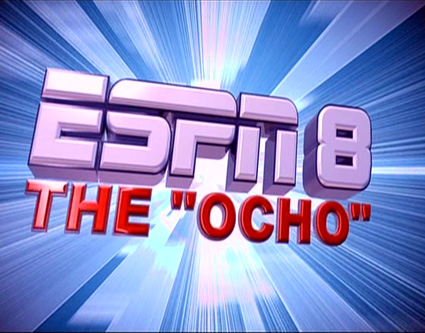
(7) ESPN Deportes
(8 ) ESPN UT

The Ocho has finally arrived.

(Follow Frank the Tank’s Slant on Twitter @frankthetank111 and Facebook)

(Image from Scream Punch)

The Big Ten Expansion Index: A Different Shade of Orange

The Big Ten has sent college conferences across America into a tizzy with its announcement that it will examine the possibility of expanding. Of course, the announcement was really a non-announcement – the conference has always looked at expansion issues every few years. However, this feels a little bit different this time around where it feels as if though the conference is finally starting to think about options outside of the Irish-born elephant located in the middle of the conference footprint in South Bend that always seems so stubborn (or what they would call “independent”).

A few years ago, I wrote that if the Big Ten ever wanted to expand with a school other than Notre Dame, then it ought to invite Syracuse for a variety of reasons. A lot of the same analysis still applies today, although I wanted to do a comprehensive review of the various candidates using a 100-point index (as I’ll expand upon in a moment). The conclusion is that the best available Big Ten candidate certainly wears orange, but it’s not who most of the general public is discussing (even though it makes incredible sense considering that a new school has to have a massive impact in order to make it worth it for the conference, which is the nation’s oldest and wealthiest, to split the pot 12 ways instead of 11). We’ll get to that in a bit.

I. GENERAL RULES

There are two overarching rules to examining potential Big Ten expansion candidates:

RULE #1: Think like a university president and NOT like a sports fan.

RULE #2: 11 + 1 = 13

The first rule is something that over 90% of the pundits (whether it’s in the “traditional” media or on blogs and message boards) violate with impunity on this subject. A massive number of sports fans see Team A vs. Team B as being a good matchup in this particular season and think that the Big Ten ought to expand solely based on that reasoning yet not even bother to address any academic requirements. Others put a high value on strict geography without even thinking about financial matters such as whether a school will add any new TV markets. Contrary to an Internet-fueled urban legend, there isn’t any rule that says that all Big Ten states much touch each other. Even if such rule existed, finding the right school completely trumps any geographic issues for a conference that looks at itself as an exclusive club. I’m going to hammer on this geography issue A LOT because too many sports fans are hung up on this when the university presidents really don’t care about it as much as being aligned with peer institutions for BOTH academics and athletics wherever they might be located.

As for the second rule, that isn’t just fuzzy math for a conference with 11 members that still calls itself the Big Ten. The reason why the Big Ten has stood at 11 members for so long is that Penn State, which has been an unqualified success in bringing an enormous amount of resources to the conference, is now the baseline standard for any type of expansion candidate. That is, a new school must bring financial, academic and fan base value to the conference that is way above and beyond what an average school would bring to the table. The Big Ten DOESN’T need 11 + 1 = 12, where all that does is add another mouth to feed without materially changing the fortunes of the current conference members. At the same time, the Big Ten absolutely positively will not even consider 11 + 1 = 11.5, where the revenue split per school would actually go down by adding a 12th member. Instead, a viable expansion candidate has to show that by becoming the 12th school in the conference that it would be the equivalent of bringing value that is above and beyond simply adding a conference championship game – essentially, the Big Ten needs 1 marquee school that is worth 2 average schools. Hence, the proper math for the Big Ten is 11 + 1 = 13.

(Note that the excellent Big Ten lawyer blog The Rivalry, Esq. borrowed a modified version of the 11 + 1 = 13 concept in its own analysis of Big Ten expansion candidates and gave a shout out my way in the process.)

So, when some columnist, blogger or message board poster starts talking about Big Ten expansion, remember those two overarching rules at a bare minimum when considering whether the writer has a financially and academically astute brain built for running conferences or a sports stereotype “What have you done for me lately?” brain. Only the former type of brain has any type of credibility.

II. EXPLANATION OF THE BIG TEN EXPANSION INDEX

As I alluded to earlier, I’ve built a 100-point Big Ten Expansion Index that evaluates the viability of each particular school’s Big Ten candidacy. There are 6 categories (Academics, TV Brand Value, Football Brand Value, Basketball Brand Value, Historic Rivalries/Cultural Fit, and Mutual Interest) that receive different weights depending upon how important they are in the decision-making process. If a school were to receive a perfect score in each category, then it would have 100 points. Here are detailed explanations of the categories and how they are weighted:

Academics (25 points) – This is a zero-sum category: either a school meets the academic requirements and receives the full 25 points or it doesn’t. Casual sports fans tend to ignore this component since they just see conferences for how they perform on the field or hardwood. However, academics are heavily weighted in this analysis because membership in the Big Ten also means membership in the Committee for Institutional Cooperation (CIC). That’s not a small consideration as the Big Ten universities plus former conference member University of Chicago share research and resources among each other for academic purposes. Therefore, any expansion candidate needs to fit in with academic discussions among U of C and Northwestern faculty just as much as they need to bring prowess to the football field against Ohio State and Michigan. Membership in the American Association of Universities is preferred but not required if a school is in the upper echelon of the U.S. News & World Report rankings. Tier 3 schools, however, are going to be eliminated right off the bat no matter how much they might bring to the athletic side of the equation.

TV Value (25 points) – An expansion candidate needs to either bring new major TV markets to the conference or be such a massive national name that it would overshadow a small market. Outside of the obvious school in South Bend, any school that overlaps a market that the Big Ten already has today without bringing new markets on top of that will receive 0 points – the most important point that people need to understand is that being within the current Big Ten footprint is a massive negative to the conference. Too many sports fans mistakenly think the opposite way, where they think that because School X is in the same state as Ohio State or School Y used to have a long rivalry with fellow in-state school Penn State means that they are good fits for the conference, when in reality those types of schools bring little or no value to the Big Ten because they don’t add any more TV households to the table. I’ll repeat the mantra here: think like a university president instead of a sports fan.

Another important consideration here is that the Big Ten’s future media revenues are going to be heavily dependent on the performance of the Big Ten Network. As with any basic cable channel, whether it’s ESPN or the Food Network, the Big Ten Network’s revenues and profitability are largely based upon getting into as many basic cable households as possible – pure and simple. The TV ratings for a particular school in a market don’t mean as much as whether such school has enough leverage and drawing power in a region or market to get the Big Ten Network onto basic cable there. What this means is that there’s going to be a heavy premium (if not outright requirement) that a new school delivers the largest number of cable TV households possible on top of what the Big Ten has now. On the flip side, if a school doesn’t add any new Big Ten Network subscribers, then that school is a non-starter.

Football Brand Value (30 points) – This is the most heavily weighted category as a reflection of the reality of the college sports landscape. The revenue generated from football is so massive in comparison to the other sports (including basketball) that no expansion is likely to happen in the Big Ten unless the new school is a bona fide gridiron power. It’s why the ACC was willing to water down its basketball conference with football schools like Miami and Virginia Tech a few years ago and the root of the massive unilateral pushback from the major conferences about any type of NCAA Tournament-esque college football playoff proposal – there’s so much money involved with football that there’s no rational economic reason for the BCS conferences to share it.

It must be emphasized that Football Brand Value puts much more weight on the long-term history and financial underpinnings of a program over short-term or recent success. Thus, Team A that has sold out 80,000-seat or even 100,000-seat stadiums for decades whether it wins or loses is much more valuable than Team B that only sells out a 40,000-seat stadium when it’s in the national championship race, even if Team A has had a mediocre seasons recently and Team B happens to rank in the top 3 of the BCS rankings this year. The “What have you done for me lately?” attitude of most sports fans doesn’t apply here. Instead, the proper question is the opposite: Even if the target school goes 0-12 in a season, will it still attract TV viewers and attendance? In other words, the true value of a football program is really measured by how much attention it still receives when it’s down as opposed to how much attention it gets when it’s up. The Big Ten will only consider programs that have large and real hardcore fan bases that will stick them in good times and bad as opposed to programs that have bandwagon fans that will bolt when there’s a 7-5 season.

Basketball Brand Value (10 points) – Personally, there’s nothing that would make me more delirious as a sports fan than Illinois winning the national championship in basketball. However, when it comes to conference expansion discussions, basketball simply won’t be much of a consideration, which is why the Football Brand Value category is weighted three times as much as the Basketball Brand Value category. A common argument that you’ll see on blogs and message boards is that “Team A won’t leave Conference X because Team A is a basketball school and Conference X is so much better in basketball than the Big Ten.” Once again, this is a sports fan view as opposed to a university president view. As I alluded to before, the financial value of football outweighs basketball interests by such a massive margin that every single all-sports athletic director in America will take a bad football program in a top drawing football conference over a championship caliber basketball program in the best basketball conference without hesitation.

That being said, if all things are relatively equal in the other categories, then basketball considerations could be the tipping point. In that event, this index assigns 10 points to a school that would be a legitimate marquee basketball program in the Big Ten, 5 points to a middle-to-upper middle class basketball school that isn’t quite a top program but would at least provide some depth and 0 points to a school that doesn’t bring anything to the basketball side of the equation whatsoever. There might also be a specific case where the conventional financial argument between football and basketball could be turned on its head (which will be addressed in examining how Big Ten Network distribution could work with a certain school located in Upstate New York).

Historic Rivalries/Cultural Fit (5) – This is more of a “smell test” category. Does a school have existing or historic rivalries with any Big Ten schools? Is the atmosphere balancing academics and athletics at the expansion target in line with the rest of the conference? When the average sports fan looks at the conference alignment, does it seem to make sense? 5 points are given to a perfect fit across the board, 3 points are given to a good fit in some respects but maybe less so in others, while 0 points are given to anyone that simply would stick out like a complete sore thumb (with much more emphasis on the character of the school as opposed to geography).

Mutual Interest (5) – The basic question is the likelihood of whether an expansion candidate would actually accept an invitation from the Big Ten. This is relevant because Notre Dame publicly declined an official Big Ten invitation in the late-1990s, which was a drawn-out process and left a lot of sour feelings among the conference members. As a result, the conference has no desire to invite anyone unless that school has confirmed with its university president and board of trustees that it will say “Yes” without a public debate or discussion. 5 points are given to a school whose university president will be on the next plane to O’Hare and start popping champagne the moment that the Big Ten extends an offer, 3 points to a school that will give an invitation heavy consideration but could go either way and 1 point to a school that will hear the Big Ten out yet will almost certainly reject any offer.

III. EVALUATION OF THE BIG TEN EXPANSION CANDIDATES

The candidates are listed in reverse order from least desirable to most desirable. For the purposes of this evaluation, I’m assuming that the only viable expansion candidates are currently independent or members of the Big East and Big 12. For various reasons, the Big East and Big 12 have the most unstable conference situations where a move to an extremely stable Big Ten would be attractive on paper, while there is little reason for any school to leave the SEC, ACC or Pac-10 at this time (meaning suggestions that I’ve seen elsewhere that the Big Ten should add the likes of Maryland, Vanderbilt and/or Kentucky aren’t going to be examined here). I’ve placed the candidates into tiers of Pretenders, Contenders and The Only Real Choices.

A. Pretenders

CINCINNATI
Academics: 0
TV Value: 0
Football Brand Value: 10
Basketball Brand Value: 5
Historic Rivalries/Cultural Fit: 0

Mutual Interest: 5
Total: 20
Overview
: This is the ultimate example of the short-sighted sports fan “What have you done for me lately?” choice based upon this particular year’s results as opposed to thinking like a university president. Cincinnati is in the third tier of the U.S. News rankings, doesn’t add any new Big Ten Network subscribers since Ohio State already has the city of Cincinnati covered for the conference (and then some) and it would be an urban commuter school in a conference that is largely composed of large flagship universities where nearly all of the students live on campus. For those that think that the Football Brand Value is too low at 10, remember that the criteria is a long history of football success as opposed to recent gains. At the end of the day, Cincinnati couldn’t sellout 40,000 seats until it was in the national championship race (which indicates a high level of bandwagon fandom), its coach couldn’t take the Notre Dame job fast enough despite being the #3 team in the country, and the school doesn’t even have a football practice facility. In contrast, Ohio State has practice facilities that put almost every NFL team to shame. Here’s my personal litmus test for expansion discussions: anyone that mentions Cincinnati as a viable Big Ten candidate loses all credibility whatsoever with me on the issue.

LOUISVILLE
Academics: 0
TV Value: 10
Football Brand Value: 15
Basketball Brand Value: 10
Historic Rivalries/Cultural Fit: 0
Mutual Interest: 5

Total: 40
Overview: Similar to Cincinnati, Louisville is a tier 3 school, which eliminates them off-the-bat. Elite basketball program and excellent fan base overall (even with the football team being in the doldrums lately), yet there rightfully isn’t much buzz about Louisville as a candidate.

IOWA STATE
Academics: 25
TV Value: 0
Football Brand Value: 10
Basketball Brand Value: 0
Historic Rivalries/Cultural Fit: 3
Mutual Interest: 5

Total: 43
Overview: The only expansion name that gets thrown out by the pundits more idiotically than Cincinnati might very well be Iowa State. I’m not exactly sure why the Big Ten would want to take one of the least valuable schools in the BCS that is located in a small state which is already covered by the conference with a much more popular flagship. If it wasn’t for Iowa State having a halfway-decent engineering school, it would be the worst possible Big Ten expansion candidate out there. Yet, Iowa State’s name gets tossed around merely because it’s within the Big Ten footprint, which I’ve already explained is actually a massive negative mark as it doesn’t open up any new markets. Therefore, I’ll amend my original litmus test for expansion discussions: anyone that mentions Cincinnati or Iowa State as a viable Big Ten candidate loses all credibility whatsoever with me on the issue.

WEST VIRGINIA
Academics: 0
TV Value: 10
Football Brand Value: 25
Basketball Brand Value: 5
Historic Rivalries/Cultural Fit: 3
Mutual Interest: 5

Total: 43
Overview: On the field, West Virginia is a solid school across-the-board: excellent football program with a great traveling fan base, an upper tier basketball program and a dormant rivalry with Penn State. However, the off-the-field considerations will kill any talk about the Mountaineers – it’s a third tier school academically and the school brings very few new TV households.

B. Contenders

PITTSBURGH
Academics: 25
TV Value: 0
Football Brand Value: 20
Basketball Brand Value: 10
Historic Rivalries/Cultural Fit: 3
Mutual Interest: 5

Total: 63
Overview: Pitt is mentioned by a lot of pundits as a top candidate for Big Ten expansion or maybe even the very best candidate outside of Notre Dame. Certainly, there is a lot to base this upon: excellent academic research reputation, long history in football, elite basketball program, a great-but-dormant rivalry with Penn State and there’s no doubt that Pitt would accept a Big Ten offer. However, WAY WAY WAY too many people have completely forgotten about the obvious problem with Pitt: just like Iowa State and Cincinnati, Pitt wouldn’t add a single new Big Ten Network subscriber. Penn State already delivers the Pittsburgh market and much more (Philadelphia and the rest of Pennsylvania), so Pitt’s TV value to the Big Ten is zero. It’s unfortunate that Pitt couldn’t trade locations with Rutgers – if that were the case, then Pitt would be an excellent candidate. Alas, the one thing that Pitt can’t change is its location, which means that it won’t ever receive an invite from the Big Ten.

RUTGERS
Academics: 25
TV Value: 15
Football Brand Value: 15
Basketball Brand Value: 0
Historic Rivalries/Cultural Fit: 3
Mutual Interest: 5

Total: 63
Overview: Another popular name that’s being discussed in the general public and it’s almost solely based on the location of Rutgers in the New York DMA. The problem is that it’s highly debatable as to whether Rutgers has the leverage to get the Big Ten Network onto basic cable in the New York City area overall or even in just New Jersey. In fact, a lot of neutral observers would say that the Big Ten already has the most popular school in that market in the form of Penn State, so adding Rutgers wouldn’t even do much on that front. Therefore, the market of Rutgers is fantastic on paper, but its ability to deliver that market is questionable at best, which results in it only having a TV Value of 15. Without guaranteeing the NYC market, Rutgers isn’t really very attractive.

MISSOURI
Academics: 25
TV Value: 15
Football Brand Value: 15
Basketball Brand Value: 5
Historic Rivalries/Cultural Fit: 3
Mutual Interest: 3

Total: 66
Overview: As an Illinois fan, it would be fun to see the Braggin’ Rights games for both football and basketball be taken in-house. However, as someone that always wants the best for the Big Ten overall, Mizzou is more of a “meh” move. There’s some decent value on all of the fronts in terms of academics, TV markets (the portion of the St. Louis market that the Illini don’t deliver and Kansas City), football, basketball and cultural fit, so it’s not as if though there’s anything particularly bad about the school. Yet, nothing screams out that adding Mizzou is a spectacular game changing move by the Big Ten, either. As I stated earlier, Penn State is the standard for Big Ten expansion, and on that front, no one can reasonably put Missouri anywhere near that level. If the Big Ten just wants to expand just for the sake of expanding, then Missouri is a decent choice, but I don’t think that’s the Big Ten’s modus operandi. Therefore, I think that the heavy talk about Missouri going to the Big Ten is mostly coming from the Mizzou side as opposed to the Big Ten side. (Please see this interview with the Missouri athletic director, who seemed to be saying, “Please invite us to the Big Ten!” in the most diplomatic way possible.) Plus, as I’ll get to later, it’s possible that all of the Big 12 schools are up for grabs, in which case there truly is a non-Notre Dame game changer available.

NEBRASKA
Academics: 25
TV Value: 15
Football Brand Value: 30
Basketball Brand Value: 0
Historic Rivalries/Cultural Fit: 3
Mutual Interest: 3

Total: 76
Overview
: I’m giving Nebraska the benefit of the doubt on the academics front here – its undergraduate admissions standards are significantly below anyone else in the Big Ten, but it’s an AAU member with solid graduate programs. Still, Nebraska brings maximum points in the most important category of Football Brand Value. Hypothetically, is Average Joe Sports Fan in Anytown, USA going to be that interested in watching Missouri vs. Ohio State/Michigan/Penn State or Rutgers vs. Ohio State/Michigan/Penn State? Probably not. However, Nebraska vs. Ohio State/Michigan/Penn State will get marked on the calendar by ABC for national distribution immediately an draw massive ratings year-in and year-out. Nebraska’s issue, though, is that while its national reputation is great for traditional TV contracts with ABC/ESPN, its tiny home state doesn’t help much with the Big Ten Network since the school probably won’t spur many cable providers outside of its home markets to add the channel. As a pure football move, Nebraska would be a fantastic addition, but I think the TV market issue is significant enough to keep the Cornhuskers from receiving an invite.

SYRACUSE
Academics: 25
TV Value: 20
Football Brand Value: 20
Basketball Brand Value: 10
Historic Rivalries/Cultural Fit: 3
Mutual Interest: 5
Total: 83
Overview
: As I noted earlier, Syracuse was my favorite Big Ten expansion candidate outside of Notre Dame for a long time. The analysis from my original post still largely stands. If the goal of the Big Ten is to gain entry into the New York market and effectively dominate the East Coast in the same way that it dominates the Midwest, then I believe Syracuse is a much smarter addition than Rutgers. While Syracuse football probably doesn’t have the leverage to get the Big Ten Network into New York DMA households just as Rutgers, the difference-maker here could be Syracuse basketball. New York is a terrible college football town, but it’s a pretty good college basketball city, and on that front, Syracuse is at or near the top in that market. So, NYC residents may not care to get the Big Ten Network for a handful of Rutgers or Syracuse football games per year, but they may very well have enough interest in 10-15 Syracuse basketball games per year to launch the BTN into basic cable distribution there. In essence, the “football means everything in college sports” mantra could be turned on its head here with respect to New York where basketball is the driving revenue factor. I’m not saying that this logic will hold in practicality, yet at least it seems more likely to me than the thought of either football programs at Rutgers and Syracuse really having an impact for the Big Ten in the NYC market.

C. The Only Real Choices

NOTRE DAME
Academics: 25
TV Value: 25
Football Brand Value: 30
Basketball Brand Value: 5
Historic Rivalries/Cultural Fit: 5
Mutual Interest: 1

Total: 91
Overview
: It’s pretty simple as of today – if Notre Dame wants to join the Big Ten, then it’s in. The national fan base of its football program is unparalleled and, frankly, it would propel the conference into East Coast markets such as New York better than pretty much any school that’s actually located on the East Coast.

Of course, it’s easy to see what’s in it for the Big Ten. However, the issue has always been about what’s in it for Notre Dame. While I personally believe that Notre Dame will continue with its current stance in favor of independence, the college sports financial landscape has drastically changed since the Fighting Irish rejected a Big Ten invite in the late-1990s. What the average sports fan doesn’t realize is that Notre Dame’s NBC contract, which is what the uninformed pundits point to as the major reason why the Irish wouldn’t join the conference, pales in comparison to what every single Big Ten and SEC school makes from their respective conference TV contracts. Notre Dame reportedly makes around $9 million per year from NBC, which was a level that made it the top TV revenue school back in 1999. In contrast, ESPN’s Outside the Lines reported last week that the Big Ten is currently making $242 million per year in TV revenue which is split equally among the 11 schools, meaning that everyone from Michigan to Northwestern is taking in $22 million per year. Think about that for a second: the vaunted Notre Dame was the #1 TV revenue maker in the entire country up until just a few years ago, yet it’s now only #3 in its own home state behind Purdue and Indiana (and less than half as much of each, at that).

How did this happen? It’s the fact that the TV landscape has tipped completely in favor of cable over the past decade. Cable channels have a dual revenue stream, where they make a certain amount of money for each subscriber it has every month plus advertising on top of that. In contrast, over-the-air networks can only rely on advertising. For instance, about $3 of your monthly cable bill goes to ESPN whether or not you watch it. ESPN is in over 100 million households, which means that it’s making $300 million per month and $3.6 billion per year in subscriber fee revenue… and that’s before the network sells a single ad… and that’s not counting its revenue from ESPN2, ESPNEWS, ESPNU and ESPN Classic. As a result, ESPN is the single most profitable entity in the entire Disney empire, which is why the network can afford to pay much more for high profile sports events such as Monday Night Football (note that ESPN is paying almost twice as much for MNF as NBC is for a better flex option slate of Sunday Night Football) and the BCS bowls than the traditional TV networks. When Comcast bought NBC Universal last month, the main prize was the stable of profitable cable channels such as CNBC, MSNBC and Bravo. In contrast, NBC itself is bleeding over several hundred million dollars per year in losses and is the main reason why General Electric wanted to sell the entertainment unit in the first place.

While the Big Ten has ensured that its top tier games continue to be shown on ABC for football and CBS for basketball, it has taken advantage of the sports landscape by securing massive cable revenue for its second tier games on ESPN and its own Big Ten Network. The SEC has done the same via its own wide-ranging media rights deal with ESPN. Notre Dame’s issue is that it’s almost impossible for it to take advantage of these financial changes by being outside of a conference unless it moves all or most of its games to cable (i.e. Versus, which is now a sister company to NBC in the new Comcast conglomerate), which defeats the main advantage of having an independent TV contract in the first place (nationwide over-the-air NBC coverage whether you have cable or just rabbit ears). As a result, independence has turned from Notre Dame’s greatest financial asset into possibly its greatest long-term financial liability.

Therefore, the “Notre Dame makes way too much money as an independent with the NBC contract to ever join a conference” argument is simply not true anymore. For the first time in a century, it may very well be in the rational economic interest of Notre Dame to join the Big Ten. The academics and faculty in South Bend already strongly supported a move to the Big Ten in the 1990s because of the CIC research opportunities and now the financial people might be on board. Of course, this type of logic doesn’t necessarily apply to Notre Dame alums (no offense intended for the Irish fan readers of this blog – I sincerely mean it in a positive way that describes the special passion that alums have for the school) – it’s “independence or die” for them. As I’ve thought about this issue more, this longstanding mentality might actually be as much of a roadblock for the Big Ten as it is for Notre Dame. On one side of the ledger, you have school that has spent most of its history protecting itself and profiting from independence. On the other side, you have the nation’s oldest collegiate conference where most of its members have dealt with each other for over 100 years, share everything equally and have a legitimate “all for one and one for all” mentality. Ohio State truly understands that what’s best for the Big Ten overall is best for Ohio State individually. Could Notre Dame ever adopt that type of worldview? It might be impossible, which could lead to a lot of heartburn down the road.

As a result, it would behoove the Big Ten to look toward another powerhouse university where there appears to be much more mutual interest than the pundits are generally acknowledging. This is a school that the Big Ten could add as a 12th member and unequivocally never think about Notre Dame again…

TEXAS
Academics: 25
TV Value: 25
Football Brand Value: 30
Basketball Brand Value: 10
Historic Rivalries/Cultural Fit: 3
Mutual Interest: 3
Total: 96
Overview
: You’re not seeing a misprint – the University of Texas-Austin is the single best possible addition for the Big Ten and the Longhorns are a whole lot more open to it than what the public seems to realize. The average sports fan that has been raised to view college conferences in a regional geographic context probably believes the notion of Texas going to the Big Ten is weird, crazy, upsetting and will never happen. However, as I stated under the Notre Dame overview, the college sports landscape has completely changed from a decade ago where national TV contracts and cable channel distribution now rule the day.

Putting aside any geographic concerns for the moment, Texas is a perfect fit in almost every possible way from the Big Ten’s perspective. The academics are top notch where Texas is one of the nation’s top 15 public universities in the latest U.S. News rankings and its graduate programs are right alongside Michigan, Illinois and Wisconsin as among the elite for public flagships. The football program in Austin was just ranked as the most valuable in all of college football by Forbes magazine (#2 is… Notre Dame) and, unlike Nebraska, the Texas basketball program is playing at an elite level, as well. As I’m writing this blog post, both the Texas football and basketball teams are ranked #2 in the country. At the non-revenue sport level, Texas would completely put Big Ten baseball back on the map. Finally, the value of the Big Ten’s traditional TV deals and Big Ten Network revenue would skyrocket with the addition of the #5 (Dallas-Fort Worth) and #10 (Houston) TV markets in the nation plus the entire state of Texas (the country’s 2nd most populous after California). While it’s questionable whether Syracuse or Rutgers could really break the Big Ten into the New York area, there’s absolutely no doubt that Texas would deliver the Big Ten Network to every single cable household in the Lone Star State. The market impact is incredible – the Big Ten, which already has the largest population base of any conference, would further increase such base by over 1/3 with Texas to over 90 million people. When you start thinking about Texas as a possible Big Ten candidate, the thought of inviting Missouri, Syracuse or Rutgers feels like a inconsequential move.

It’s clear why the Big Ten would want Texas. So, why on Earth would Texas want to join the Big Ten? Well, the financial implications are massive. As I stated earlier, the Big Ten receives $242 million per year in TV revenue to split evenly among its 11 members, which comes out to $22 million per year for every single school. In contrast, the Big 12 receives $78 million per year in TV revenue that is split unevenly among its 12 members based on national TV appearances. That comes out to $6.5 million per year for the average Big 12 school. Even Texas, which is a beneficiary of the Big 12’s unequal revenue distribution model since it receives a large number of TV appearances, received only about $12 million in TV revenue last season according the interview with Missouri’s AD that I linked to earlier. In other words, every single Big Ten school makes $10 million per year more than Texas does on TV revenue whether such school is on ABC 12 times or the Big Ten Network 12 times. Remember that the $10 million difference is more than what Notre Dame receives from its vaunted NBC contract. If Texas were to simply bring enough to the Big Ten to maintain the status quo of per school revenue, that would be an 83% jump in TV revenue for the Longhorns immediately off the bat. Considering that the addition of Lone Star households to the Big Ten Network’s distribution would yield an even greater increase in revenue, Texas would easily see in excess of a two-fold increase and maybe even close to a three-fold increase in TV revenue whether it wins or loses.

The average sports fan will look at those numbers and retort, “It’s not all about the money. It’s about rivalries and the passion.” That’s a fair enough point. However, consider that Texas has only been in the Big 12 for 15 years, compared to the original Big 8 members like Nebraska and Oklahoma that have been together for nearly a century. Texas cares about playing Oklahoma (which was a non-conference rivalry for decades up until the formation of the Big 12 in 1994) and Texas A&M. After those two schools, the general consensus among Texas fans is that they could care less about Texas Tech, Baylor and virtually everyone from the Big 12 North (who are all old Big 8 members). Similar to how most of the schools in the East (particularly Big East schools) consider Penn State to be a rival yet the Nittany Lions don’t reciprocate that feeling, all of the Southwestern schools think of Texas as their main rival while the Longhorns simply don’t care about them. Also note that outside of the states of Texas and Colorado, the Big 12 is a decidedly Midwestern conference, only those Midwestern states pale in population size compared to the Big Ten’s Midwestern base. What this means is that the Texas ties to the Big 12 are fairly loose and not ironclad at all in terms of history while the geographic factor really isn’t that important considering how many Big 12 schools are in the Midwest. If Texas maintains its rivalries with Oklahoma and Texas A&M in the non-conference schedule, the Longhorns keep their two most important regional rivalries alive while opening themselves up to the entire nation during the conference schedule.

Speaking in terms that the average sports fan in Texas ought to understand, think of the Dallas Cowboys. When the NFL realigned its divisions in the 1990s, it strongly considered moving the Cowboys to the NFC West. It made geographic sense and, at the time, the Cowboys were in the middle of its run of great games against the San Francisco 49ers, so there was some emotional juice that could’ve been taken to a higher level with those teams in the same division. However, Jerry Jones completely insisted that the Cowboys stay in the geographically-challenged NFC East. Why? Because the Cowboys wouldn’t be able to continue being “America’s Team” by playing teams in the South and West Coast. In order to obtain a national fan base, you need to play in the major markets in the East. If Texas were to move to the Big Ten, it would break out from being a school with a strong regional fan base into one that could be the equivalent of the NFL Cowboys with a national fan base by playing in a disproportionate share of the largest markets in the country located East of the Mississippi River.

Academics are also an extremely important selling point for Texas. The issue with the academic standards in the Big 12 is that there are no academic standards in the Big 12. Texas is the highest ranked Big 12 school in the U.S. News rankings tied at #47 (the Big Ten schools ahead or tied are #12 Northwestern, #27 Michigan, #39 Illinois, #39 Wisconsin and #47 Penn State) while every single other school in the Big 12 except for #61 Texas A&M is ranked lower than every other Big Ten school (the lowest ranked are Indiana, Michigan State and Iowa tied at #71). No one else in the Big 12 comes even close to the academic research abilities of Texas. The potential entry of Texas into the Big Ten would include membership in the CIC, which opens up a whole new level of academic research opportunities for the school that simply doesn’t exist in the Big 12. The first general rule that I mentioned about discussing Big Ten expansion was that people need to think like a university president as opposed to a sports fan. If moving to another conference would (1) make more money for the athletic department AND (2) improve the academic standing of the university, you’ve made quite a powerful argument to the Texas university president.

Finally, there’s a CYA aspect to all of this for Texas. Please take a look at this discussion about expansion options on Barking Carnival, which is my favorite Texas blog. I was shocked to find very few “BIG TEN FOOTBALL SUX”-type comments and instead saw a whole lot of consternation about the long-term viability of the Big 12 overall. Here’s something that I didn’t think about before: if Missouri were to hypothetically leave the Big 12 for the Big Ten, then the Big 12 could end up imploding (i.e. Colorado would bolt for the Pac-10) or at least be severely weakened. The reason is the subpar Big 12 TV contract that I mentioned earlier. St. Louis and Kansas City are decent markets and Missouri is a decent state for a conference like the Big Ten, but none of them have much of an impact when the conference already has Chicago, Philadelphia, Minneapolis and the entire states of Ohio and Michigan. In contrast, St. Louis and Kansas City are respectively the 4th and 5th largest markets for the Big 12 (and more importantly, respectively the 2nd and 3rd largest markets outside of Texas) and Missouri is by far the largest state in the conference other than Texas. Therefore, the loss of Missouri would cause the currently bad Big 12 TV contract to get even worse since no possible replacement school from, say, the Mountain West (i.e. BYU, Utah, etc.) would come close to replacing those markets and households. In turn, all of the Big 12 schools might be sent scrambling for new homes. While that might be a doomsday scenario, Mizzou leaving for the Big Ten would severely damage the Big 12 at the very least.

So, if all of the Big 12 schools could be theoretically up for grabs, why the heck would the Big Ten go after a minnow (Missouri) when it could get a whale (Texas) instead? Why the heck would the Big Ten take Missouri or even Nebraska and let Texas possibly walk off to the much less financially powerful Pac-10? Why the heck would Texas just let a middle tier school like Missouri leaving for another conference put its future in limbo? Simply put, if a decent-but-not-great school like Missouri leaving could have that much of a potential impact on the Big 12, then that’s clearly evidence that the conference is unstable and maybe a powerhouse school like Texas will understand that it needs to start evaluating more stable options (if it hasn’t already). This presents a monster opportunity for the Big Ten to swoop in and solidify its place as the nation’s most powerful sports conference.

Sports-wise, the Big Ten has a reputation of being staid and conservative. In terms of overall conference management, however, the Big Ten is quite forward looking and thinks outside of the box. It’s easy to say that the Big Ten Network is an obvious cash cow for the conference as of today, but at the time of its formation, it was a massive risk considering that it could’ve easily taken a massive traditional rights deal from ESPN in the same manner as the SEC without the pain of a year of fighting for basic cable distribution in the Midwest and Pennsylvania. It now looks like the Big Ten is going to benefit from that risk. Similarly, I’m convinced that the Big Ten isn’t going to make a “meh” move simply to get to the 12 teams needed to stage a football conference championship game. The new school has to be strong enough where if Notre Dame all of the sudden decides that it wants to join a conference in 10 or 20 years, the Big Ten can comfortably say “No” and not have buyer’s remorse about the 12th member that it added. I don’t think that Missouri, Syracuse or Rutgers would come close to meeting that standard, but Texas hits the mark and even more. Therefore, there’s one task for the Big Ten over the next year or so:

Hook ’em.

(Follow Frank the Tank’s Slant on Twitter @frankthetank111)

UPDATE #1 (1/4/2010) – Tons of great feedback on this post, so I’ve addressed some additional issues in Big Ten Expansion Index Follow-Up #1: Superconferences, Conference TV Revenue and More Reasons Why Texas to the Big Ten Makes Sense.

UPDATE #2 (1/8/2010) – Confirmation that the Big Ten “contiguous state” rule is a myth, responses to blogs and message boards from across the country and, most importantly, the views of Texas fans in Big Ten Expansion Follow-Up #2: Nationwide and Longhorns Fan Responses on Texas to the Big Ten.

UPDATE #3 (1/20/2010) – More on the financial gap between the Big Ten and Big 12, how Notre Dame almost joined the Big Ten and thoughts on the East Coast schools and fallout in other conferences in Big Ten Expansion Follow-Up #3.

UPDATE #4 (2/1/2010) – Why the “Pitt Joining the Big Ten” Rumors are False.

UPDATE #5 (2/11/2010) – Newspaper reporting that the Big Ten has entered into preliminary discussions with the University of Texas.

UPDATE #6 (2/17/2010) – Template for Shooting Down Every Argument Against Texas Going to the Big Ten

UPDATE #7 (2/21/2010) – Explaining why the “initial list” of 15 Big Ten candidates is an examination of who would join WITH Texas and/or Notre Dame (NOT instead of them).

UPDATE #8 (3/2/2010) – What’s the purpose of the Big Ten leaking a study of Notre Dame, Missouri, Rutgers, Syracuse and Pitt?

UPDATE #9 (3/6/2010) – How Rutgers could work in the Big Ten (as long as another national marquee name also comes along)

UPDATE #10 (3/9/2010) – Notre Dame AD Jack Swarbrick leaves an opening for the Irish to join a conference.

UPDATE #11 (3/19/2010) – Rumors that the Big Ten is looking to add Boston College, Notre Dame and Rutgers.

UPDATE #12 (3/24/2010) – How the Pac-10 could affect Big Ten expansion.

UPDATE #13 (3/29/2010) – Notre Dame’s AD runs his trap again.

UPDATE #14 (4/6/2010) – Big Ten considering a 16-school conference.

UPDATE #15 (4/12/2010) – How a multi-phase expansion could be a good idea for the Big Ten.

UPDATE #16 (4/19/2010) – The value of expansion candidates to the Big Ten Network.

UPDATE #17 (4/25/2010) – Getting krunk on expansion news (or lack thereof).

UPDATE #18 (5/2/2010) – Rumors about a 5-team expansion with Nebraska, Missouri, Pitt, Rutgers and Syracuse.

If the Lions Are On the Clock, It Must Be NFL Draft Day

joey-harrington-matt-millen-detroit-lions-nfl-draft

A couple of quick thoughts on today’s NFL Draft:

(1) With the Bulls and Blackhawks in the playoffs, both the White Sox and Cubs not yet knocked out of the postseason race two weeks into the baseball season, and the fact that the Bears essentially have had their draft already with the Jay Cutler trade, it’s been nice to not have to deal with several weeks of babble of who the Bears will take in the NFL Draft.  In past years, the Chicago sports media would have been in all-draft mode for days on end with supposed life or death questions of the Bears’ future.  Sure, the Bears still need an arsenal of wide receivers for Jay Cutler to actually throw to and I’m very interested to see where various Illini players such as Vontae Davis will end up, yet these concerns pale in comparison to everything else that’s happening on the Chicago sports scene.  Don’t get me wrong – I enjoy draft talk as much as anyone, but I really love watching my favorite NBA team being competitive in the playoffs (notwithstanding this past Thursday evening) a whole lot more.  It’s great to have actual games on the field dominate the sports discussion in Chicago in April as opposed to the war room at Halas Hall.

(2) The NFL has compounded its mistake of moving the draft start time from its long-time slot at 11:00 am CT on the first day to 2:00 pm CT last year by pushing this year’s start time back another hour to 3:00 pm CT.  I understand that this move was made to draw in more viewers in prime time.  However, it takes away a lot of the allure of the NFL Draft as a television event in the first place.  To me, it’s a perfect “have the TV on in the background event” and an excuse to get together with your buddies to hang out for a whole morning and afternoon in a low-key manner while you invent creations such as bacon tacos (as Minneapolis Red Sox and I did the year that the Vikings forgot to get their draft pick in on time).  However, it’s far from a prime time edge-of-your-seat event (particularly when playoff basketball and hockey games are alternative options).  So, instead of the draft having already started in the late morning as a write this post, ESPN and ESPN News are in the midst of an 8-hour marathon of punditry (featuring the legendary hair of Mel Kiper, Jr.) on draft prospects, even though the world already knows that Matthew Stafford of Georgia is going to be picked first by the Detroit Lions.  (Let’s see if that pick works better than, well, every Lions pick since Barry Sanders.)  The NFL had a great all-day format for the draft, but its belief that this is somehow a compelling prime time event is misguided and, as a result, this will be the second year in a row where I’ll watch little, if any, of what was once one of my favorite not-on-the-field sports events of the year (next to NCAA Tournament Selection Sunday, the NBA Draft, and the NBA Draft Lottery) as someone that has always wanted to run a sports team.

(Image from The Nasty Boys)

It’s Funny Because It’s True: The ESPN College Basketball Fan Casting Call

espn-8-the-ocho

I’m normally not one for hyperbole, but the following find from Awful Announcing might very well be the most awesome sports-related story that I’ve come across since starting this blog: the ESPN casting call for college basketball fans representing different schools.  Due to the fact that it’s so over-the-top in its stereotypes and littered with spelling and grammatical errors, you might think that this is an Internet hoax.  However, ESPN contacted Awful Announcing to make it clear that the casting call was being canceled, which meant that the most powerful cable network in the nation really was going to use these parameters to find people to represent various universities (before they got caught, of course).

Let’s see if I would have met the requirements to be Mr. Illini:

[ ILLINOIS ]
MALE. African-American. Young Obama. Think Toofer-the straight-laced, Harvard grad write r from 30 Rock (Keith Powell)

Well, as a half-Chinese/half-Polish guy, it doesn’t look like ESPN believes that I could represent my Illini.  Believe me when I say that Illinois was treated very positively compared to some other schools.  In comparison, let’s take a look at the alma mater of my man crush Derrick Rose:

[ MEMPHIS ]
MALE. What can we say about Memphis? He’s a southern BLACK kid, really culinary and polite. He’s artistic, and draws comic books really well.

As Awful Announcing noted, an “African-American” gets to be a Harvard graduate, while a “BLACK” can draw comic books really well.  I see that ESPN’s casting director really took to heart America’s historic election of a new President last week.  Anyway, I was able to find a surprising starring role that I could fit into:

[ NOTRE DAME ]
MALE He’s an ASIAN kid who is in to all things Notre Dame, ridiculously so. Oh, and he’s always fighting. Every time we encounter him he always has some words or another, be it the faint traces of a black eye, or a scab or whatever. He epitomizes the fightin’ Irish.

As someone that grew up during the Lou Holtz era on the South Side of Chicago (alright, it was the south suburbs, but all North Siders seem to believe that the Chicago area ends at around 57th Street) where every other person was Irish Catholic, I obviously believe that an Asian kid with a black eye “epitomizes the fightin’ (sic) Irish.”  It’s interesting that Notre Dame was the one program that ESPN’s proxies seemed to go out of their way to avoid so many of the school’s stereotypes (well, other than the black eye and scab part), but there was another Midwestern Catholic university where they sincerely nailed it:

[ MARQUETTE ]
FEMALE. Marquette, on a scale of 1-10, she’s a six. A B-, C in every category you can define a person by. Her defining characteristic is you don’t really remember her. You’re not breaking your arm to get to her, but you’re not chewing it off to get away. She does have a winning personality though. Midwest, sweet girl.

Never have truer words have been spoken about Marquette.  (Yes, I’m a DePaul Law alum.)

That was just a mere sampling – 24 schools in all were up for casting and there are many more gems (although ESPN’s lack of a college basketball contract with the Pac-10 has deprived us of roles for USC and Berkeley).  I’m simultaneously mortified that this is not a joke and gleeful that this will live on the interweb forever.

UPDATE: USA Today appears to be the first in the mainstream media to have picked up this story.

(Image from Scream Punch)

Cut That Mullet and Frank the Tank’s Football Parlay – 11/7/2008

jeff-fisher-bears

Here are this week’s parlay picks (home teams in CAPS):

COLLEGE FOOTBALL PARLAY

(1) Oklahoma State Cowboys (+3.5) over TEXAS TECH RED RAIDERS – Last week’s Texas-Texas Tech game was definitely the best college football game so far this season (and the last half of the 4th quarter was simply spectacular).  That game was such an exhilarating victory for the Red Raiders against an arch rival that it’s tough to imagine that they can keep the same intensity the week after.  The problem is that Oklahoma State is no slouch in the loaded Big 12 – these are excellent upset conditions.

(2) LSU TIGERS (+3.5) over Alabama Crimson Tide – ‘Bama has got to have a tough game at some point and Baton Rouge makes sense to being the place where that happens.  I won’t be surprised if Penn State is the #1 team in the country by the end of the weekend (which will unleash a torrent of Big Ten hating columns from the national media about how bad the conference is compared to the Big 12 and SEC this year).

(3) Illinois Fighting Illini (-7.5) over WESTERN MICHIGAN BRONCOS – Illini fans have been perplexed for a very long time as to why Ron Guenther would agree to play a game at Ford Field against WMU, particularly when we already had a game in the Detroit area this season against Michigan.  There is zero upside for the Illini here.

FYI – I’ve been eying the Illinois-WMU game on the calendar for a couple years now as FUBAR.  I’ll admit to being a complete future college football scheduling dork, which makes CFBPalace an invaluable resource to me.   Honestly, I love my job as a lawyer, but if I had to choose another profession (with the caveat being that I actually have the physical capabilities to fill that role, meaning that my lifelong dream of being shooting guard for the Bulls doesn’t count until I have my 30-year old growth spurt), I would rank the possibilities as follows: (1) NBA general manager, (2) political strategist, and (3) the guy at ESPN that hooks up college football teams that have open dates on their schedules (yes, this position actually exists).

Frank the Tank’s College Football Parlay Record
Last Week: 1-2

Illini Games for the Season: 4-4
Overall Season: 16-13-1

NFL FOOTBALL PARLAY

(1) ST. LOUIS RAMS (+9) over New York Jets – There’s no logical basis for this pick.  The bookies have broken me.

(2) Green Bay Packers (+2.5) over MINNESOTA VIKINGS – In another complaint about the bookies, they continuously make the lines for Packers games this year so ridiculously attractive that a reasonable person can’t say no.  I have to shower every time that I pick the Packers just to remove the filth that my laptop chokes up on me, but if the Vikings are ever giving points, I’m taking them with no regrets.

(3) CHICAGO BEARS (+3) over Tennessee Titans – Remember how I said that I had a bad feeling about last week’s game against the Lions where they’d win but fail to cover (which is what ended up happening)? Well, despite the fact that Rex Grossman is going to be playing and a picture of the Bears defense has been on the side of milk cartons since the second week of the season, I’ve got baseless positive vibes about this game.  (By the way, I never knew before now of the story of how the playing career of Titans coach Jeff Fisher with the Bears was actually ended due to a broken leg inflicted by former Steelers coach Bill Cowher.  That’s what I call some knowledge that you need to drop when you start discussing the greatest mullets in history at your next cocktail party.)

Frank the Tank’s NFL Football Parlay Record
Last Week: 2-1

Bears Games for the Season: 3-41
Overall Season: 13-11-3

Have a great weekend and, as always, Go Illini and Go Bears!

(Image from USC Legends)