
I was listening to Terry Boers and Dan Bernstein (for non-Chicagoans, they host the afternoon drive on WSCR 670 “The Score” and, in my opinion, have the best sports talk show in the city) last week and they had an extended conversation on the state of DePaul basketball, which was extremely unusual since I don’t believe that I’ve ever heard them discuss the Blue Demons in ten years of listening to their show. Their main point was that DePaul doesn’t seem to know what type of program that it wants to be as of today – if the school doesn’t want to commit the resources to be competitive in the brutal Big East, then it ought to just resign itself to being a Loyola-type program. Truer words have never been spoken. When I wrote this high-level assessment of the DePaul program in the wake of its first Big East conference game three years ago (a victory over rival Notre Dame), I was optimistic about the school joining a conference that it felt it should have always belonged to (in the sense of being the dominant Catholic university in a major media market). However, I also sounded the following warning:
Still, it’s not just enough for DePaul to simply join the Big East – the Demons need to establish a winning program within that conference. Otherwise, DePaul is going to be to the Big East what Northwestern basketball is to the Big Ten: a Chicago outpost whose arena is filled up every game with fans of the opponents.
Unfortunately, it looks like the latter scenario is becoming the norm at Allstate Arena. DePaul has lost its first five Big East games of the season, including a blowout loss at home against a horrific South Florida team. While I knew that DePaul’s stadium situation would always put a damper on the program’s ability to draw recruits, what I didn’t expect was for the school to simply ignore the financial realities of what it takes to be able to compete in the Big East. Let’s just put aside schools with football programs, such as Notre Dame and Syracuse, and take a look at a ranking of the 2007-08 athletic revenue and expenses of the Big East Catholic schools that don’t play Division I-A football (all of the Catholic schools except for Notre Dame):
- Georgetown
Undergraduate Enrollment: 6,545
Revenue: $28,956,475
Expenses: $28,956,475 - St. John’s
Undergraduate Enrollment: 11,567
Revenue: $27,865,749
Expenses: $27,750,357 - Villanova
Undergraduate Enrollment: 6,663
Revenue: $23,925,129
Expenses: $23,925,129 - Marquette
Undergraduate Enrollment: 7,482
Revenue: $23,677,426
Expenses: $23,677,426 - Seton Hall
Undergraduate Enrollment: 4,577
Revenue: $17,345,372
Expenses: $17,345,372 - Providence
Undergraduate Enrollment: 3,892
Revenue: $17,314,913
Expenses: $17,314,913 - DePaul
Undergraduate Enrollment: 11,128
Revenue: $14,342,873
Expenses: $14,342,873
For some points of reference, Ohio State had the largest amount of athletic revenues in the nation last year with $117,953,712. Among the schools in Chicago sphere of influence, Notre Dame had revenues of $83,352,439, Illinois had $57,167,843 (almost right at the median for schools with BCS football programs), and Northwestern had $41,835,733. All information is from the fascinating institutional data site run by the U.S. Office of Postsecondary Education.
The expenses number is a pretty good proxy for each school’s athletic budget since athletic departments will typically spend every penny of it (which leads to some Enron-esque accounting to meet the balanced budget mandates of most schools, so that’s why every one of the Catholic schools listed above except for St. John’s reported revenues that equaled exactly to their expenses). As you can see from the list, it’s clear that DePaul is far behind its peers in the rest of the Big East in terms of commitment of resources to athletics.
I’m not saying that DePaul should be prioritizing athletic spending over other parts of its educational mission. However, if DePaul wants to be part of a power conference, then it’s going to have to make the commitment that is commensurate of a power conference team or else consider moving out. When the Blue Demons have a smaller budget than Providence and Seton Hall, which are institutions with around 4,000 undergraduates (compared to DePaul with over 11,000), much less being nearly doubled by smaller schools in smaller markets like Marquette and Villanova, it appears as though the administration just wanted to be passive part of the Big East as opposed to actually competing in it.
I completely understand that DePaul is collecting much larger checks from ESPN and other sources as a Big East member compared to, say, if it had moved to the Atlantic 10 in the same manner as St. Louis University. There’s also a certain cachet of being in the same conference as Notre Dame, Georgetown, and other Catholic universities that DePaul wants to consider its peers. It was obvious five years ago that the invitation to the Big East was an opportunity that the school under the El tracks in Lincoln Park couldn’t possibly pass up and I was extremely excited about the move at the time. However, DePaul hasn’t done much over the past several years, if anything, to justify that invitation. As of now, DePaul has an athletic budget that’s closer to Loyola than Marquette, and while that’s fine for a mid-major school, it’s simply not befitting a Big East program. DePaul needs to figure out what it wants to be in terms of sports.
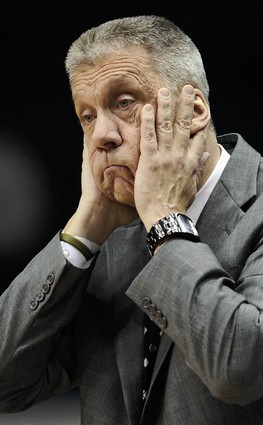
(Image from Chicago Tribune)
 FRANK THE TANK'S SLANT